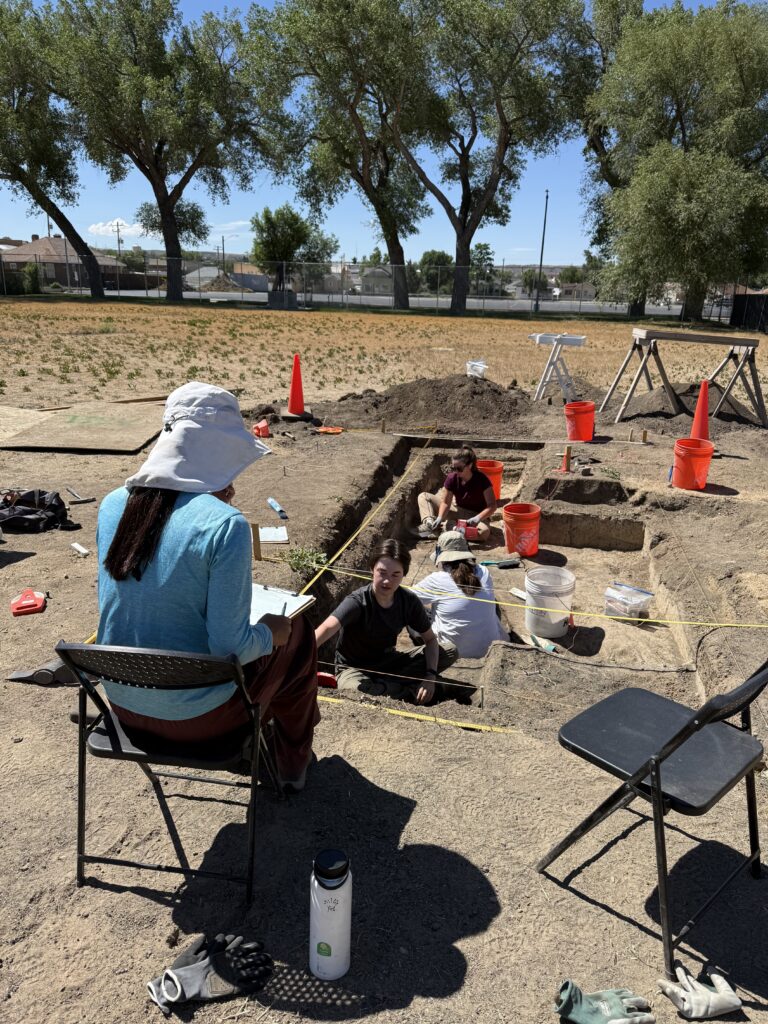
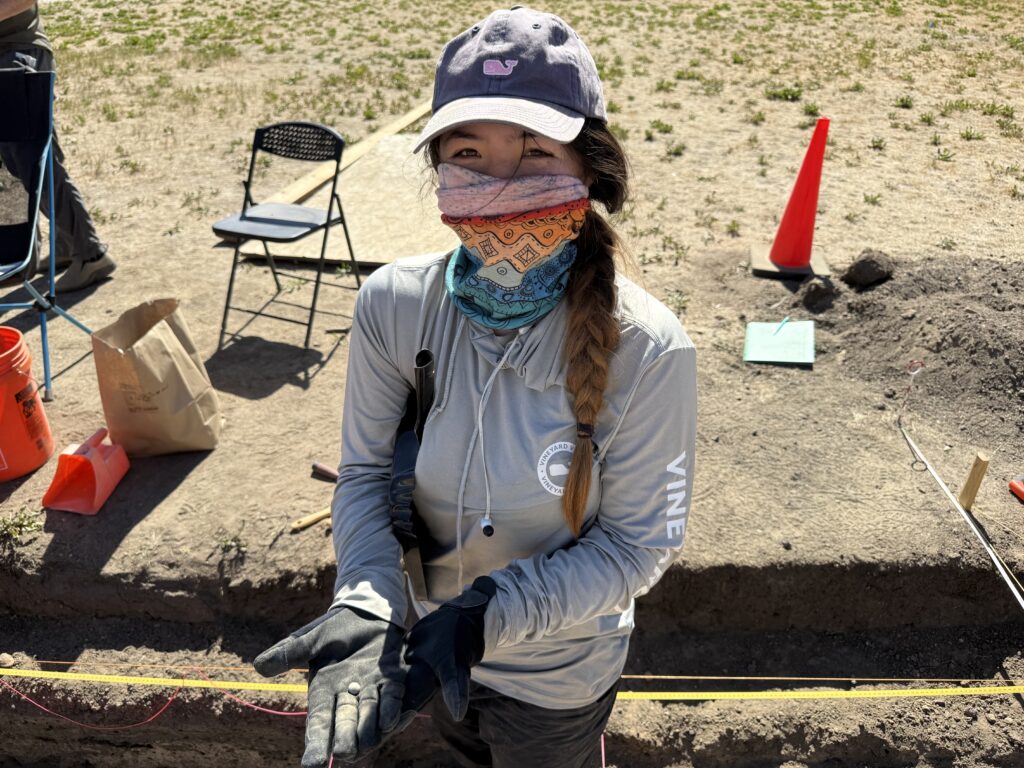
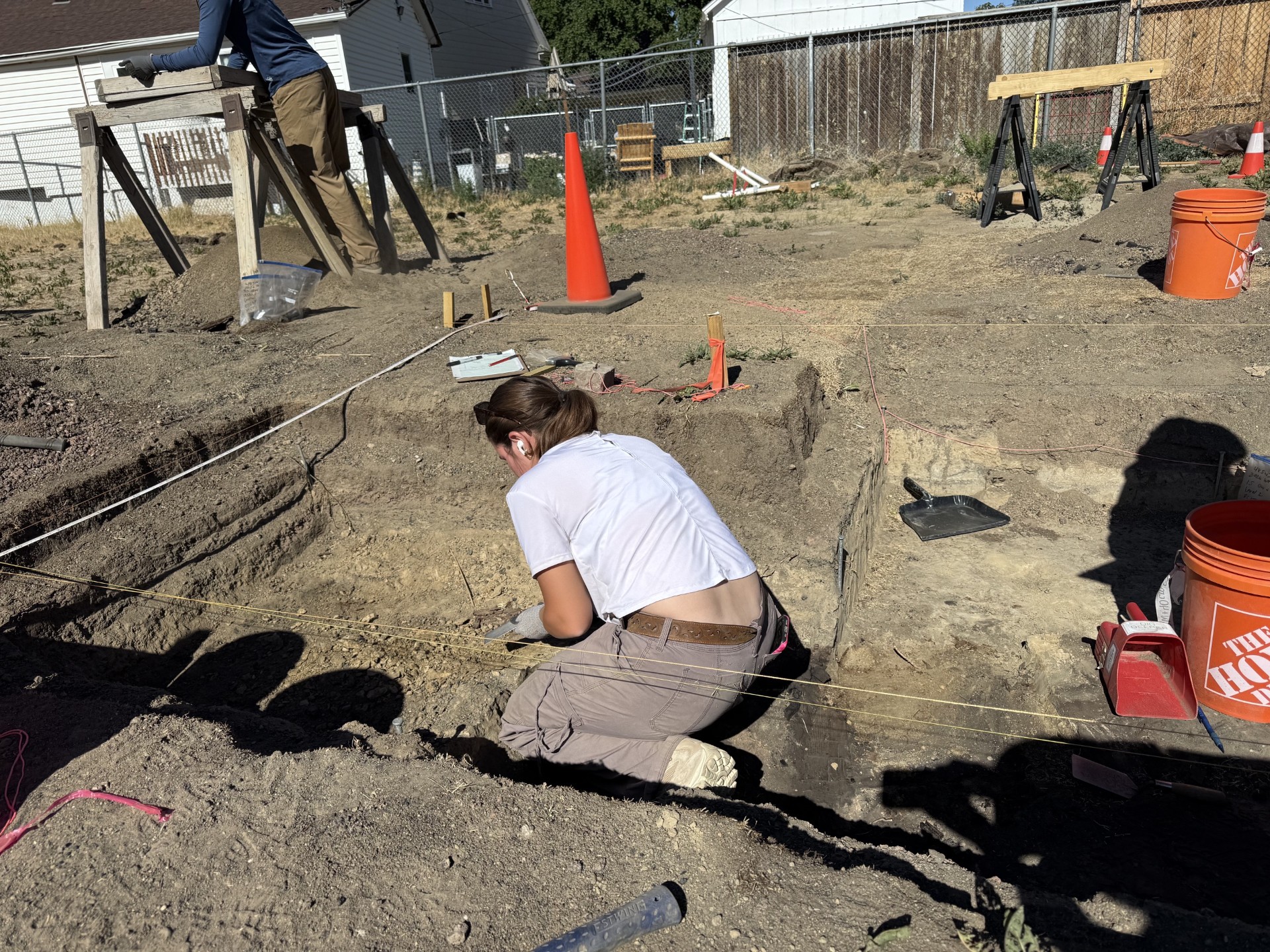
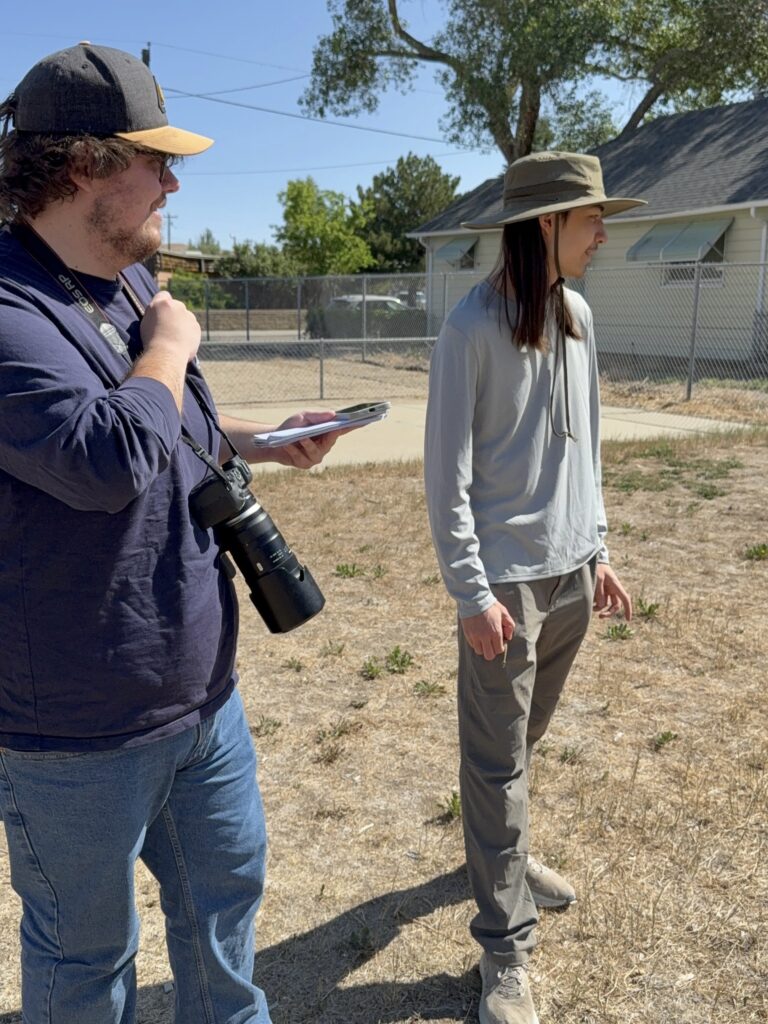
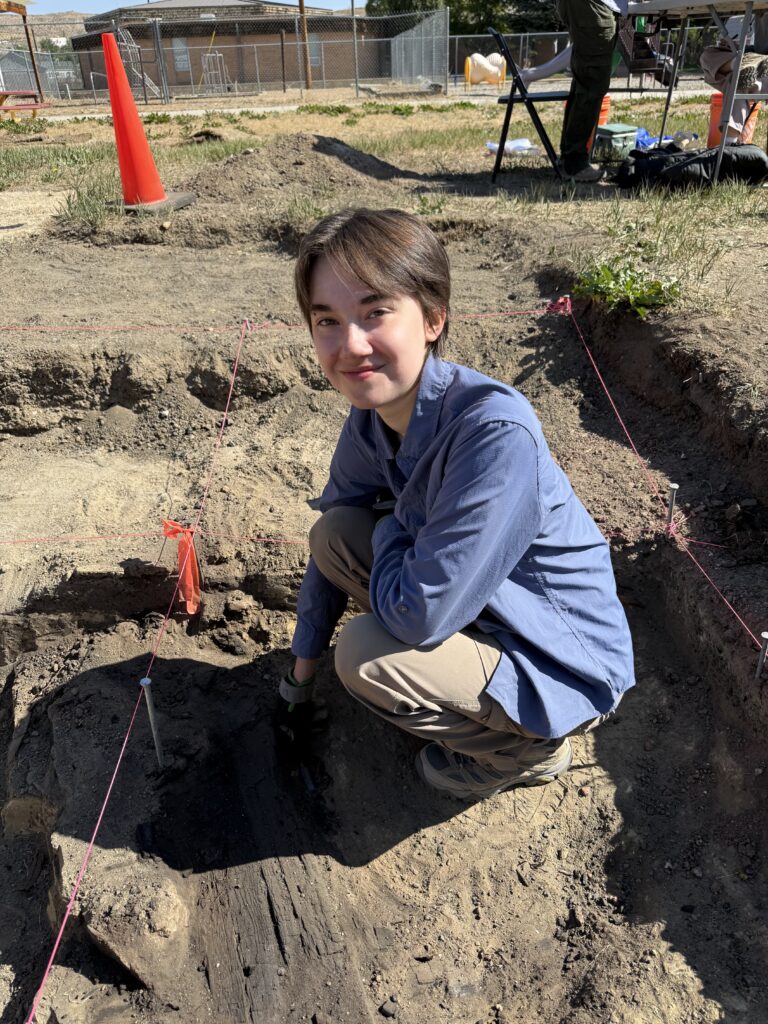
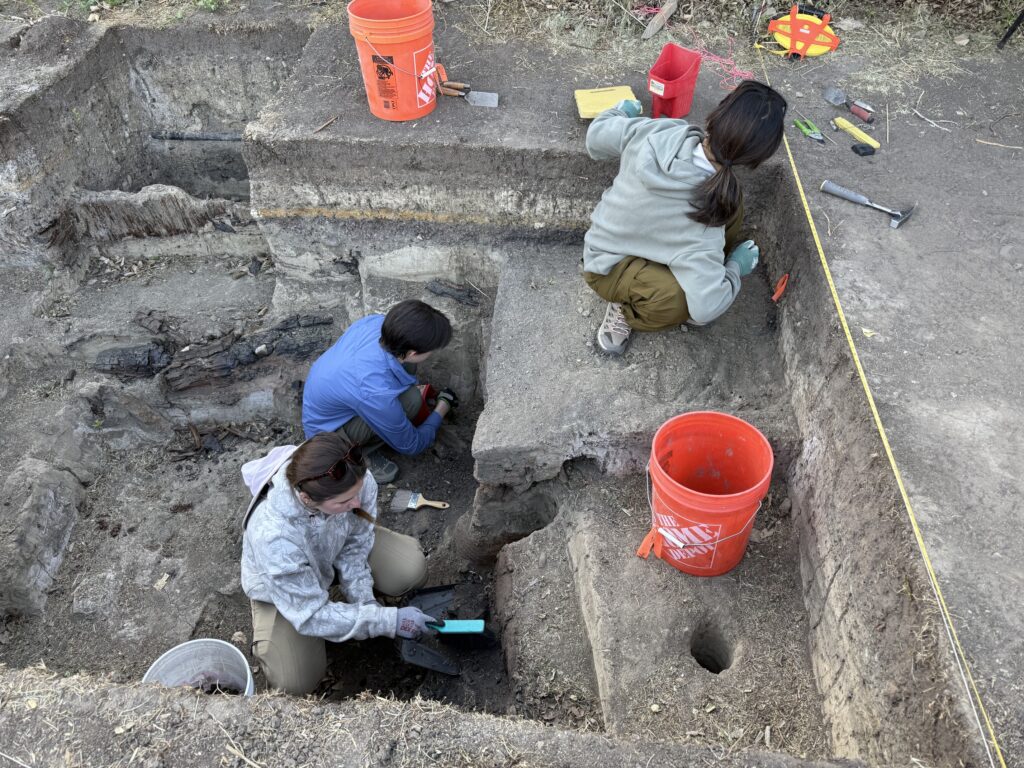
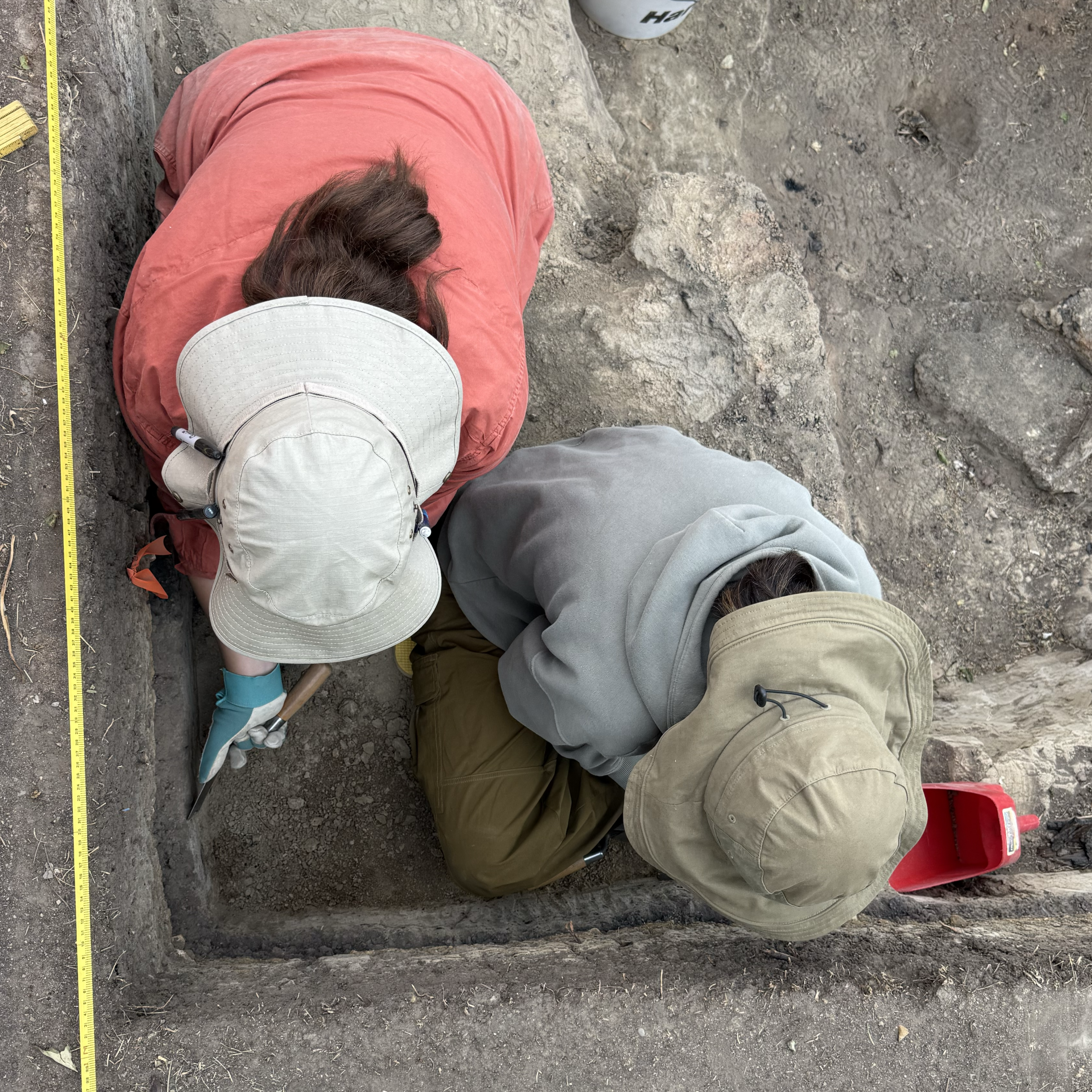
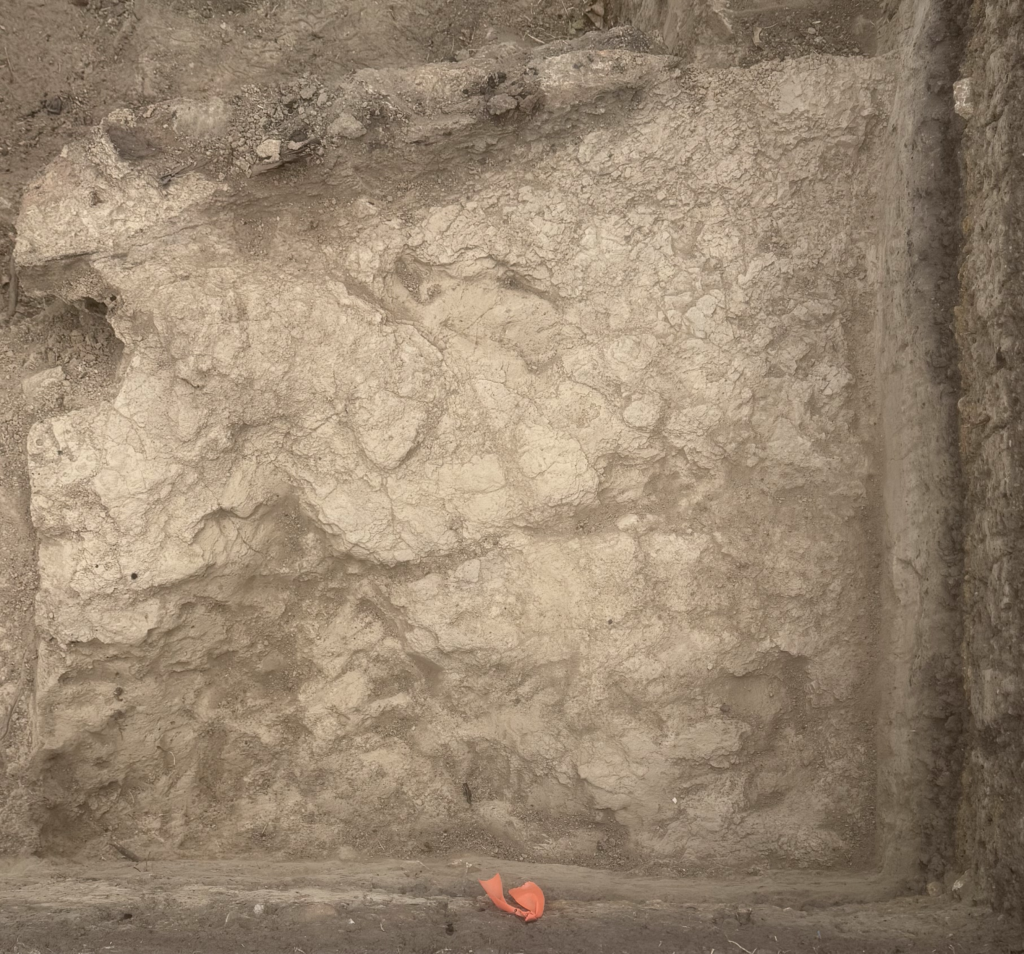
Hi all! This post marks the official launch of the Buried Chinatowns blog which features community-engaged archaeological research on Chinese diasporic communities.
All of the research featured on this blog is a collaborative effort between Dr. Laura W. Ng, undergraduate research assistants at Grinnell College, various archaeological research collaborators, and most importantly, descendant communities.
Final Week at the Rock Springs Chinatown Excavation
Hello everyone! It’s Emily, back with one final update from my last week working at the Rock Springs Chinatown excavation site.
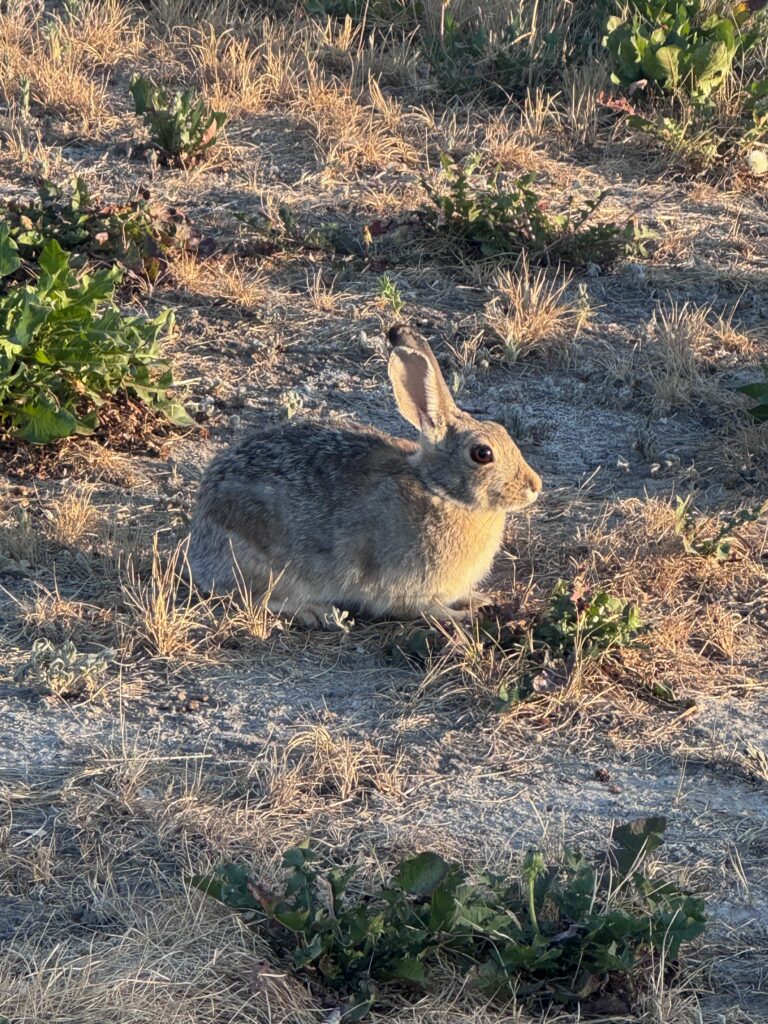
Our unofficial mascot, a rabbit that we saw nearly every morning eating weeds
Monday: July 6th
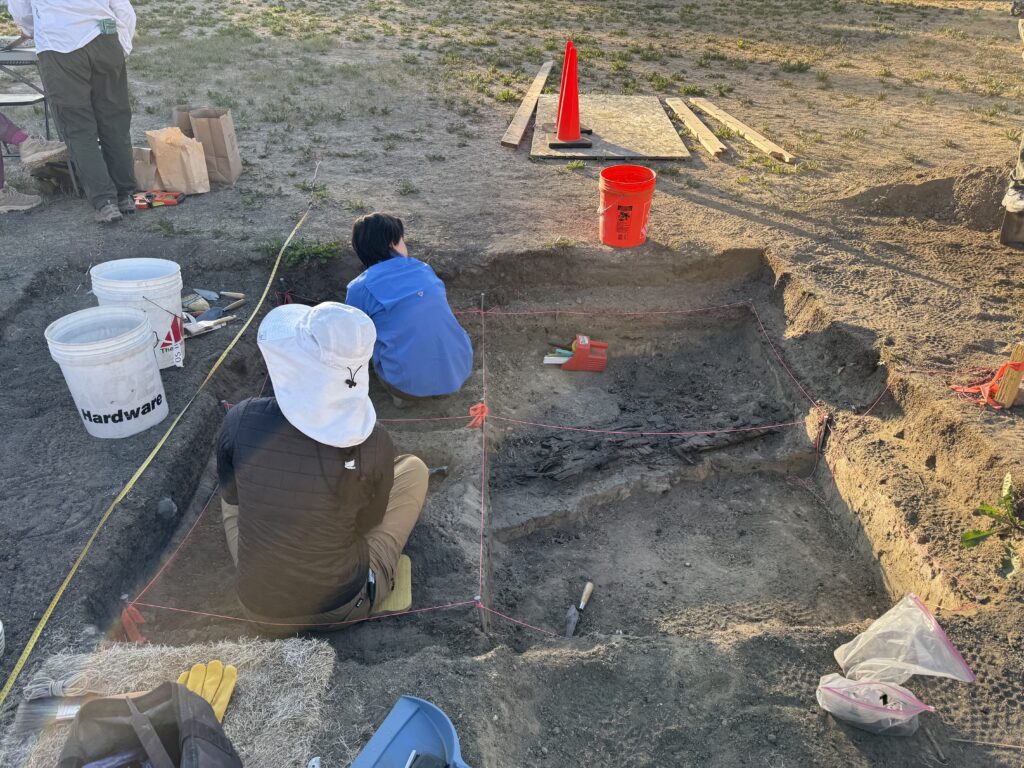
This week, we moved over to the western section of the site that Dr. Dudley Gardner had originally blocked off, and we were finally able to continue excavating there. Jenna, Paul, Lian, and I decided to leave the units we had been working on due to the lack of uncovering any wooden structural remains. Without those features, even if we found interesting artifacts, it would be difficult to place them into context, understanding where they came from, when they were deposited, and how they relate to the site is one of the most important parts of archaeology.
So, we started fresh in Units 0S0W and 2.6S0W, on the side of the site with absolutely no shade. New volunteers included high school student Colette from Los Angeles, Emma-Leigh who is originally from Georgia, and Pat and Siu Lin Santee from Salt Lake City, UT. Despite the heat, we made some exciting discoveries, including two completely intact medicine vials.
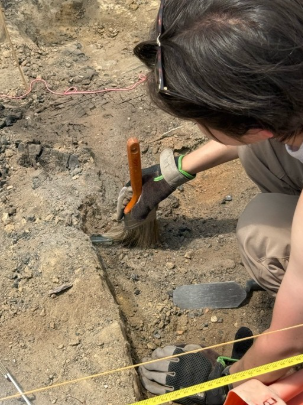
Jenna uncovering one of two Chinese medicine vials found
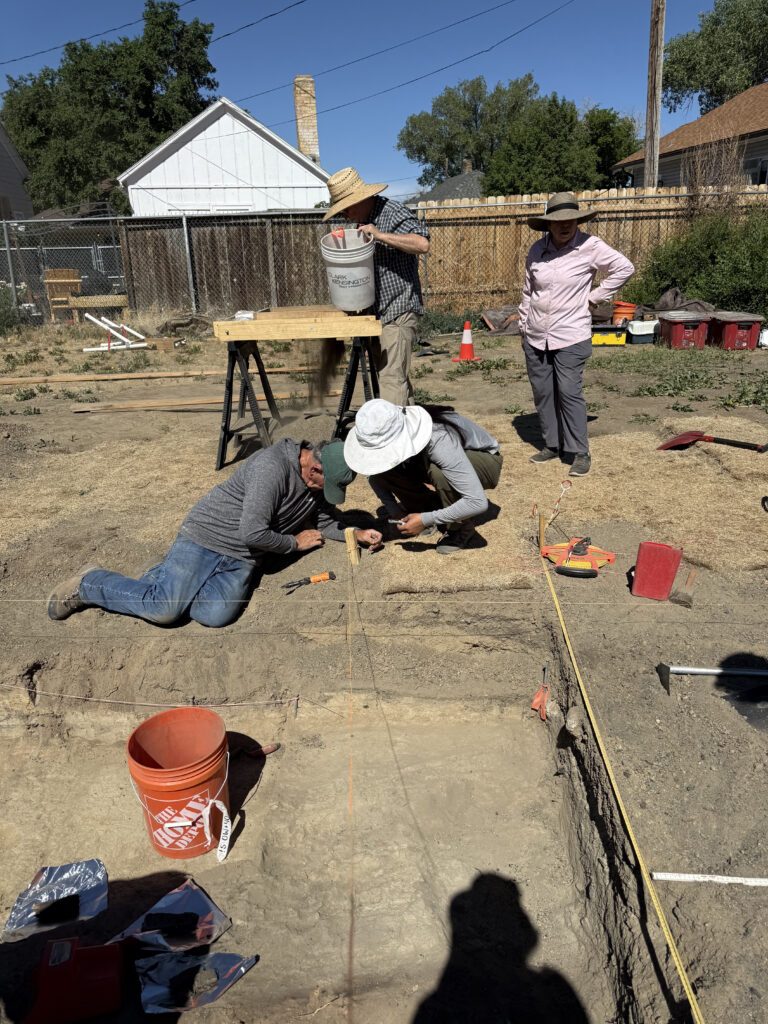
Pat (left) and Siu Lin (right) Santee screening one of many bucketfuls of dirt for us
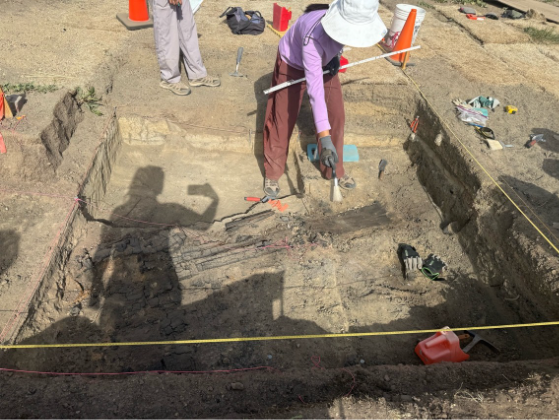
Meanwhile, in Unit 1S0W + 40cm South, Amber uncovered additional lumber, potentially floorboards, that continued through several units. They all ran in the same direction and sat right next to one another, making it clear that we were uncovering part of a larger structure.
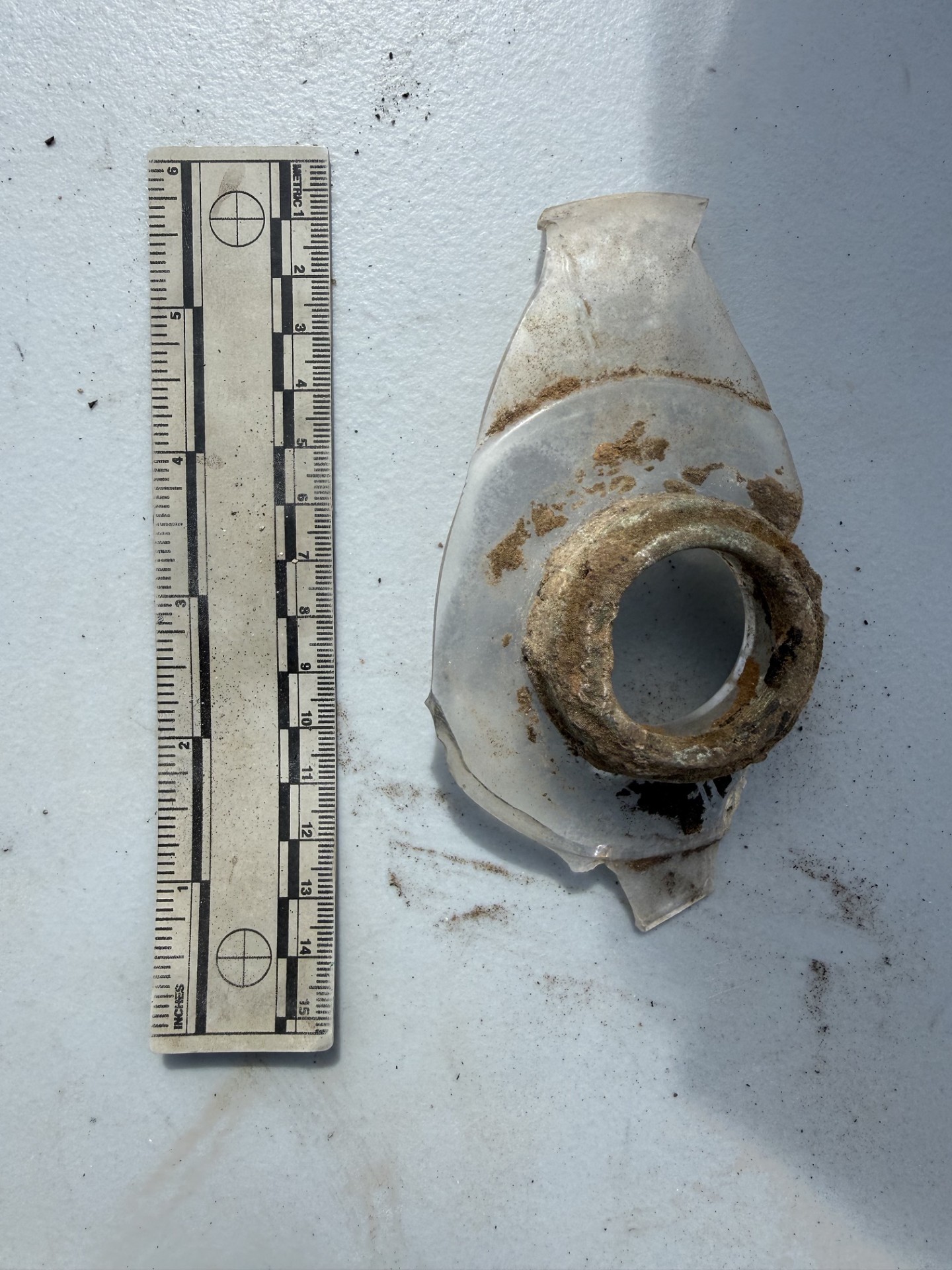
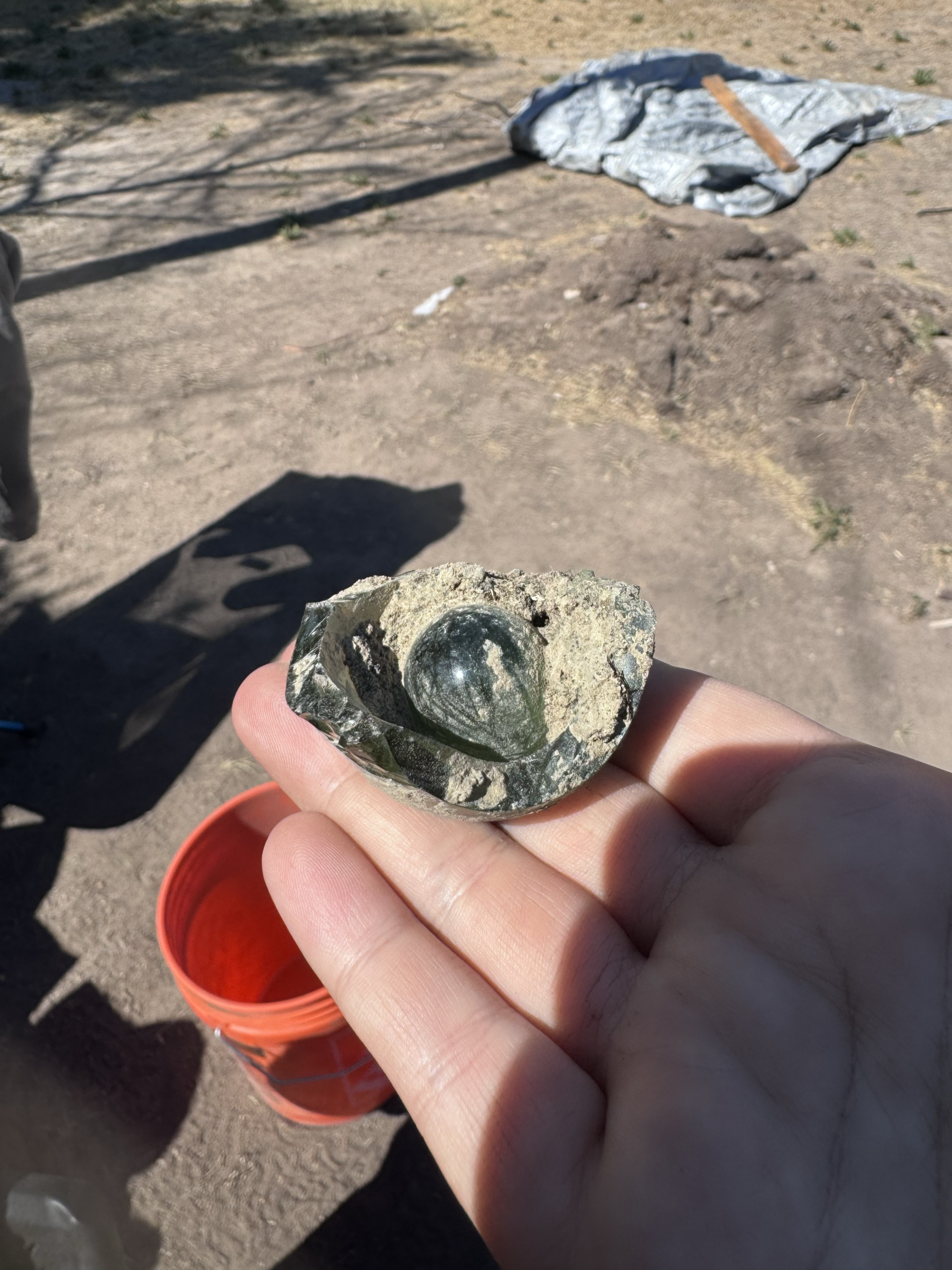
In Jenna’s unit, underneath several large wooden boards, she found a piece of curved glass with copper/brass metal covering the rim. Combined with other thick, clear glass fragments and several copper/brass rings we had found, we think these pieces may have belonged to a lantern.
Possible lantern fragment from unit 0S0W
Tuesday: July 7th
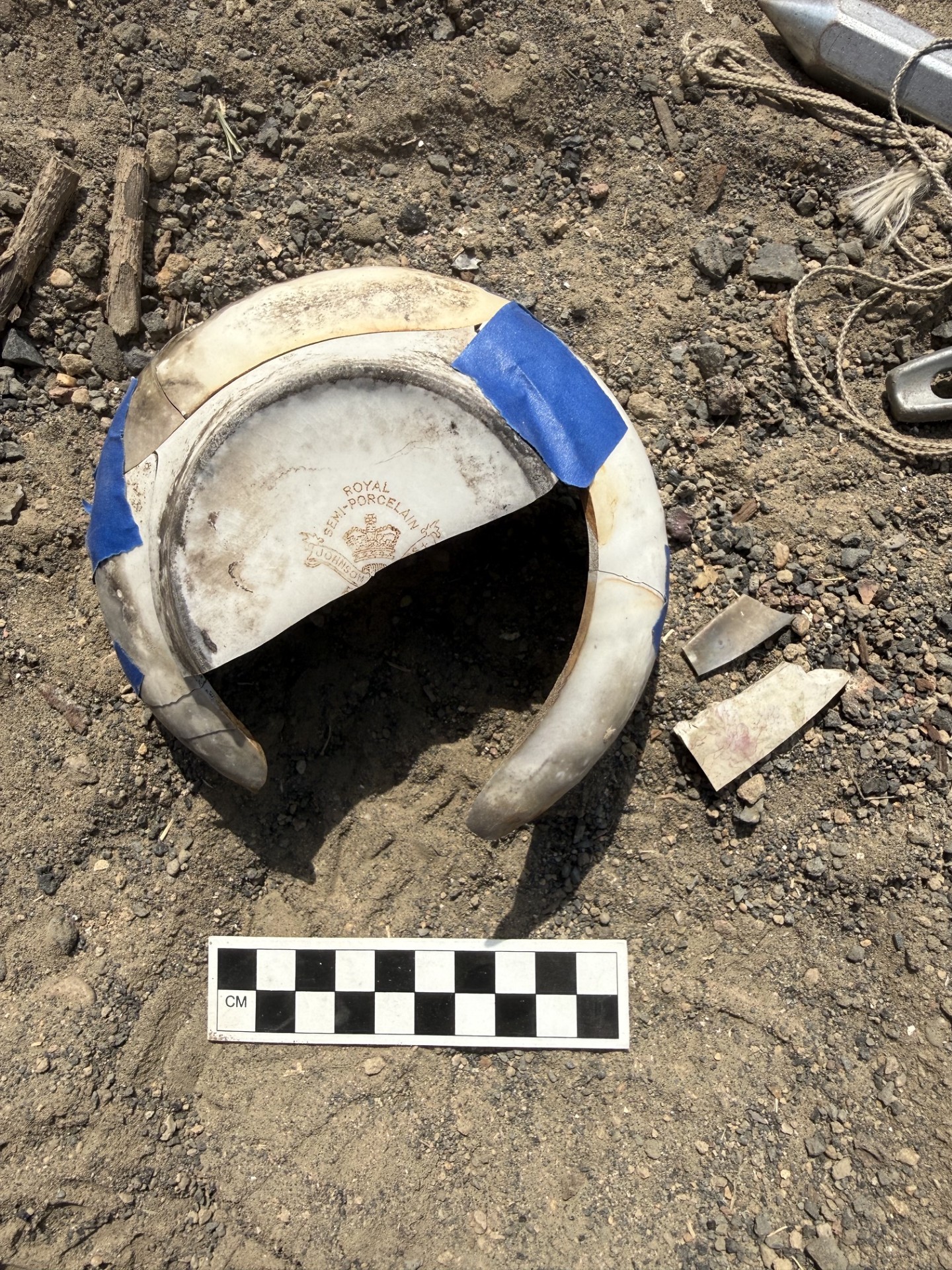
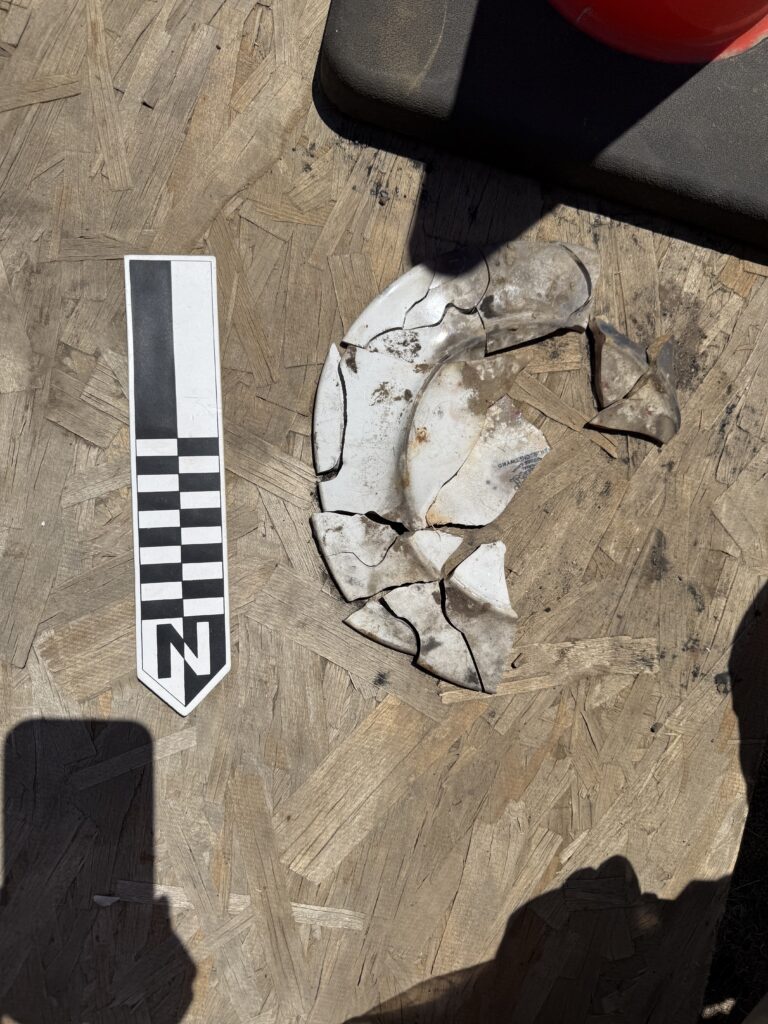
On Tuesday, we continued excavating the western section of the site. We uncovered a bowl, along with several other whiteware ceramics that still had makers’ marks, which will hopefully help us identify and date them. After some quick research on the maker, “Johnson Brothers” of England, and “royal semi-porcelain,” Professor Ng believes this bowl was manufactured after the massacre. The bowl interfaces with the charred wood and has evidence of being in a fire. We will use this bowl, in conjunction with the stratigraphy and other evidence, to determine if this structure was from the original or rebuilt Chinatown.
Whiteware bowl with an English maker’s mark
Whiteware plate with a maker’s mark
We also finished mapping much of the burnt wood we had uncovered, especially the largest board that stretched from Amber’s Unit 1S0W + 40 cm into Alice’s Unit 0S1W. Once it was documented, we wrapped the wood samples in foil so they could be identified later.
Colette is brushing off the large wooden board that stretches across multiple units
After lunch, Dudley took Jenna and me to another historic site where he spends much of his time at, Fort Bridger. Last week, he took Alice and Amber, so it was finally our turn.
After about an hour-long drive, we arrived at the museum, where Dudley gave us a tour and shared the history of the site. It was fascinating hearing about the work he has done there as the site’s archaeologist. He even had us help tidy up part of the excavation before showing us more of the area.
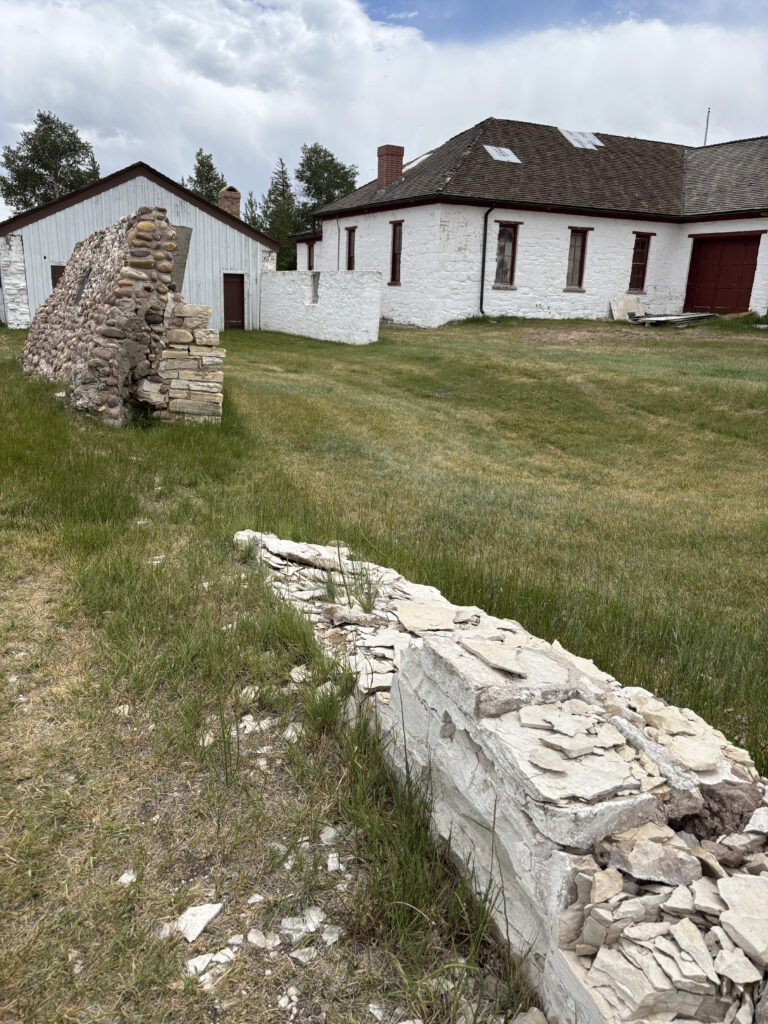
Fort Bridger State Historic Park. Photo by Alice Yan when she visited the site
The highlight for me was seeing the original Mormon wall and learning just how important Fort Bridger was as a stop along major western migration routes like the Oregon Trail.
After touring the site, Dudley took us to his workshop, where we helped catalog artifacts from one of his previous excavations at Eagle Rock, a prehistoric site in Colorado. It was interesting to see the different types of stone that people used to make arrowheads. To top off the day, he took Jenna and me out to dinner to thank us for helping him, which was incredibly kind of him.
Wednesday: July 8th
On Wednesday morning, we were back at the Rock Springs site.
In Lian’s unit, she uncovered a massive tin container that looked more like a bucket than a typical tin can. It had a very large diameter but was surprisingly shallow. Even with its shallow depth, we found traces of what may have been stored inside. There was a lot of burned organic material, including shells that we couldn’t confidently identify.
As Lian continued bringing her unit down to match the surrounding depths, she uncovered a large sheet of woven bamboo matting. Although it had turned black over time, the weave pattern was still clearly visible. Because it was sitting directly on top of the floorboards that extended across multiple units, we think it may have been part of a floor mat.
On Jenna’s side of the excavation, she and Alice opened Units 1N1W and 1N0W to continue following the wooden beams and determine whether the structure extended even farther than we had already uncovered. Emma-Leigh also opened a new unit, 3S0W, and removed the sod layer to begin excavating.
Jenna is excavating unit 1N0W and Colette is helping with paperwork
Sadly, this was Lian’s last day with us. After spending the past several weeks working together, we wanted to give her a proper goodbye. After work, our crew went to Pinup Coffee together, grabbed drinks, and spent some time together before saying goodbye to Lian.
Lian Lew with a white Chinese gaming piece
Thursday: July 9th
Thursday, I was back to excavating. I took over Emma-Leigh’s unit, 3S0W, and worked on bringing it down to the same depth as the surrounding units.
While digging, I found two medicine vials along with several pieces of wood that didn’t appear to be part of the main floorboards because they were much higher in the soil. One larger board connected to Lian’s unit, so I mapped it, removed it, and collected it for testing. One thing that stood out was that only part of the board had been burned.
Amber took over Lian’s unit, 2.6S0W, and continued bringing it down to the floorboard level. As she excavated, she uncovered even more boards that connected perfectly with the others, giving us an even better picture of the structure.
Here I am excavating unit 3S0W
Friday: July 10th
My goal on Friday was to finish excavating my unit and bring it down to the same depth as the others. However, as I dug farther, I realized I had reached sterile clay.
After asking Professor Ng how to proceed, I cleaned the surface of the unit to expose the sterile clay and document how the structure had originally been cut into it. The angle of the clay lined up with the surrounding units, running northwest, and even matched what had been documented during the 2025 excavation on the east side of the side.
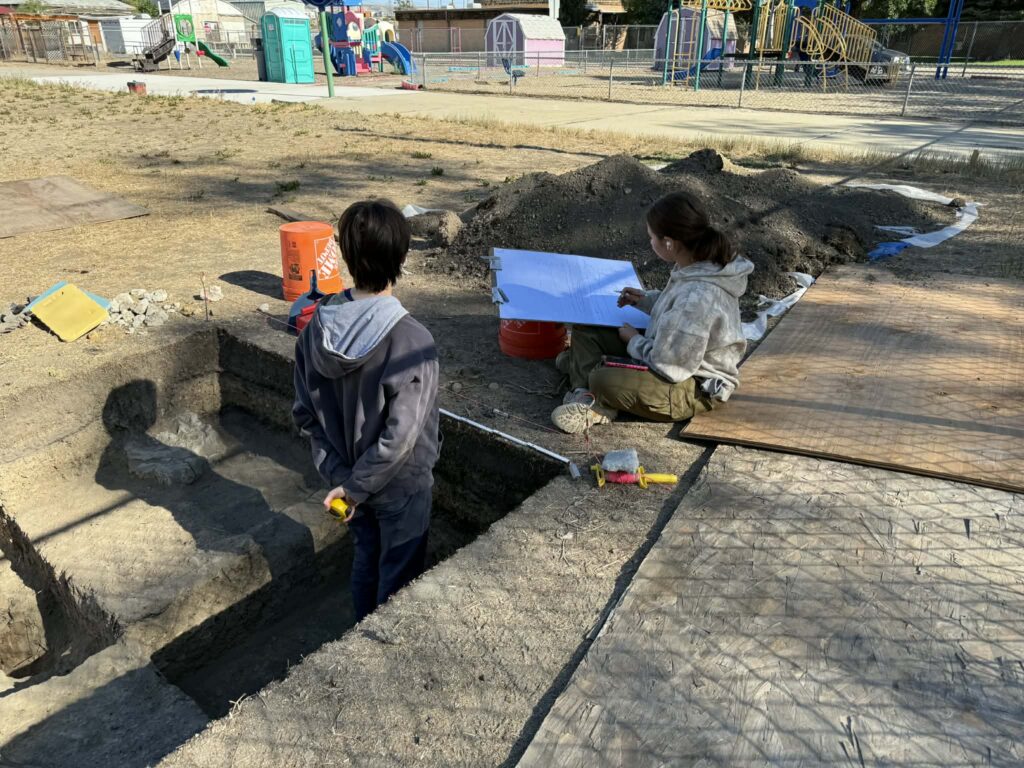
Once my unit was finished, I helped Amber and Professor Ng clean Unit 1S0W. Since it was our last full day on site, we wanted to make as much progress as possible before wrapping everything up.
Jenna worked incredibly hard trying to reach the floorboards in her unit. Although she ran out of time before getting all the way there, she uncovered a remarkable amount of wood along the way.
Jenna is collecting the elevation depth of wooden boards in unit 1N0S
Saturday: July 11th
On our final day, we returned to our original excavation units to finish documentation.
Jenna and I mapped the north wall profile of previous excavation unit, 20N2W, recording the different soil layers we had excavated. This profile will help place the artifacts we recovered into a clearer archaeological context. Amber and Alice returned to the 2025 excavation to map the south wall profile of Unit 6N2W, where they had spent their first two weeks excavating.
Jenna and I profiling a previously excavated unit
After finishing all of our paperwork, we covered our units, and packed up our equipment. We briefly attended the 100th Anniversary of Rock Springs International Day, which celebrates the city’s immigrant history, and then began the drive back to Grinnell College.
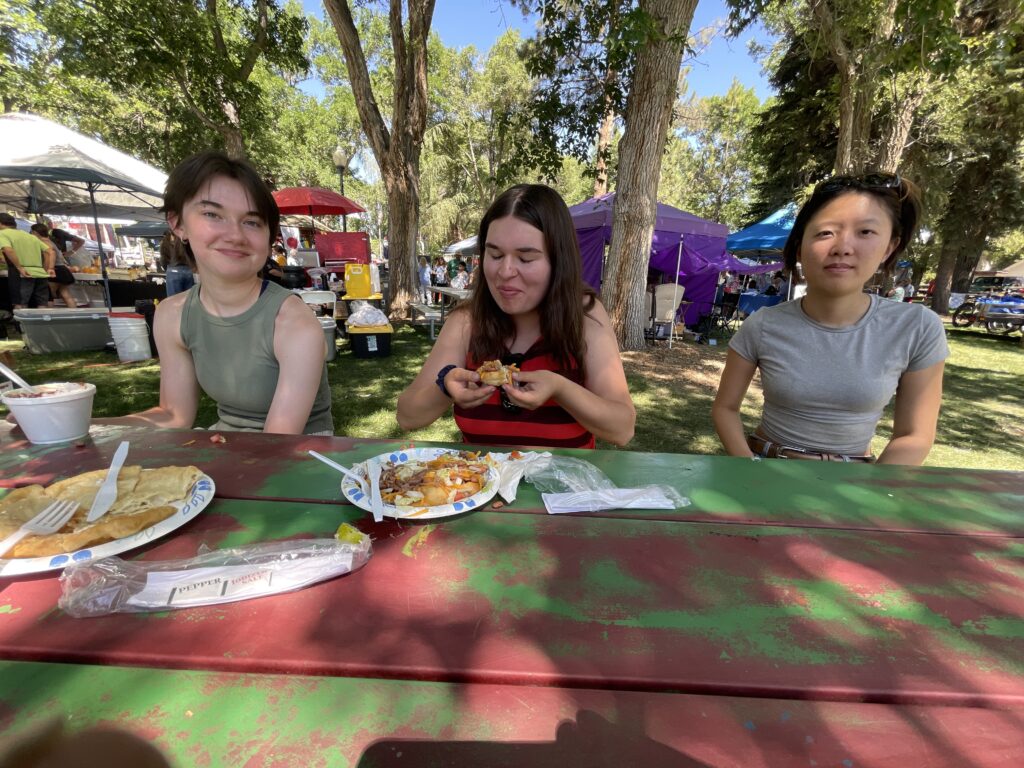
L-R: Jenna, Amber, and Alice at International Day enjoying Mexican-style corn and fry bread Photo by Dudley Gardner
Food Donation Acknowledgments
The project would like to thank Jeff Yee Litt for treating us to ice cream at Wild West Candy Parlor, Kori Brown for a gift card that was used twice at Pin Up Coffee, Ricky and Grace Leo for dinner at their house, Mark and Susi Leo for dinner at their restaurant China Garden, Robert Lew & family for dinner at Taqueria Ariela ́s Ara, Bill Lew for providing kolaches from Cowboy Donuts, Pat and Siu Lin Santee for bringing portuguese egg tarts from Salt Lake City, the Wang Family for two rounds of Cowboy Donuts and dinner at Broadway Burger Station, Philip Lew & family for Domino’s pizza lunch, and two local Rock Springs residents who brought us donuts and fruit.
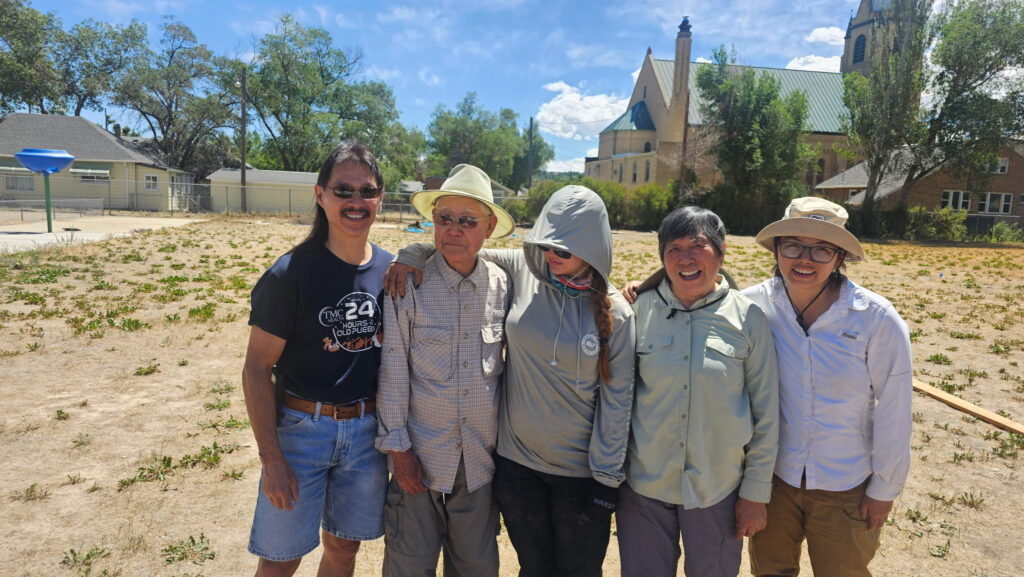
L-R: The Philip Lew Family, Siu Lin Santee, and Laura Ng
Bill Lew bringing us two boxes of kolaches from Cowboy Donuts
Dudley (standing right) talking with two local residents who brought us snacks over two days
Artifact Donation Acknowledgments
We would also like to thank the couple across the street at Bridger Avenue for donating artifacts found on their property from Camp Pilot Butte (1885-1898), a U.S. Army Camp installed because of the Chinese massacre, and to a local resident for donating several intact Chinese brown glazed stoneware vessels that her father-in-law retrieved from the 1960s construction of Washington School on Ahsay Ave.
Funding Acknowledgment
Thank you to all of the project funders and donors for making the 2026 field season possible.
Hello everyone! This is Jenna again, with an update on week three of four working at the Chinatown site in Rock Springs. On Monday, it was a cold start to the week with temperatures in the 40s and 50s while we were working and 20+ mph winds! However, we still had a productive day at the site.
Using the pick-matic, one of my favorite archaeology tools
Joining us on the site today and for most of the week were Bob Lew and his grandson Carson Lew-Williams, who are descendants of a survivor of the 1885 Rock Springs Chinese massacre. Additionally, Bob’s grandfather, Lew Fook, had worked in Rock Springs as a coal miner and later as a cook in the 1930s. It was good to meet them, especially since I am working on creating an ArcGIS StoryMap about their ancestors! After getting a tour of the site, they helped us out by screening dirt for artifacts from various units.
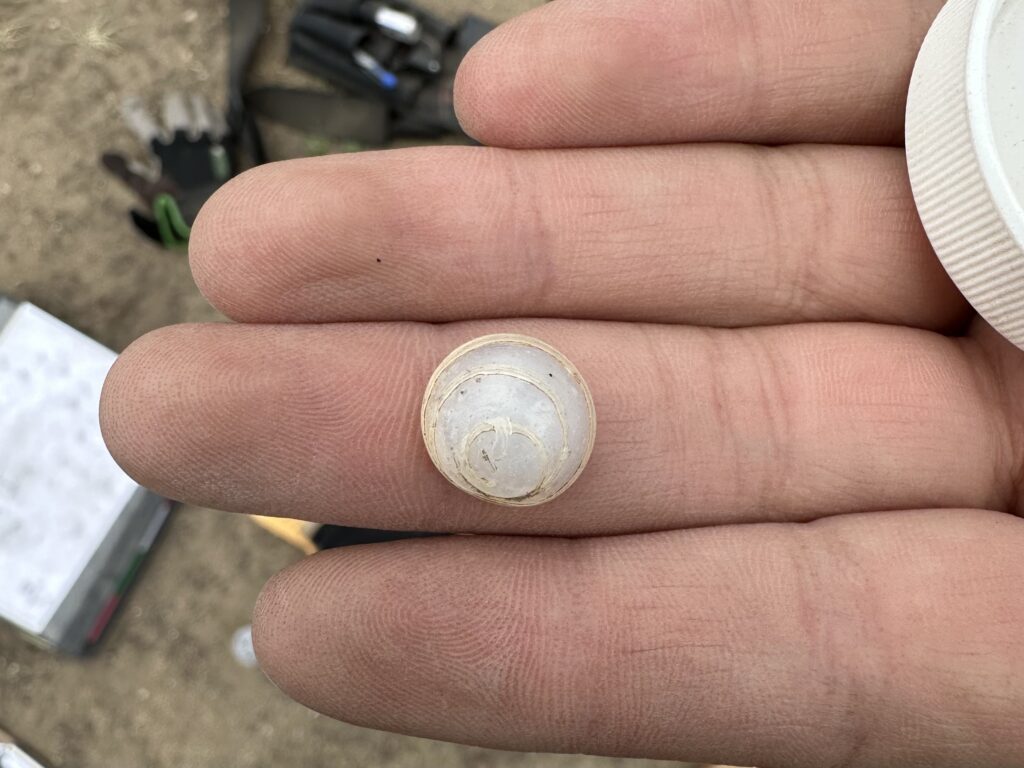
I spent most of the day on the west side of the site, continuing to excavate in the units opened by Dudley. Working together, Lian and I kept uncovering burned wood planks we found at the end of last week. These units are next to a basement that Dudley had excavated last year and found many artifacts in, so what we found here this week could be remains of the building that the basement belonged to. We also found many pieces of Chinese stoneware, window glass, and nails, which are further indication of a structure from the Chinatown. My favorite discovery of the day was a round white stone from a game the Chinese played called waikei (圍棋) in Cantonese. Dudley told us that its swirl pattern is unique to what has been found from the Rock Springs Chinatown site.
Dudley talking with Bob Lew and Carson Lew-Williams about the site
A white gaming piece that I found for the Chinese game of waikei (known as go in Japan)
Thankfully the weather on Tuesday was much nicer, which boded well for all the digging that was done. This day I moved back to the other side of the site to work on the new excavation units we opened trying to find another structure from the original Chinatown like the one excavated in 2025. Emily and I, with the help of Paul and Carson, opened two new 1×1 meter units to the north of the two units already started. We spent most of the day digging through the sod and clinker layers to reach cultural soil that could be screened for artifacts. Meanwhile, just south of us, Paul continued to dig in the other units, finding vertically oriented wood that could indicate a structure.
The other exciting discovery of the day was multiple pieces of a white earthenware saucer in adjacent units, which we discovered fit together! Additionally, in the other excavation area, Amber and Alice extracted the large tin can they had been digging down towards over the past couple weeks. The now empty can might have once held black powder based on its shape, opening, and other characteristics. Though all the digging made today a bit tiring, it was good to set up new units for the rest of the week.
Emily, Carson, Bob, and I straightening the sidewalls of the newly opened units on Tuesday
Emily, Paul, and I working on paperwork while Bob, Carson, Alice, and Dudley screen dirt
Wednesday was another day of heavy digging in the same excavation units as Tuesday. We got through the clinker layer and found concrete in one of the units. There were also more vertical planks uncovered in northwest corner of unit 19N 3W. We were joined again by Carson and also by Collette Wang, a high school student from Los Angeles who learned about the project through The New Yorker article. She has already been a big help to the project having done data entry of artifact catalogs, and this week she helped at the site as well. Her and Carson contributed to a lot of the screening today! We were also visited by a reporter from Sweetwater Now who spoke to Professor Ng about the site and Carson about his family history in Rock Springs.
On Thursday, Emily, Paul, Lian, and I continued working in the units in the northeast part of the site. Since we had gotten through the clinker layer yesterday, we were anticipating more remains from the Chinatown in the stratigraphic layer we were digging through today. Though we didn’t find any structural remains like we were hoping for, we did find various artifacts including an opium bowl, a medicine vial, ceramics, and glass bottle fragments. Later in the day, Paul also opened up a new unit at 19N 4W, west of the vertical planks we found a couple days ago with the goal to uncover more of that feature.
Meanwhile, on the west side of the site, Carson, Collette, Amber, and Alice worked with Professor Ng on the units that Lian and I dug on Monday. They uncovered more burned wood planks and made many other exciting discoveries including a whiteware plate and a harmonica. After researching and writing about Chinese medicine vials last month, I especially appreciated the intact medicine vial they found!
Carson talking to reporter
Pointing to medicine vial found next to burned timber on Thursday
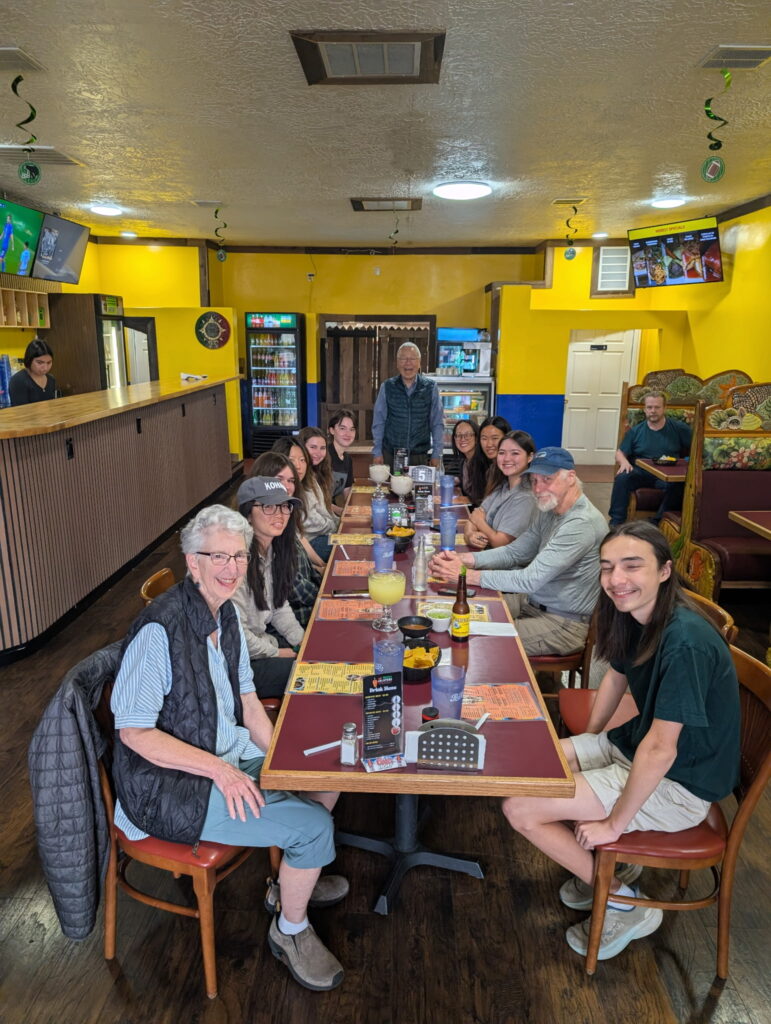
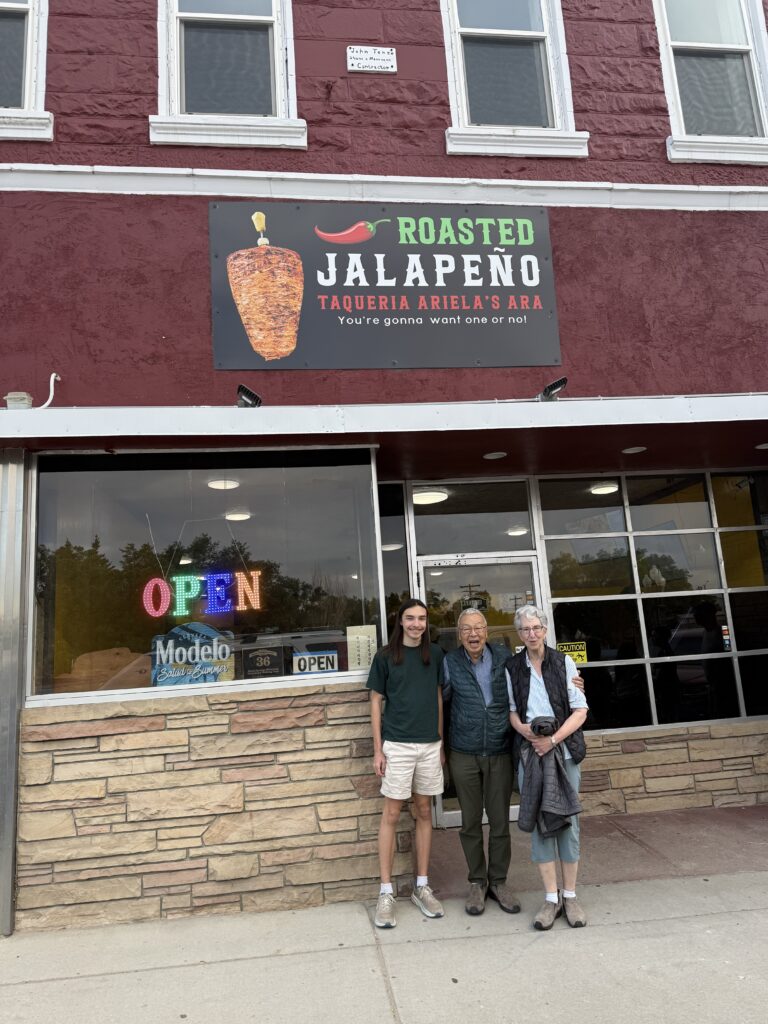
In the evening, Bob Lew treated all of us to dinner at Taqueria Ariela’s Ara on 117 K Street. Before it was a Mexican restaurant, it was called the New Grand Cafe and run by Chinese immigrants such as Leo Hung and volunteers Ricky and Grace Leo’s families. And before the New Grand Cafe, it was a restaurant called North Side Cafe; this is especially significant for Bob, as his grandfather Lew Fook worked there as one of seven partners and a cook in the 1920s and 30s. It was a great meal, and a good time to talk to everyone working on the site and learn more about Bob’s family history.
Excavation team at dinner on Thursday at Taqueria Ariel’s Ara
Carson, Bob, and Marion in front of the former North Side Cafe
On Friday, Emily, Paul, and I wrapped up the group of excavation units we had been digging for the past few days. Though we started digging those units with the hope of finding another basement structure like the one excavated last year, after finding disturbed soil deposits and no structural remains, we decided to finish the excavation of that area. We ended up determining that the wood feature we found on Tuesday is a utility pole, likely from when the Washington School was located on the site, which also explained the concrete. Though this was disappointing, significant results aren’t guaranteed where we dig, even if we know Chinatown was located in this area.
However, the rest of the team that continued excavating on the west side of the site made more exciting discoveries today. About half of a whiteware plate was excavated, with a maker’s mark revealing that the plate was made in 1872. Unfortunately, Carson had to leave in the late morning, but it was good to see his grandparents Bob and Marion one more time before they departed. I appreciate their support, especially because seeing the impact of the excavation and research of the Rock Springs Chinese for descendants provides extra motivation! I’ll be thinking of Bob’s kindness and enthusiasm for the project as I continue researching his family’s story over the rest of the month.
Collette and I digging early Saturday morning
For the last day of week three, all of us moved over to work on Dudley’s units on the west side of the site. A former student of Dudley’s, Emma-Leigh, also joined us to help with the excavation. Early in the morning, there was an exciting moment when I found my first Chinese medicine vial!
Otherwise, I found mostly smaller fragments of glass and ceramics in the unit I was digging, as well as scattered smaller pieces of rotting wood. In the unit she was digging, Collette also found more burned and unburned wood structural remains, and another part of the harmonica found earlier. In addition to continuing to dig in the other excavation units, new units to the south were also opened to be dug more next week.
Excavating the glass Chinese medicine vial
Working at the site on Saturday
In the evening, we celebrated the Fourth of July holiday by driving to North Rock Springs to watch the fireworks. It was an impressive show, and a great way to finish the week!
Funding Acknowledgment
Thank you to all of the project funders and donors for making the 2026 field season possible.
Hello all! Amber here! In this post, I will be giving the highlights along with the progress made this week in excavating unit 6N 2W, which is a continuation of the 2025 excavations. Fair warning, there are a lot of pictures containing butchered animal bones found this week, in case that’s something you’d rather not see.
Monday, June 22nd
Today, our crew: Professor Laura Ng, Paul Hoornbeek, Dr. Dudley Gardner, Lian Lew, Alice Yan, Emily Gonzalez, Jenna Mack, and myself, resumed our activities from last week.
Picking up where we left off last week, Alice and I excavated and screened the clinker layer (Stratum D) of unit 6N 2W. In this layer, we mainly found melted glass along with a few unmelted shards.
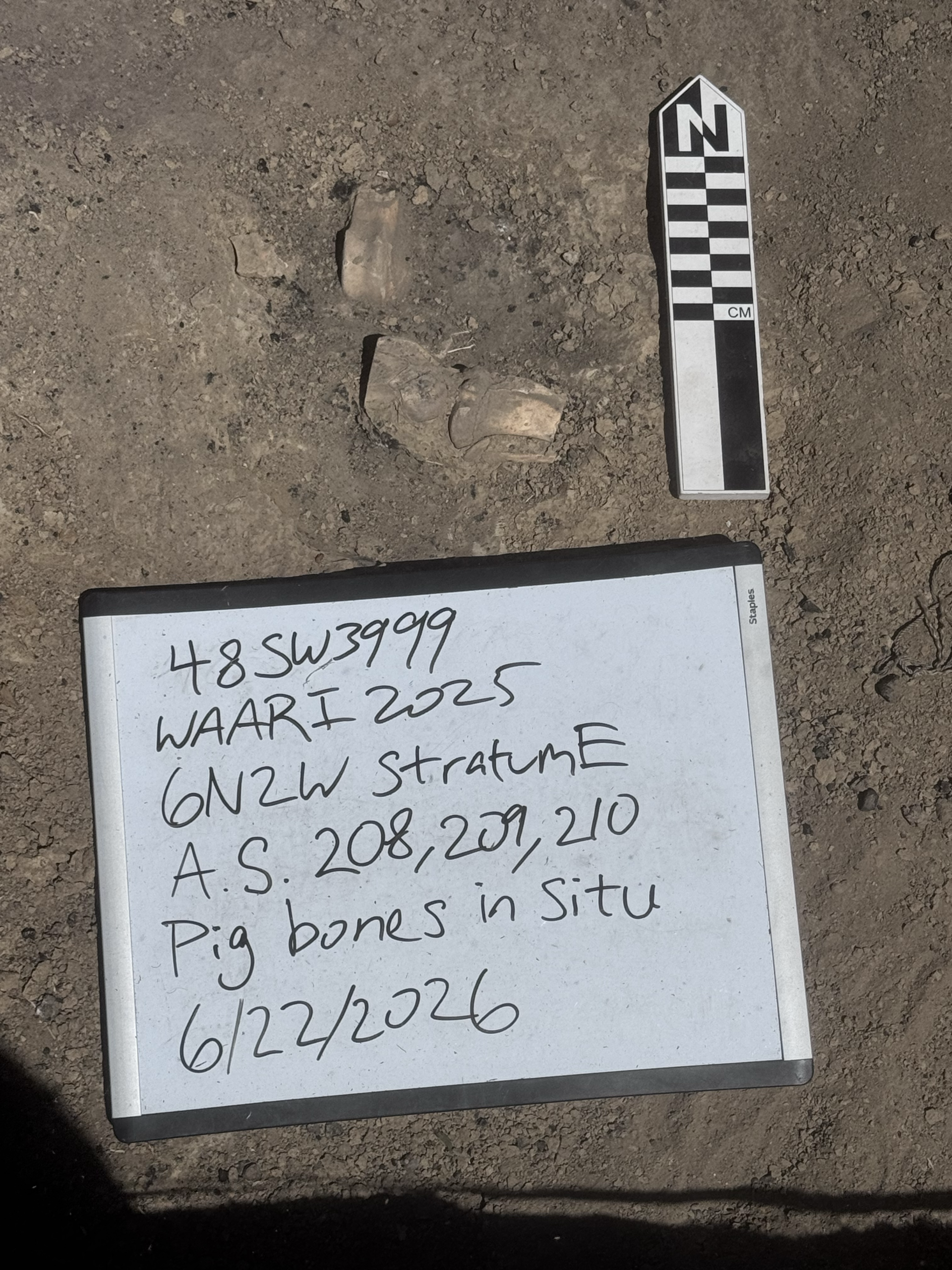
We then began excavating the next layer of soil, Stratum E, which felt more compact and contained flecks of charcoal. Some of the artifacts found today included: an olive-green glass push-up from the base of a bottle (below left), the base of a CBGS liquor bottle, a small copper disk, and some butchered animal bones (below right), probably from a pig.
Olive glass bottle base push up
Pig bones in situ
Later in the day, we were joined by John Partain, owner of the Slovenski Dom (Slovenian Hall) to our west, who has been “excavating” his basement, which contain artifacts from the Rock Springs Chinatown.
Tuesday, June 23rd
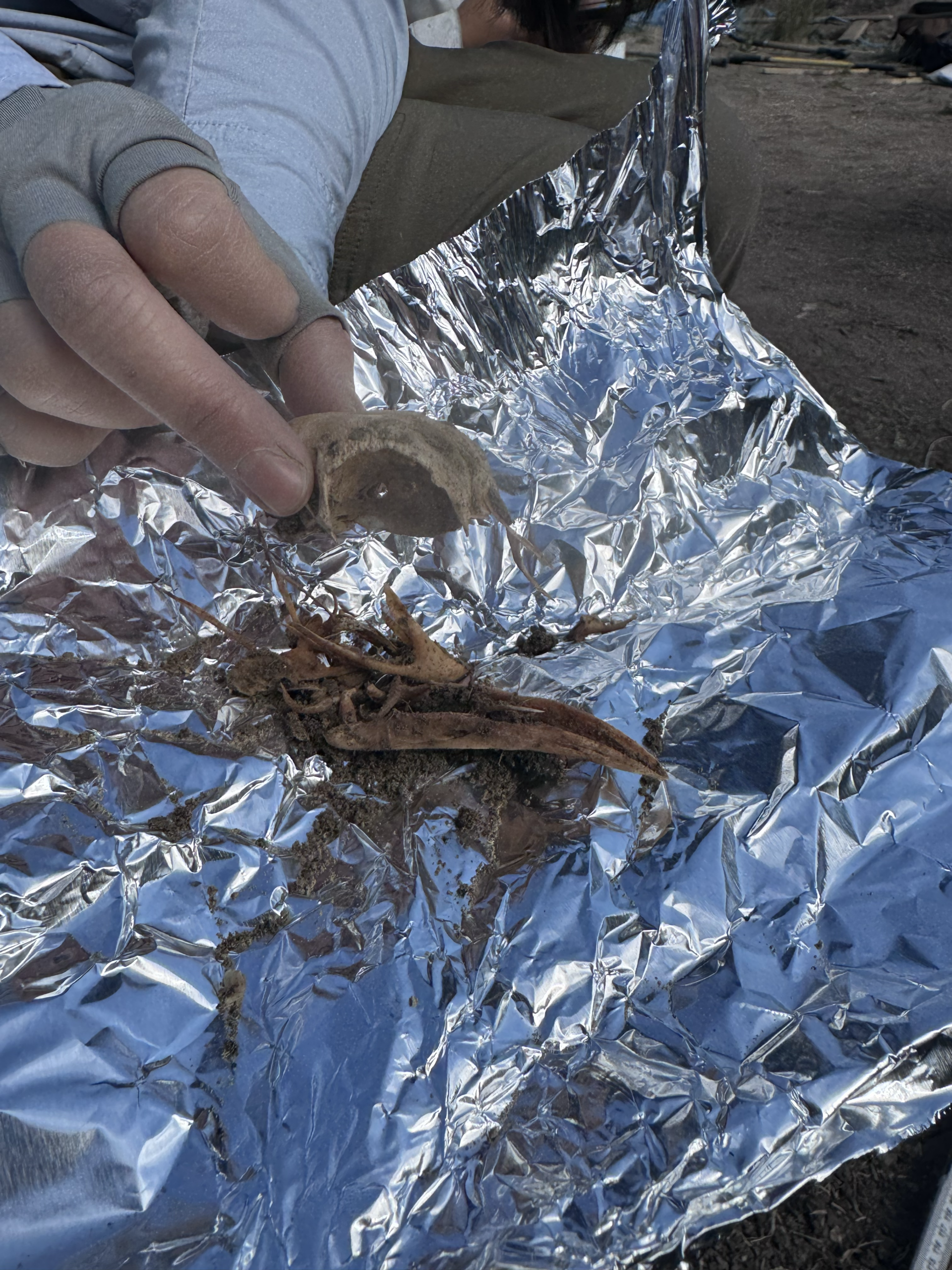
Today, Professor Ng, Alice, and I continued excavating in stratum E of the unit 6N 2W, while Jenna and Emily worked on the neighboring unit, 6N 3W (left photo). Near the bottom of this unit, they found a chicken skull (middle photo) and we continued to uncover more animal bones in unit 6N 2W (right photo).
(L-R): Emily, Jenna, and Alice excavating in area started in 2025
Chicken skull from 6N 3W
Butchered animal bones from 6N 2W
Beneath the bones pictured above, we uncovered a fragment of a Four Seasons patterned rice bowl base (left). In a different area of 6N 2W, we found the neck and finish of an amber-colored bottle (right). Interestingly, these are directly on top of burnt wooden lumber that the 2025 team calls the “Burn Layer.”
Four Seasons rice bowl base
Amber bottle neck and finish
Other finds in this unit not pictured include: fish bone, flat metal, unglazed ceramics (possibly lids), CBGS, and olive glass (possibly from the same bottle as the push-up found the previous day).
Wednesday, June 24th
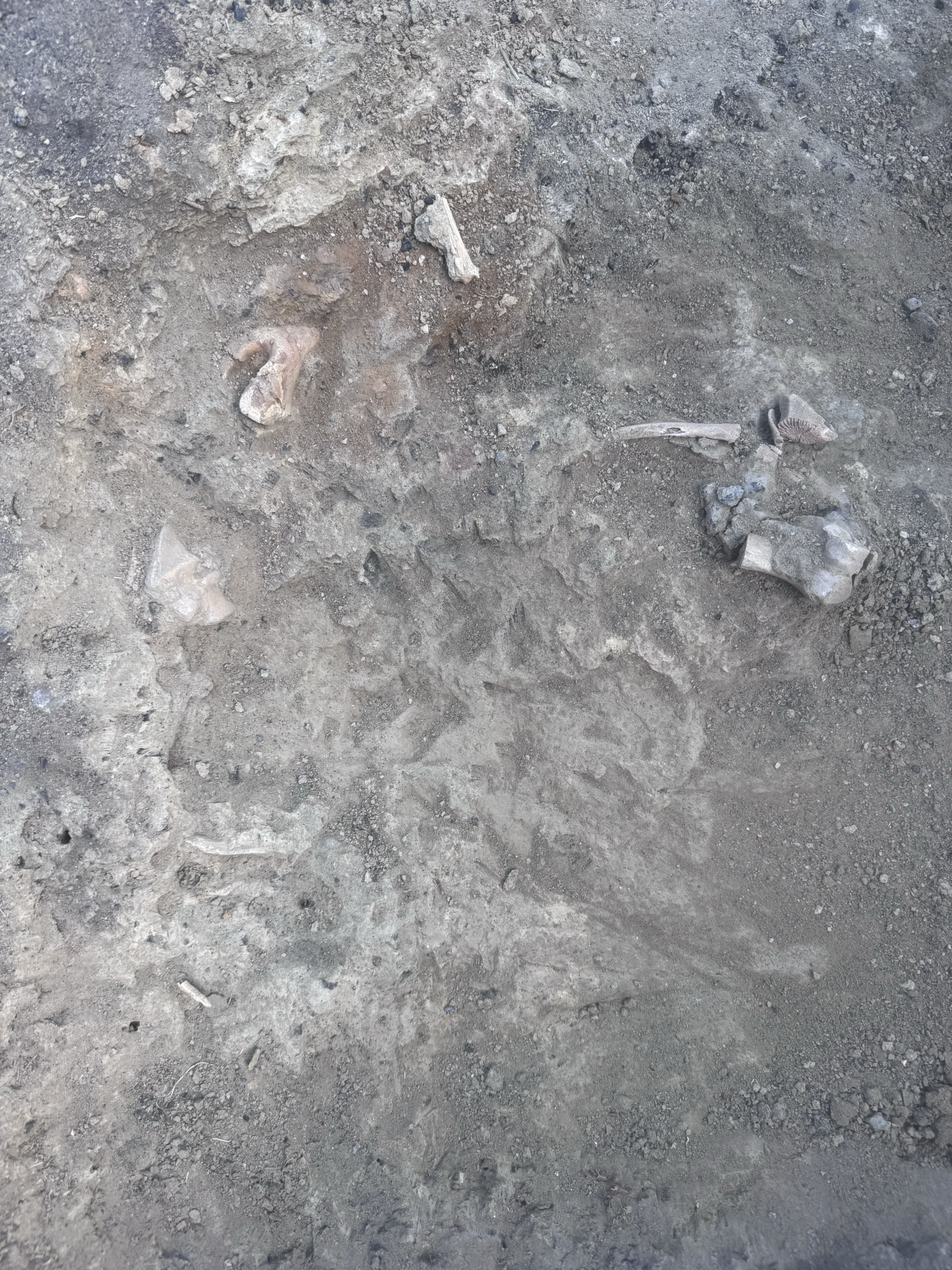
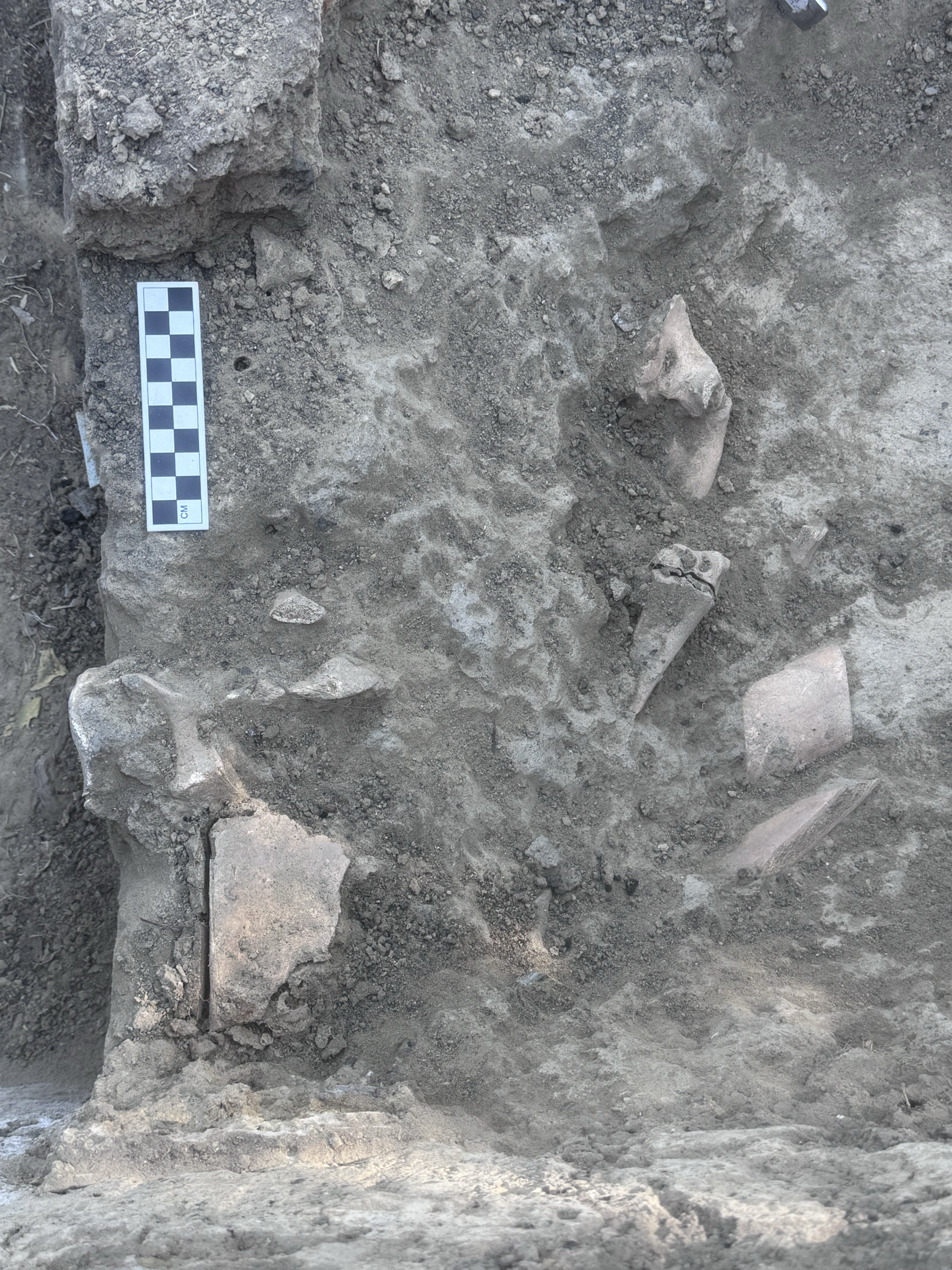
Today, we continued excavating Stratum E of 6N 2W. As we dug further down, we came upon even more animal bones! At first, we saw some medium-sized bones, which we assumed to be pig bones. We also found some fish bones. As we neared the bottom of this Stratum, we uncovered larger bones that could be from a cow or horse. Most of the bones were clustered in the southwest corner of the unit.
Butchered animal bones
Further uncovering of butchered animal bones
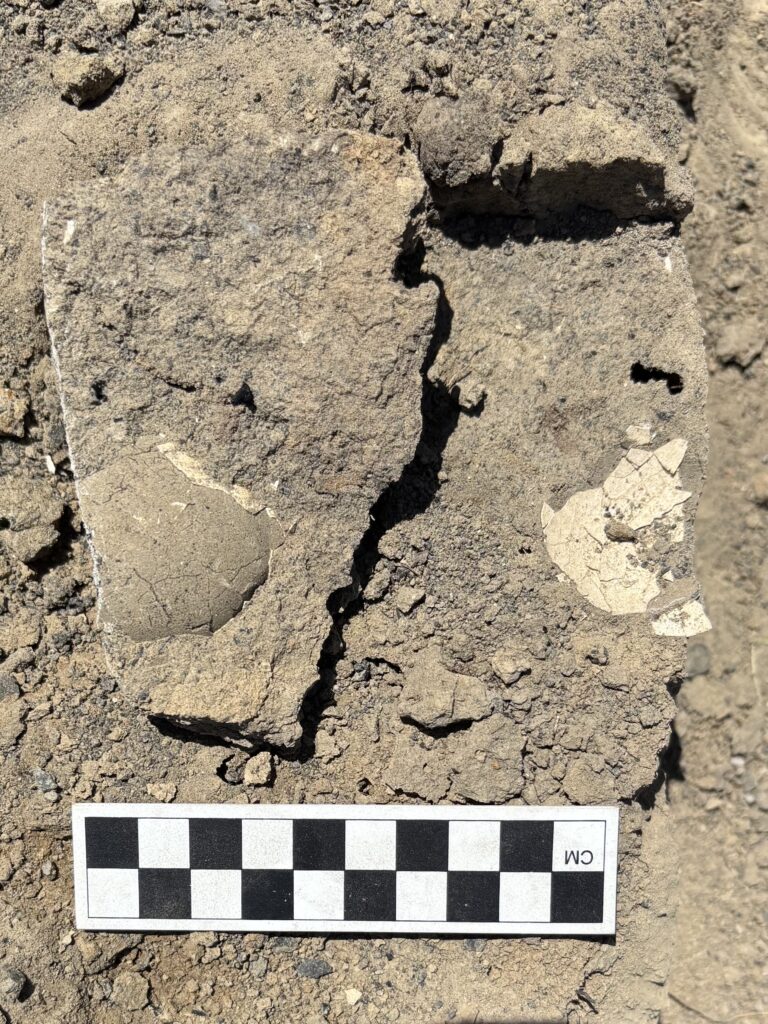
While excavating this stratigraphic layer, we also uncovered pieces of an orange opium pipe bowl (below left), and fragments of an eggshell kept together by the soil (below right). We also continued finding more pieces of olive green glass, Winter Green pattern ceramics, and CBGS near the animal bones.
Opium pipe bowl fragments
Eggshell imprint (left) and eggshell
We hope to begin excavating Stratum F tomorrow as we are nearing the sterile soil layer. While working to clear the soil from the edges of the unit, more animal bones were found around the northern edge and in the southwest corner. Further excavation will be done tomorrow.
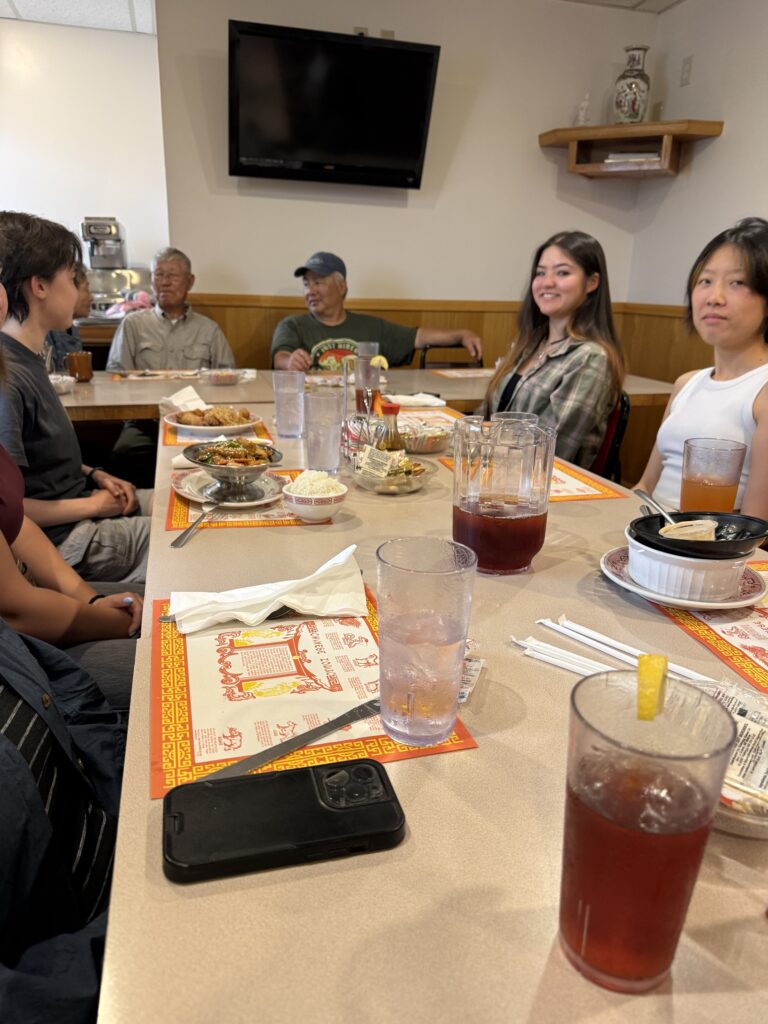
After the work day, we were treated to dinner at China Garden by Mark Leo, whose wife owns the restaurant. There, we met up with Mark’s brother Edmund, Lian, and Lian’s grandparents. The older generation told stories about their relatives in Rock Springs and recalled their experiences in the restaurant industry, such as the names of popular American and Chinese foods on their menu as well as the types Chinese serving dishes they used.
Another wonderful dinner at China Garden, which was generously hosted by Mark Leo (with the baseball cap)
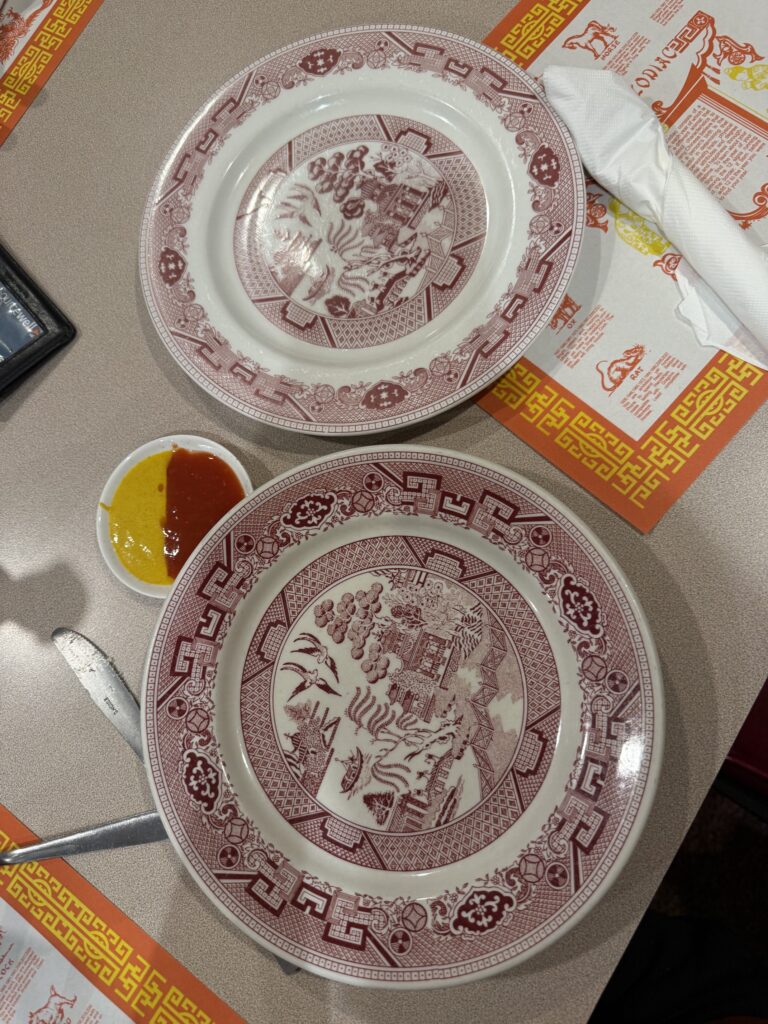
New and old versions of “Pink Willow” pattern plates for Chinese menu items at China Garden
Thursday, June 25th
No updates for today. It rained last night, making the conditions for excavation unfavorable. ☹
Friday, June 26th
Rainbow over the 1885 Chinese Massacre Memorial “Requiem” Statue
With the rain having stopped today, we were able to continue our excavation!
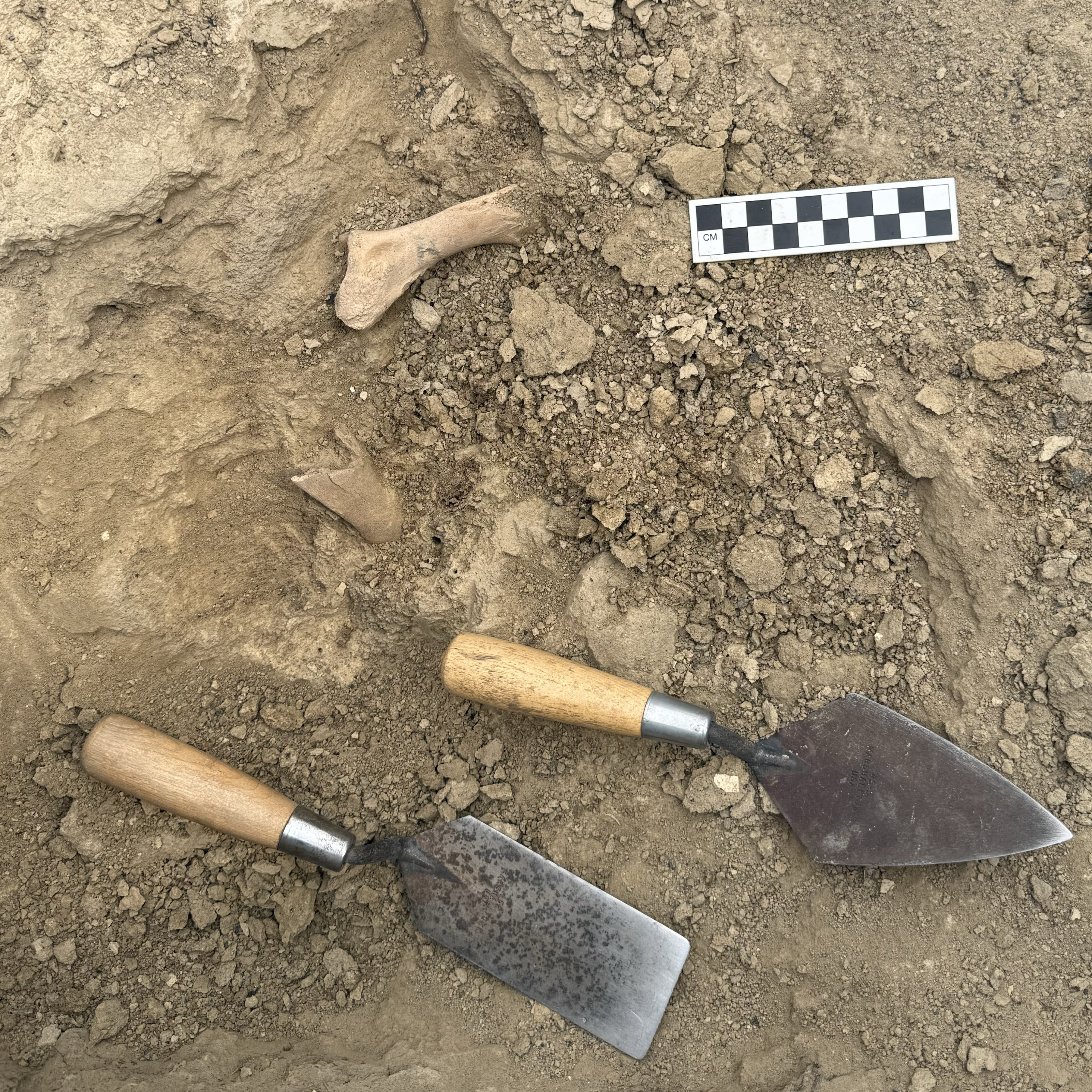
Unsurprisingly, we found more butchered animal bone in the southwest corner of the unit. We also found a piece of whiteware atop one of the bones.
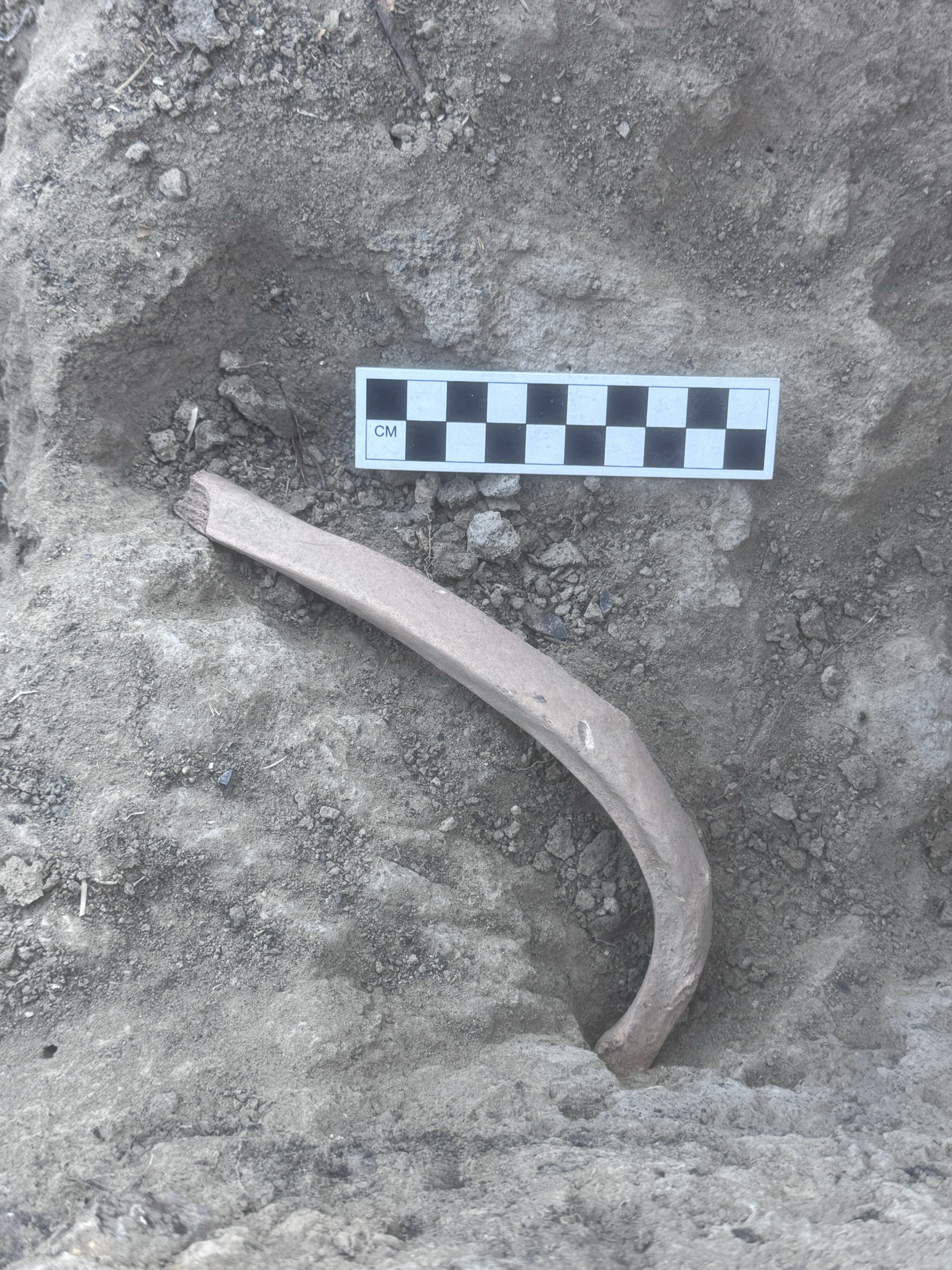
Butchered mammal rib bone
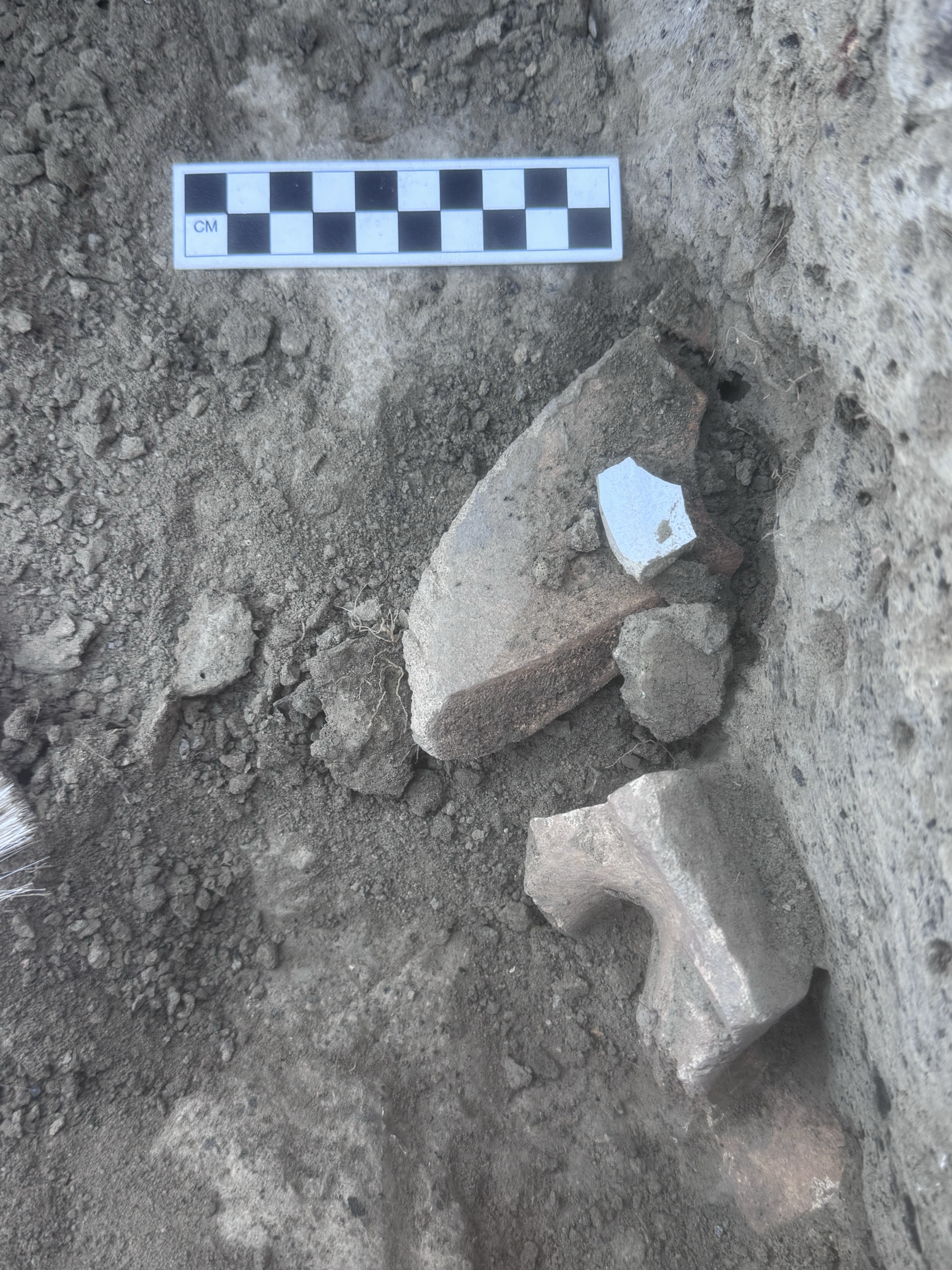
Butchered mammal bones and one whiteware sherd
We also found more shards of the olive-green bottle further north in the unit.
Olive-green glass shards
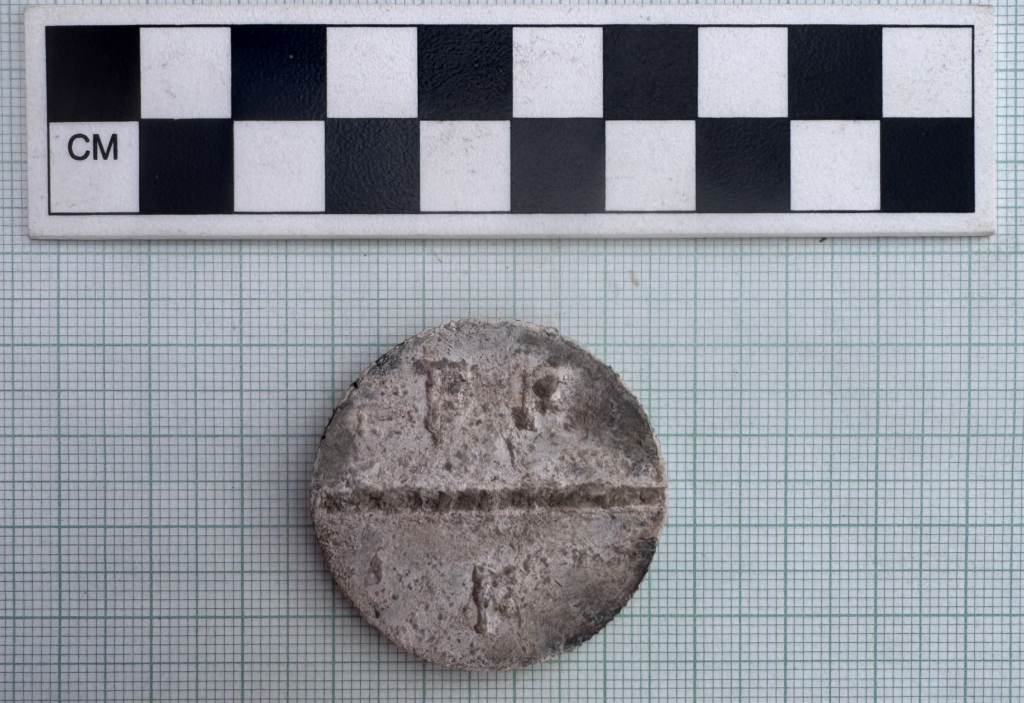
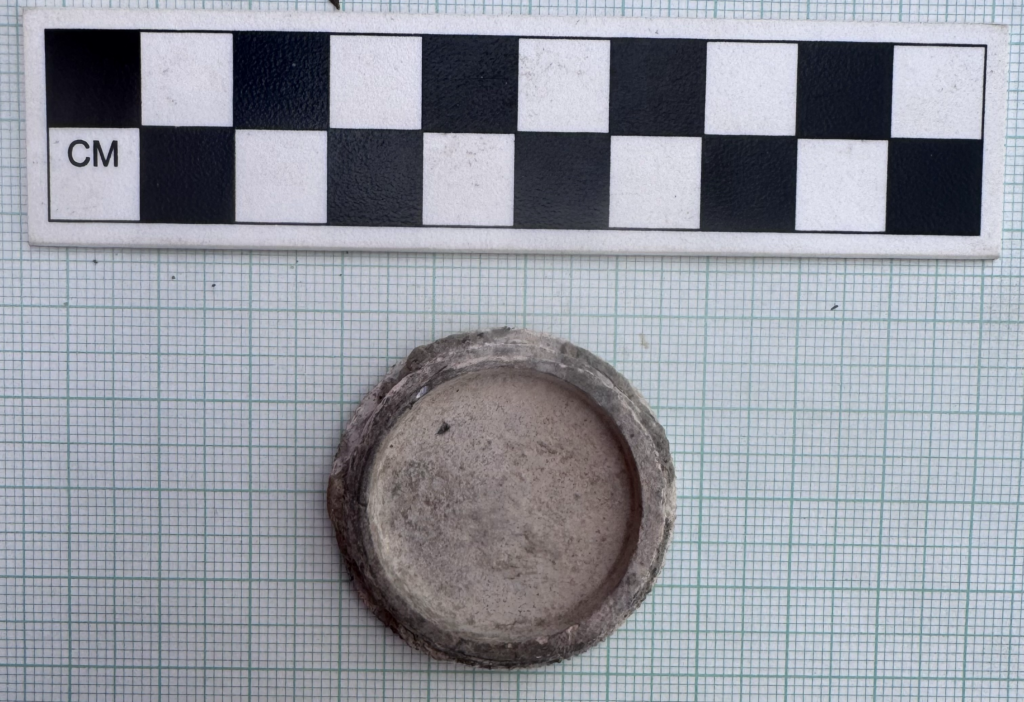
An interesting find we came across in the northeast corner of the unit was this lead cap. It measures about 4 cm in diameter, has knurling around the edge, a straight groove on top, and, to me, what appears to be the letter “F” embossed three times across the top.
Top of Lead Cap
Bottom of Lead Cap
We were unable to reach the next stratum today due to the amount of pedestaling needed (and the time it takes) to carefully extract the artifacts (mainly butchered animal bone) uncovered today.
Saturday, June 27th
While continuing to dig the rest of Stratum E out of the southwest corner, we yet again came upon more butchered animal bone, though it appears we have finally reached the end of what I’ve been calling “the bone pit.”
Close-up photo of butchered animal bones
Alice and I straightening the side walls of our unit
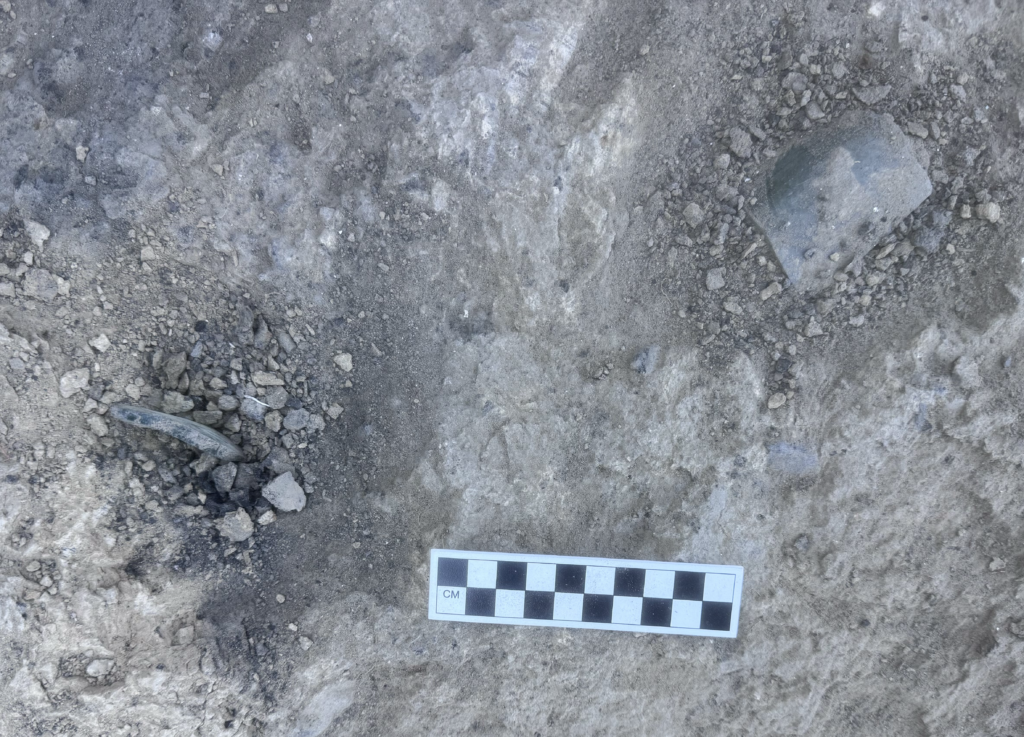
The pictures below show the progress we have made in excavating this unit. The image below on the left was taken at the end of our day on Monday and shows the beginning of Stratum E. The image below on the right shows the end of Stratum E and the beginning of Stratum F. The dark band on the northern side of the unit is from a burned wooden beam, which will be recorded as an archaeological feature within Stratum F. The soil south of the feature is sterile clay. When examining the side profile of the unit from the north side, it appeared that sterile clay was dug out by the house’s inhabitants, and a soil similar to that of Stratum E was used to fill the space under where the beam lies. Because of this, we consider the wooden beam and any soil underneath it (not visible in these pictures) to be from the same time chronologically, and therefore, all part of Stratum F. The hole along the western edge in the image on the right is a rodent hole.
End of Stratum D, Beginning of Stratum E
End of Stratum E, Beginning of Stratum F
Looking back at the plan view maps we created (not pictured), the animal bones appeared to be scattered near the center of the unit at the beginning of Stratum E. However, at lower depths, the concentration of animal bone start to shift towards the southwest corner. Strangely, when we began excavating Stratum E, the southwest corner had a bulk, making the elevation higher than the other corners. When we reached the end of this layer in this corner, it had the lowest elevation of all the corners, and a difference from its beginning elevation of about 30cm!
If the concentration of bones and artifacts are contemporaneous with the house, it almost seems like it was an intentional pit dug into sterile clay to bury discarded items such as animal remains, eggshells, and broken tablewares, Chinese stoneware, and glass bottles.
Thank you for reading this week’s report on the 2026 Rock Springs Chinatown excavation. We are excited to share our findings with you all and look forward to what next week brings us!
Funding Acknowledgment
Thank you to all of the project funders and donors for making the 2026 field season possible.