

Hello everyone! George here again. I want to tell you a bit about Chinese Brown-glaze Stoneware, or CBGS for short. CBGS is very common among ceramic types in Chinese diaspora archaeological sites. It is often characterized by the brown color of the glaze on fired containers (as one would figure by the name), but the color can vary. Chinese utilitarian stonewares range from various shades of green to even black, with most being in various shades of brown (Brott 1987). According to Brott, the glaze on CBGS can vary from a shiny, mirror-finish to a more matte, uniformly dull glaze. Sometimes, the glaze doesn’t even cover the whole vessel! On vessel forms with lids, they are always concave and unglazed.
These stoneware vessels were produced in Guangdong Province as food containers and were locally referred to as “Black Glaze ware” (Choy 2014). CBGS can be hard to date, due to the pots remaining in the same relative form for over 200 years (Yang and Hellman 1998). CBGS researchers Yang and Hellman state that these vessels would have also been made by hundreds of different local potters across the region, so combined with the sheer scale of time we’re looking at here in terms of production, it’s no wonder that there are a wide variety of little kinks and differences in CBGS vessels of all forms. They also note that incised marks can be found on the base or side of some of these pots, but due to the illiteracy of many of the pottery workers, inscribed characters can often be illegible. After leaving the pottery kiln, vessels were sent to food processing factories as they would be filled with foodstuffs, then shipped out to stores across towns (Yang and Hellman 1998).
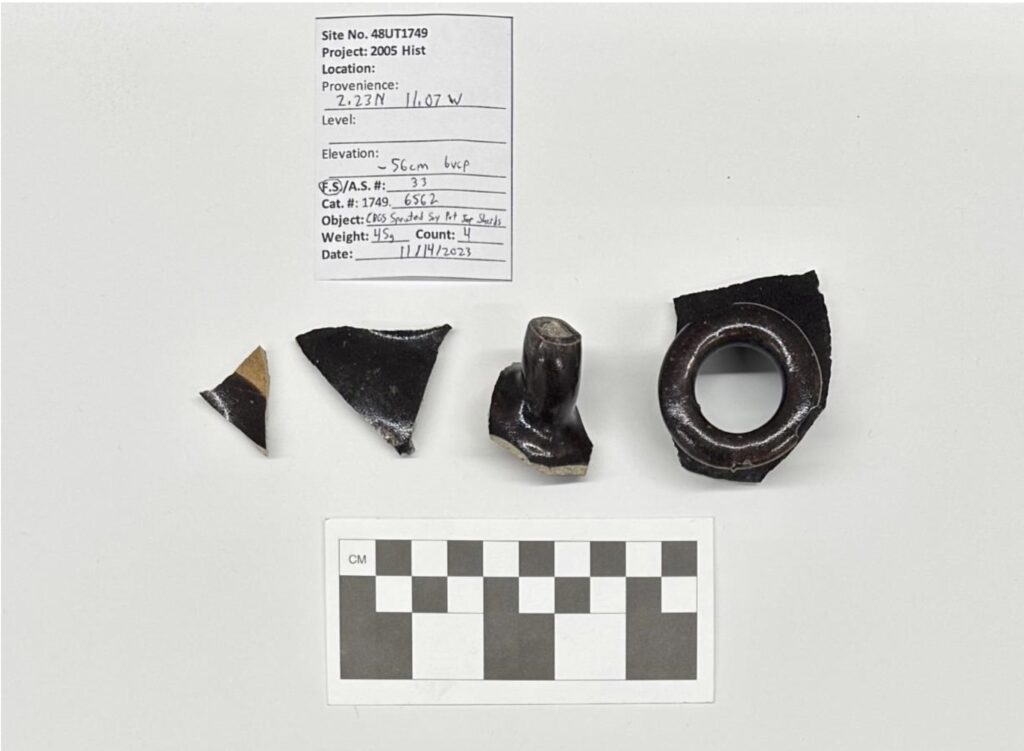
The particular sherds you can see above are from Evanston Chinatown and would have belonged to a spouted jar, or nga hú (Yang and Hellman 1998). Yang and Hellman note that spouted jars are also frequently referred to as “soy pots” in archaeological literature as the most frequent food item they would have originally been included with was soy sauce. However, the name is somewhat misleading, as it implies that these spouted jars only held soy sauce. In reality, spouted jars also contained various other commodities such as “liquor, black vinegar, and peanut oil” (Yang and Hellman 1998). They also might have held fermented soybean sauces called nom yue or fu yue (Choy 2014). Of course, people have used spouted jars to hold all kinds of food, as people in the past repurposed old containers for other items in the same way that we do today.
References Cited
Brott, Clark W. 1987. “Utilitarian Stoneware from the Wong Ho Leun Site: A Pictorial Essay.” In Wong Ho Leun: An American Chinatown, edited by Great Basin Foundation, 2, Archaeology:233–47. San Diego, CA: Great Basin Foundation.
Choy, Philip P. 2014. “Interpreting ‘Overseas Chinese’ Ceramics Found on Historical Archaeology Sites: Manufacture, Marks, Classification, and Social Use.” SHA Research Resource, 1–23.
Yang, Jeannie K., and Virginia R. Hellmann, 1998, “What’s in the Pot? An Emic Study of Chinese Brown Glazed Stoneware,” 11:59-66.
Leave a Reply