

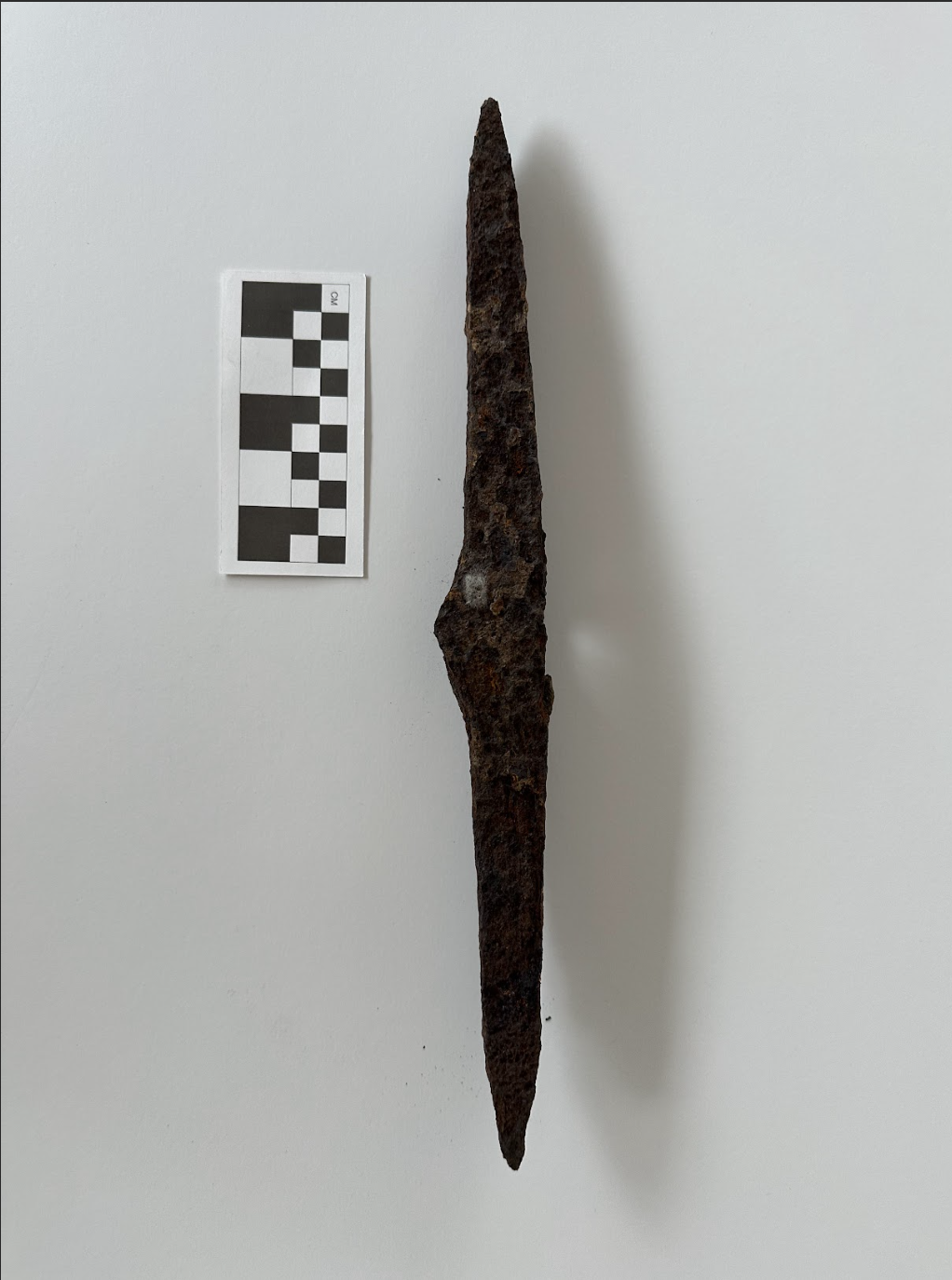
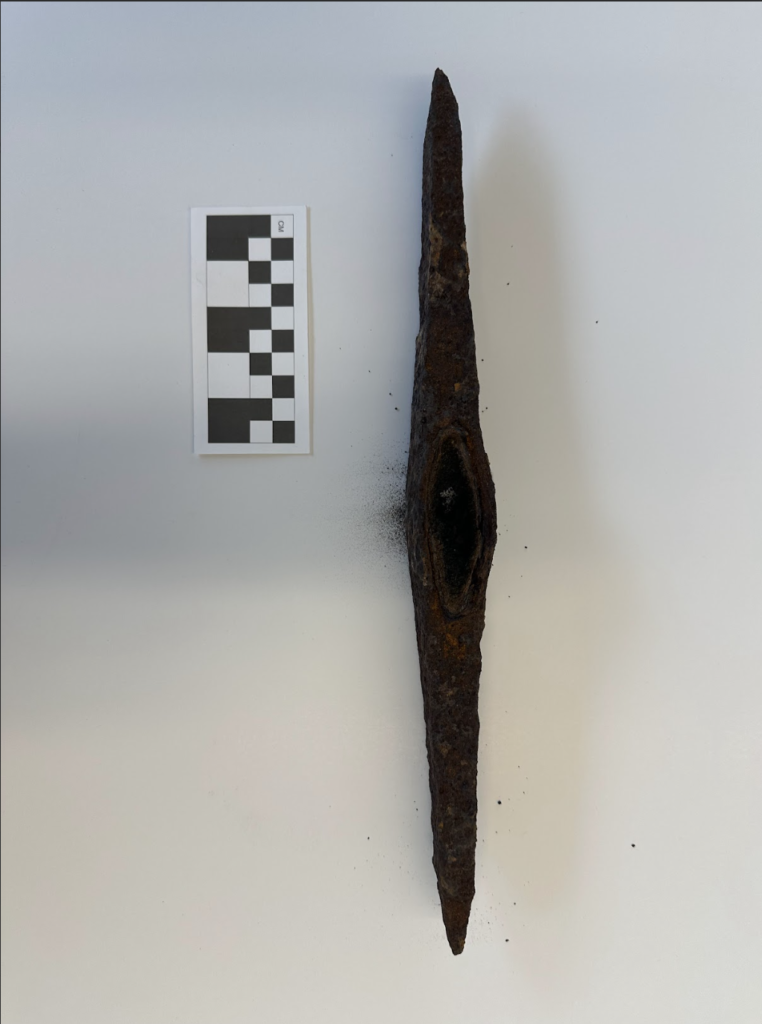
Hello everyone! George here again. I want to tell you all a bit about the coal mining experience in late 19th-century Wyoming and the kinds of tools miners used. The tool you see in the picture below is, you guessed it, a coal pickaxe head! Recovered in 2005 at one field season of the Evanston Chinatown excavations, these would have been the primary tools miners used in the late 19th century, along with blasting powder, before more advanced mining methods were developed. This post will give some context to what mining was like in Wyoming in the 19th century.
At first, coal mining methods in Wyoming were effectively imported from the British Isles. From 1851 to 1860, 37,523 people entered the state to mine, most of whom were of British origin (Gardner 1989; 34). As families immigrated who were already experienced in the coal industry, Wyoming’s coal mining operations began with an already experienced group of miners who were mainly accustomed to British coal mining operations, so Wyoming’s mines would follow them in style. As time went on, many more immigrant groups arrived in the area: Chinese, Slovene, Finnish, and Japanese, to name a few. While all were subject to varying prejudices and disadvantages in the state, both social and economic, the experience of mine work would have been something that men of all different groups would experience in common.
After the work of opening a mine was done with proper airflow, miners began the process of coal extraction. In the depths of the mine, one extracted the coal from what was called “a room” (Gardner 1989; 35). With that name, you may guess that a room would be shaped more like a cube or what we know a “room” to be, but in a mining context, these were long, narrow tunnels, averaging 30 feet wide and 150 feet long (Gardner 1989; 35). A room’s height depended on how high or low the coal seam extended. If your seam was, say, 4 feet, that meant long hours of kneeling and stooping. Now, if you had a much larger seam, an 18-foot-high one, for instance, that meant you’d need a lot of prop work to keep the roof safe. In a room, the wall where coal had not yet been mined was referred to as the “face,” and it was where the miners actually worked to extract coal (Gardner 1989; 35).
A miner would begin the process of digging coal by lying on his side and undercutting the seam (Gardner 1989; 35). A miner would use a lamp placed on his hat to help him see and work (Gardner 1989; 35). The undercutting job was done with a pick, much like the one you see above! During this period, the fancy machinery we use today did not yet exist, so extracting coal deep underground had to be done by hand. The miner would pick as far back under the bottom of the coal as possible, trying to get an angle that was the best for both power and precision. For optimal results, the miner would pick with both hands to maximize hitting power (Gardner 1989; 35). Since coal miners were paid by the amount of coal they were able to produce, one had to be a skillful picker to make a living or be an efficient worker when loading the cart (Gardner 1989; 35).
To have coal be at a size that could be efficiently loaded by hand to be hauled to the surface, the face first had to be undercut with a pick. The face would then be drilled and blasted to break up the coal. Once the coal was blasted from the face, it was loaded into small, horse-drawn cars for the trip to the surface (Gardner 1989; 36). The loading of the car was usually the job of a “green” or novice miner. The “green” miner was often the teenage son of the miner working that section of the face, or room (Gardner 1989; 36). If an experienced miner did not have a son or other relative to bring along, miners would also occasionally take a friend or a younger brother (Schwieder 1983; 38).
References Cited
Gardner, A. Dudley. Forgotten Frontier: A History of Wyoming Coal Mining. Boulder, CO: Westview Press, 1989. https://doi.org/10.4324/9780429033681
Schwieder, Dorothy Ann. Black Diamonds: Life and Work in Iowa’s Coal Mining Communities, 1895-1925. Ames, IA: Iowa State University Press, 1983.
Leave a Reply