

Hello everyone! This is Julia and I’m here to tell you about some of my favorite artifacts that we have been cataloging from Rock Springs Chinatown: porcelain house wiring cleats.
Wiring cleats were used in an early interior wiring method called Knob-and-Tube wiring. In this method, wires, insulated with rubber or thermoplastic, were run through a series of cleats and knobs (Mauldin and Cochran 1960).

The purpose of the cleats and knobs was to maintain distance between wires as well as distance between the wires and the walls. The standard two-wire cleat maintained 2 ½ inches between wires and ½ inch between the wires and the wall. This meant that cleats could only be used for exposed wiring since concealed wiring required 1 inch of space from the surface and 3 inches between wires (Mauldin and Cochran 1960). Additionally, cleats could not maintain the required distance between the wires when making turns, so knobs were employed instead (Mauldin and Cochran 1960).
The earliest cleats from the 1880s were made of wood which led to many fires, so the porcelain house wiring cleat was invented and first patented in 1889 (Gish n.d.). By 1891, porcelain house wiring cleats were required since insurance companies refused to insure houses that used wooden ones (Gish n.d.).

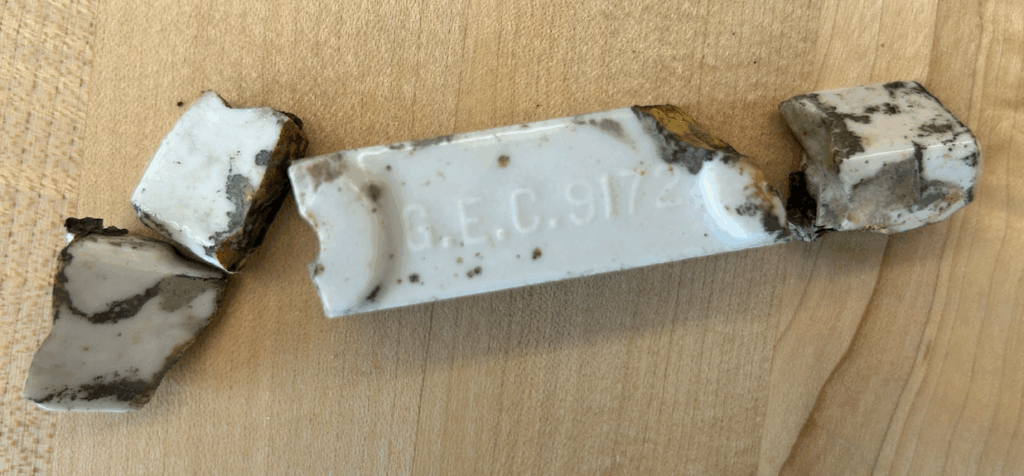
The porcelain house wiring cleats that we have found in Rock Springs are all the same model; they are each embossed with “G.E.C. 9172”. I was able to identify them using the extensive personal collection of Elton Gish.
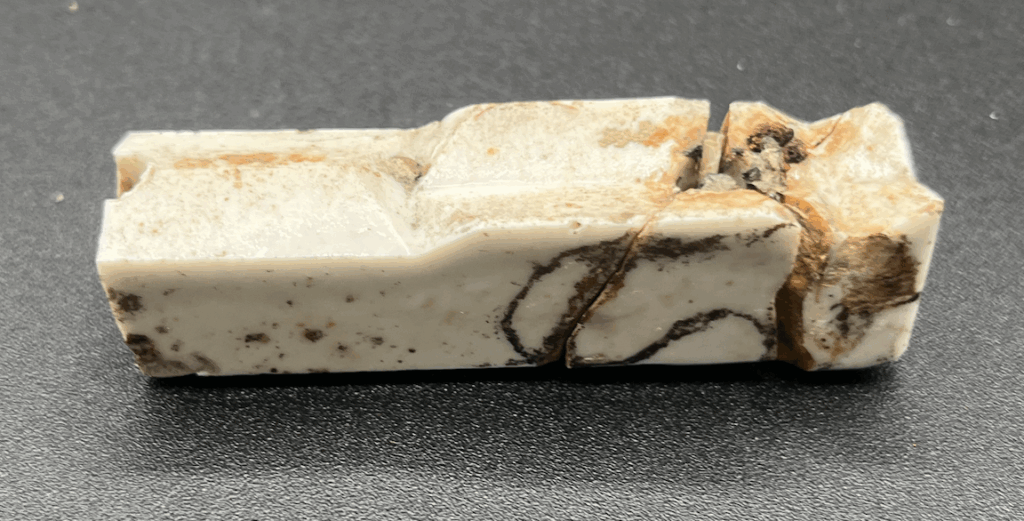
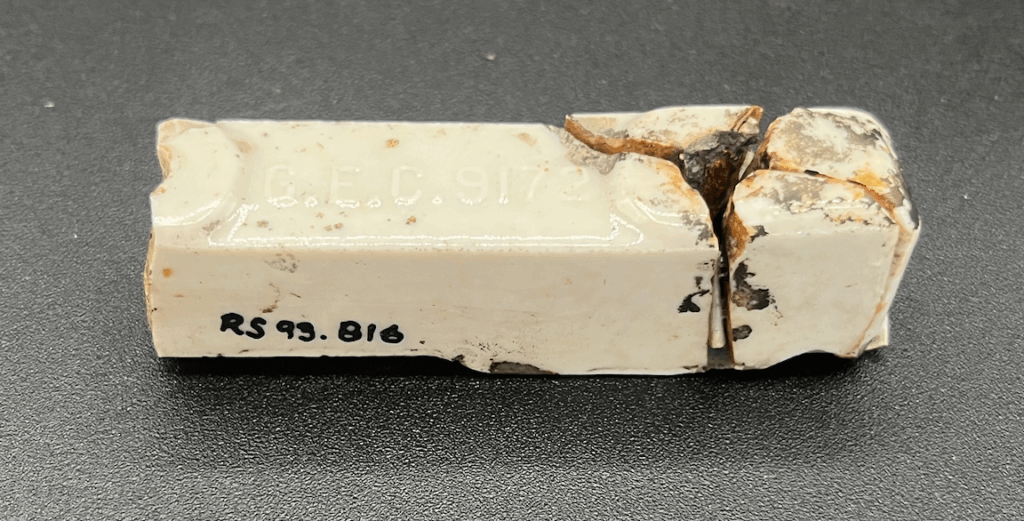
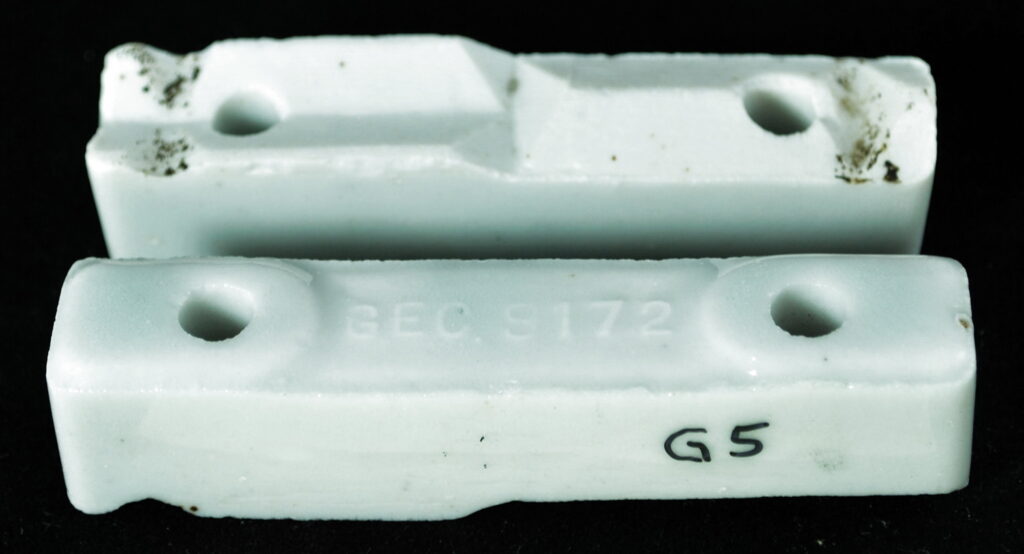
This model of the porcelain house wiring cleat was invented and patented by Henry Price Ball, a prolific consulting engineer, in 1891 (“Utility Patent 458,964” 1891; The New York Times 1941). These were three-wire cleats but were versatile and could also hold two or just one wire (“Utility Patent 458,96”).
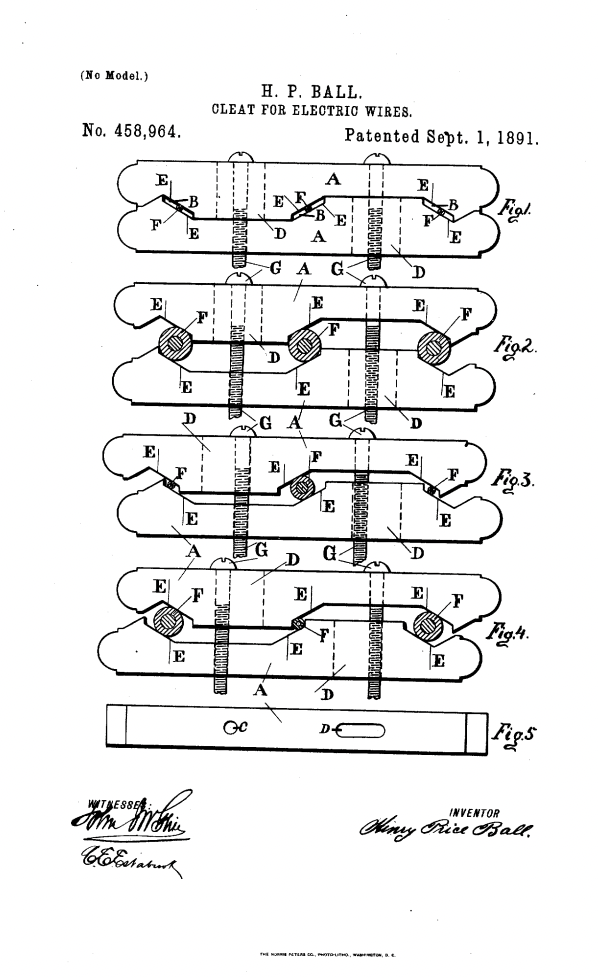
Henry Price Ball licensed this patent to the General Electric Company (“Utility Patent 458,964 1891). The General Electric company is a conglomerate company born out of Thomas Edison’s own companies that began in 1892 (Edison Papers Staff n.d.). Prior to that, there was the Edison General Electric Company which was founded in 1889 as a merger of three Edison manufacturing companies, Edison Lamp Company, Edison Machine Works, and Bergmann & Company, all based in New York and New Jersey (Edison Papers Staff).
The presence of these General Electric Company porcelain house wiring cleats in Rock Springs Chinatown is not surprising. General Electric Company was one of the leading electric goods manufacturers at the time and Rock Springs, as well as Evanston were two of the first five towns in Wyoming to start using electric lights in the late 19th century (Robert s 2022). By the time these cleats were invented there had been electricity in Rock Springs for at least two years (Roberts 2022). Additionally, the knob-and-tube wiring system was seen as a difficult to set up but good interior wiring system (Mauldin and Cochran 1960). These cleats are important evidence of Rock Springs Chinatown participating in the early adoption of electricity. They also represent a significant contrast between life in Rock Springs Chinatown and the home villages in Hoisan (Taishan) County, China. For example, in Hoisan City (Taicheng), the urban area of Hoisan, the home county of many Rock Springs Chinese, electrified public street lights did not appear until 1919 and the funds for modernization project were raised by Chinese working abroad (see Hsu 2000, 49). Additionally, according to our research collaborator Peter Lau, the less urban villages did not begin adopting electricity until the 1980s, nearly a century after it arrived in Rock Springs.
References
Edison Papers Staff. No date. “Edison’s Companies.” The Edison Papers. Accessed June 25, 2025. https://web.archive.org/web/20131002154948/http://edison.rutgers.edu/list.htm.
Gish, Elton. No date. “Wooden and Porcelain House Wiring Cleats.” Unipart, Multipart Pin-Type & Miscellaneous Porcelain Insulators. Accessed June 25, 2025. https://www.r-infinity.com/Cleats/.
Hsu, Madeline Y. 2002. Dreaming of gold, dreaming of home: Transnationalism and migration between the United States South China, 1882-1943. Stanford: Stanford University Press.
Mauldin, Hurst, and William A. Cochran. 1960. Electricity for the farm. Birmingham, AL: Alabama Power Co..
New York Times. May 3, 1941. “Consulting Engineer Was Holder of 100 Electrical Patents.” https://www.nytimes.com/1941/05/03/archives/henry-price-bali-consulting-engineer-was-holder-of-100-electrical.html.
No author. 1893. “The Pass & Seymour Three-Wire Cleat .” Electrical Engineer, March 2, 1893.
Roberts, Phil. 2022. “First Electricity in Early Wyoming, 1882.” Wyoming Almanac, January 29, 2022. https://wyomingalmanac.com/?p=1900.
“Utility Patent 458,964 – September 1, 1891 – Cleat for Electric Wires.” Insulator Patent Reference Library. Accessed June 25, 2025. https://reference.insulators.info/patents/detail/?patent=U458964.


Leave a Reply to Julia Ghorai Cancel reply