

Hello Everyone! This is Julia, a new member of the 2025 summer team for the Wyoming Chinatowns archaeology project. Today I wanted to tell you about the ironstone china found at Rock Springs that our team just reconstructed!
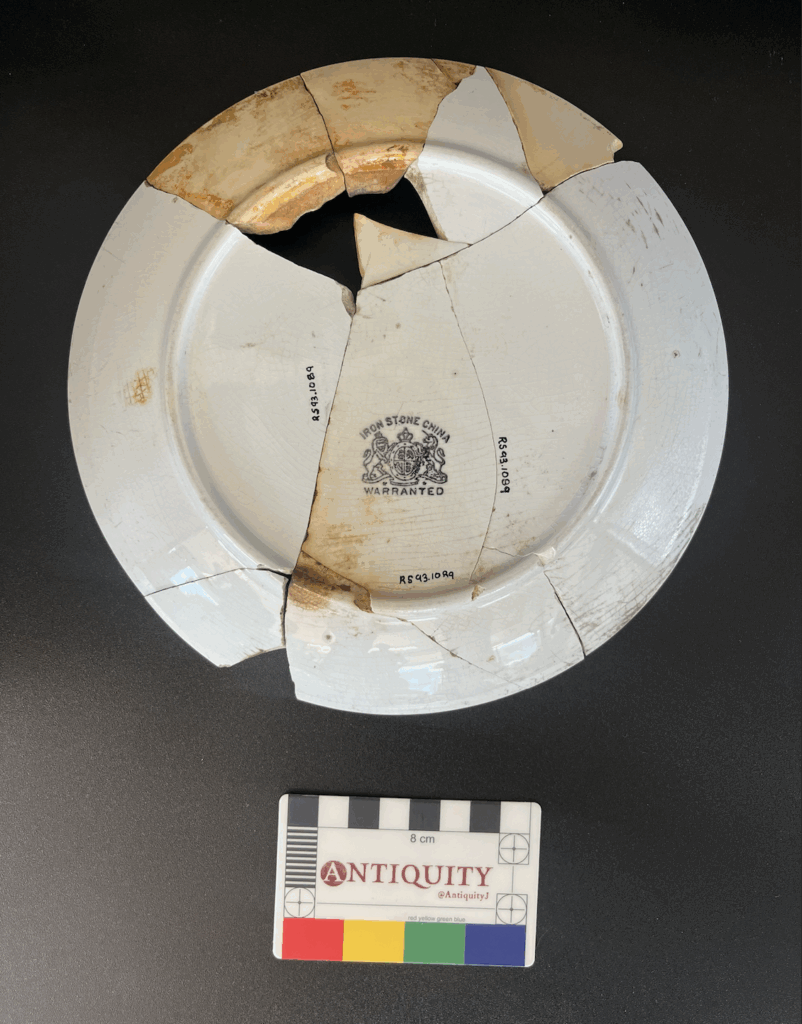
Ironstone china originated in England in the early 18th century and, despite its name, does not contain iron and is not china (what people tend to call Chinese export porcelains). It was introduced as a more affordable and durable alternative to Chinese porcelain. Ironstone china is generally considered to be a finer earthenware and is characterized by a recipe containing significant portions of china clay, china stone and calcined flint. However, the great popularity of ironstone china during the 19th century motivated many ceramics manufacturers to label many typical earthenwares as ironstones (Barker 2002). The “ironstone” plates found at Rock Springs Chinatown are thick enough to have been simple earthenware, though there is no exact distinction. Particularly, the plates from the Rock Springs Chinatown are white earthenware so they are referred to as whitewares.
The four plates from Rock Springs Chinatown each have a partial or complete maker’s mark which can be used to determine the manufacturer and when they were produced.
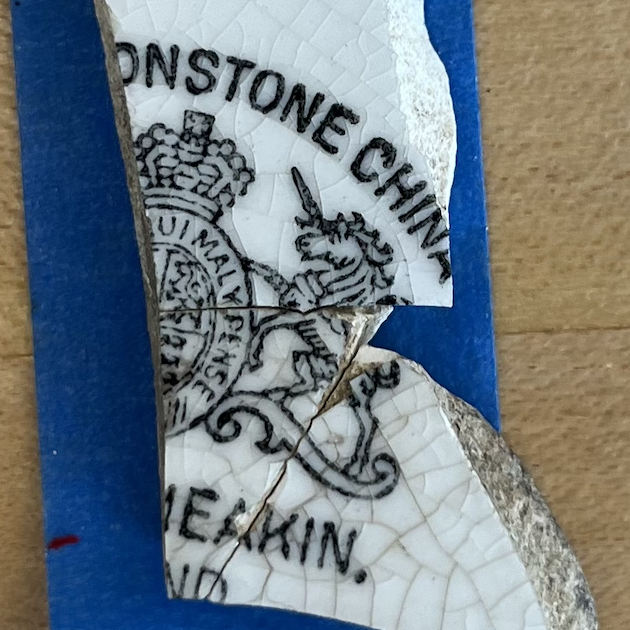
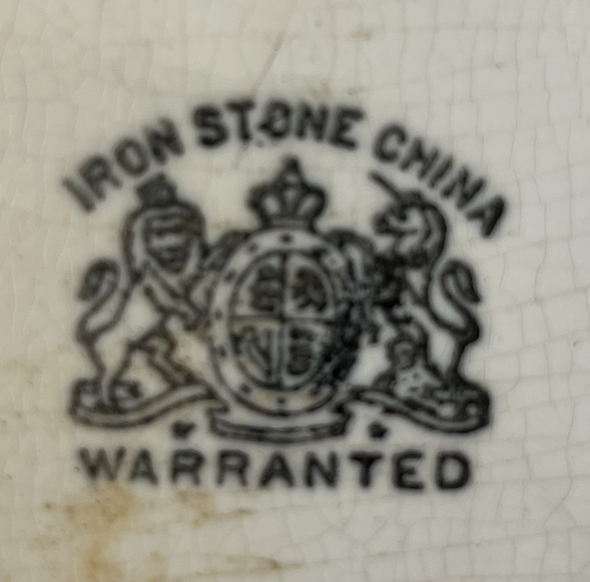
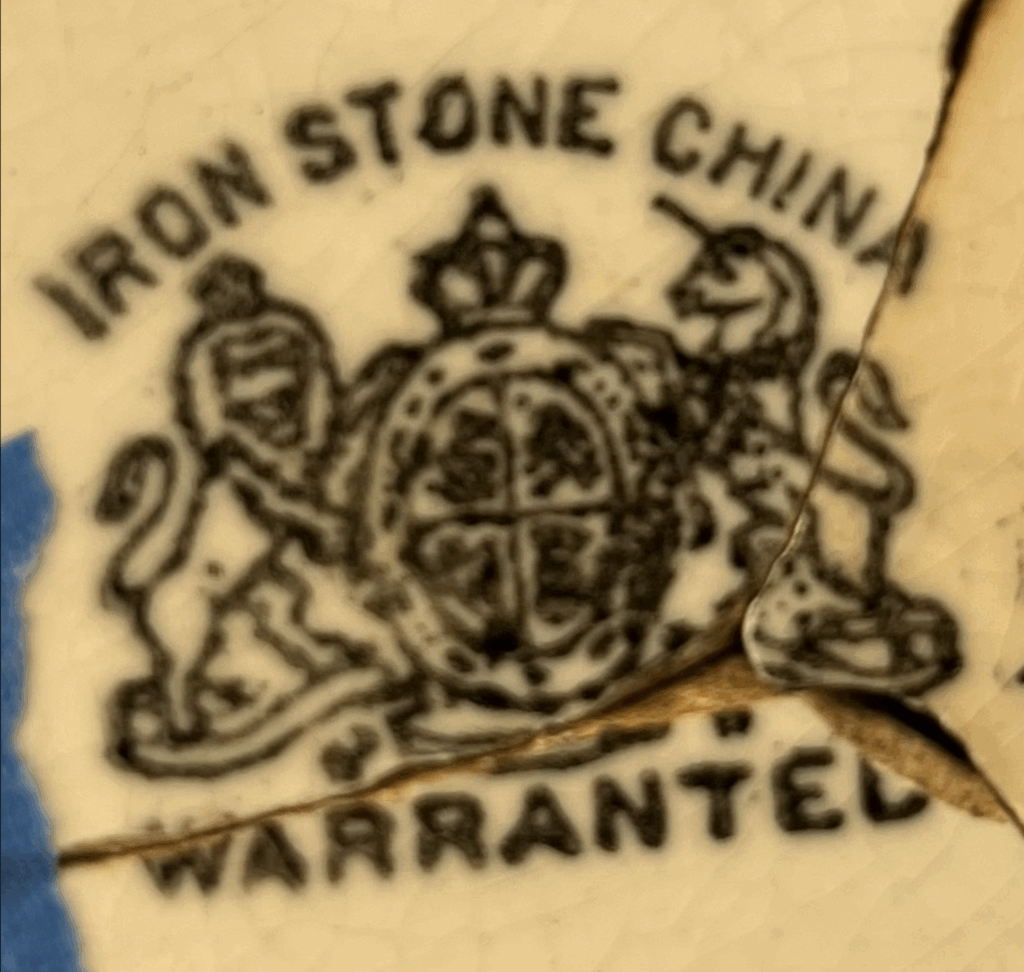
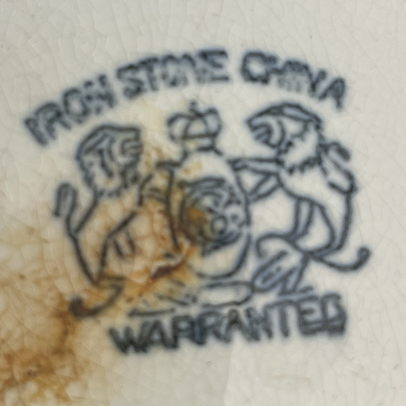
At first glance, they all look like variations of the same maker’s mark, but these plates were actually made by three different companies! Each of these manufacturers chose to use a variation of the British Royal coat of arms. The Royal coat of arms is a symbol to identify the British monarch and is used by the government of the United Kingdom and Royal warrant holders (The Royal Family n.d.). The Royal coat of arms has changed over time and has a special variation for Scotland, but it generally includes a lion and a unicorn on opposite sides of a shield whose decoration represents the countries in the UK.

The most intricate of the maker’s marks in the Rock Springs Chinatown assemblage is on Plate 1 and it was produced by Alfred Meakin Ltd in Tunstall, England 1891 or later (Birks n.d.).
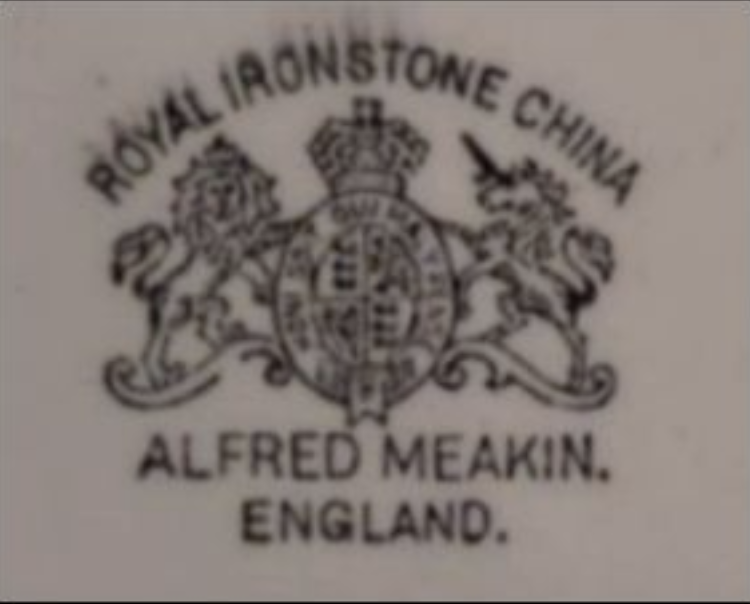
Alfred Meakin Ltd was a royal potteries manufacturing company founded in 1875 by Alfred Meakin (Alfred Meakin: Science Museum Group Collection). Alfred Meakin himself was born in Stoke-on-Trent, England where ironstone china originated (Alfred Meakin: Science Museum Group Collection, Barker 2002). This plate was most likely a genuine ironstone and Alfred Meakin Ltd had an official Royal warrant to use the royal coat of arms (Barker 2002, Birks n.d.).
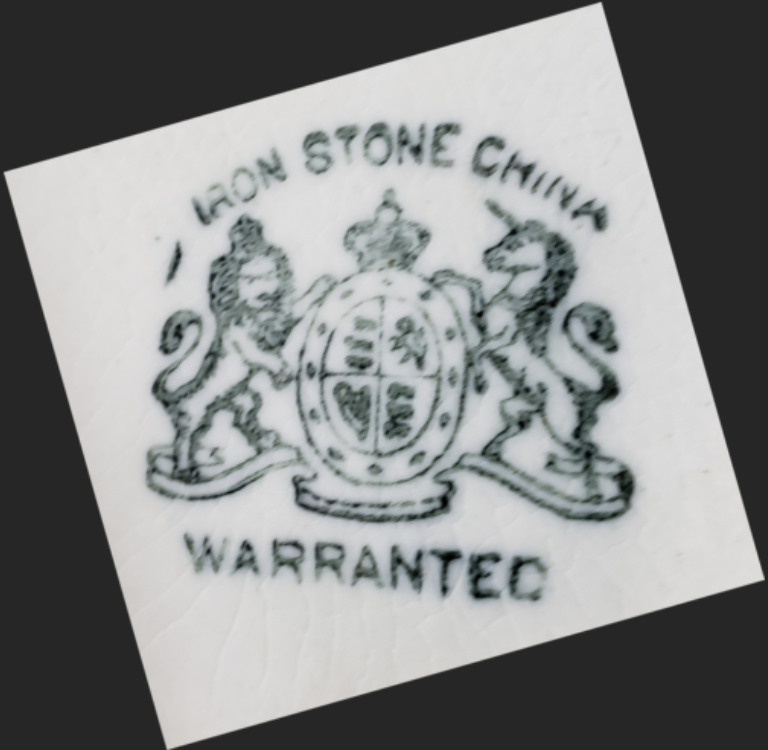
Source: https://www.themuseumofceramics.com/harker
Two of the plates had identical maker’s marks and both were made by the George S. Harker Company in East Liverpool, Ohio between 1884 and 1890 (Harker n.d.). The coat of arms used in this maker’s mark is simpler than the one used by Alfred Meakin Ltd. Additionally, since the George S. Harker Company was American, they would not have had an official Royal Warrant to use the royal coat of arms. Since ironstone china originated in the UK and was produced by official royal pottery companies early on, American companies may have used variations of the Royal coat of arms to make their Ironstone China more attractive to buyers (Barker 2002).
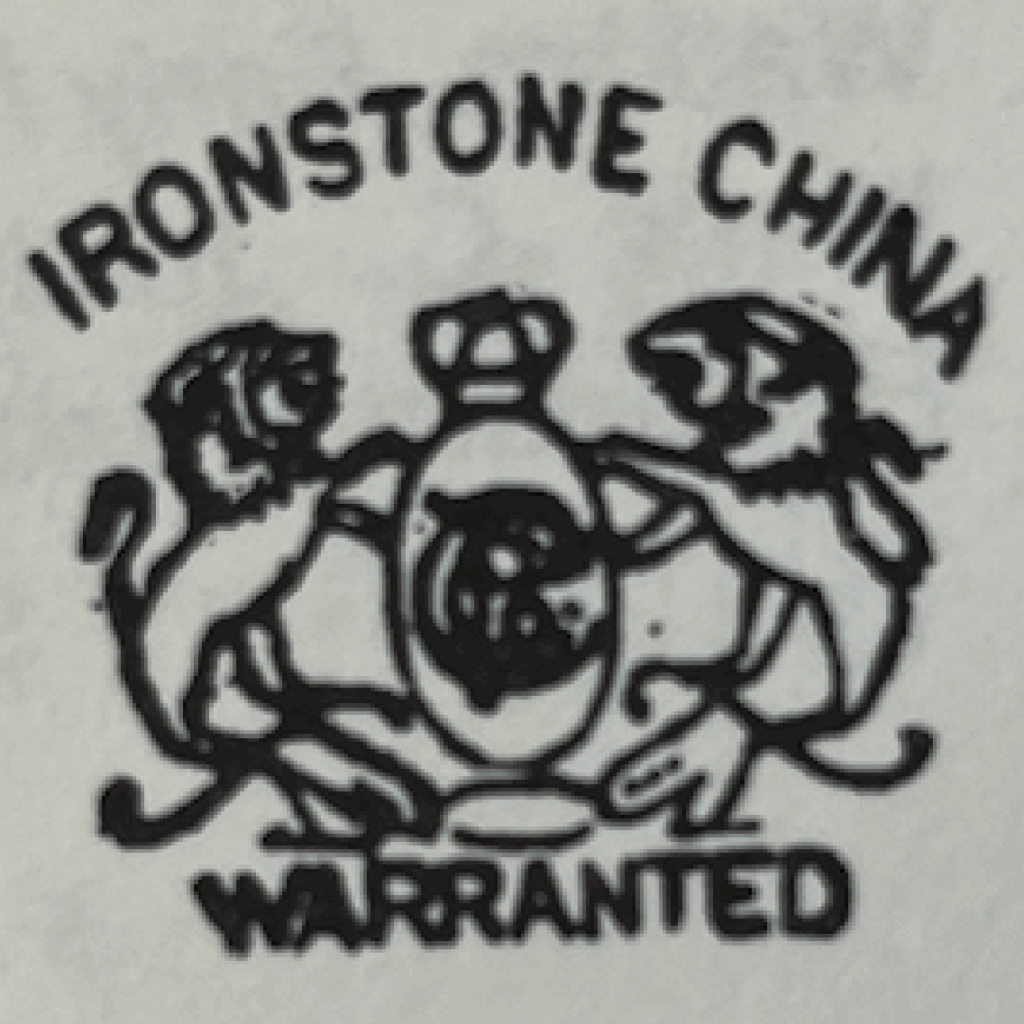
The last mark is by far the simplest and indicates that this plate was made by the Crown Potteries Company in Illinois between 1891 and 1958 (Lehner 1989). Like George S. Harker Company, Crown Potteries Company would not have had an official Royal Warrant to use the royal coat of arms. Unlike the previous two companies, Crown Potteries Company changed the royal coat of arms significantly. They placed a stylized “C” on the shield, likely a logo for their company. Customizing the shield decoration was one of the most common changes made to the Royal Coat of Arms by pottery companies (American Potters Use of the Royal Coat of Arms). Unlike other companies, Crown Potteries Company chose to replace the unicorn on the shield with an additional lion.
These plates are an important example of Euro-American tablewares used by the residents of Chinatown. They demonstrate that while the Chinese residents of Rock Springs often used traditional Chinese tablewares, they also partook in American trends and bought popular plates from a variety of producers.
References
“Alfred Meakin: Science Museum Group Collection.” Science Museum Group, n.d. https://collection.sciencemuseumgroup.org.uk/people/cp3526/alfred-meakin.
“American Potters Use of the Royal Coat of Arms.” The Potteries, n.d. https://www.thepotteries.org/mark/arms/american.htm.
Barker, David. “Ironstone.” Essay. In Encyclopedia of Historical Archaeology, edited by Charles E. Orser, 1st ed., 482–84. New York, NY: Taylor & Francis Group, 2002.
Birks, Steve, ed. “A Meakin (Ltd) Alfred Meakin (Tunstall) Ltd.” A-Z of Stoke-On-Trent Potters, n.d. https://www.thepotteries.org/allpotters/722.htm.
“Coats of Arms.” The Royal Family, n.d. Accessed June 3, 2025. https://www.royal.uk/coats-arms.
“Harker.” Museum of Ceramics, n.d. Accessed June 3, 2025. https://www.themuseumofceramics.com/harker.
Lehner, Lois. Lehner’s Encyclopedia of U.S. Marks on Pottery, Porcelain and Clay. Paducah, KY: Collector Books, 1989.


Leave a Reply to Evan Albaugh Cancel reply