

Hi everyone! This is Avajane and I am rising second year Anthropology major from Washington DC. I am doing a MAP (Mentored Advance Project) with Professor Ng and this is my first post on the Buried Chinatowns blog. Over the past week and half, our summer MAP has been cataloging and identifying artifacts excavated in 1991 from the Rock Springs Chinatown. Today, I will be sharing some information on a glass ink bottle that I recently cataloged in the collection.
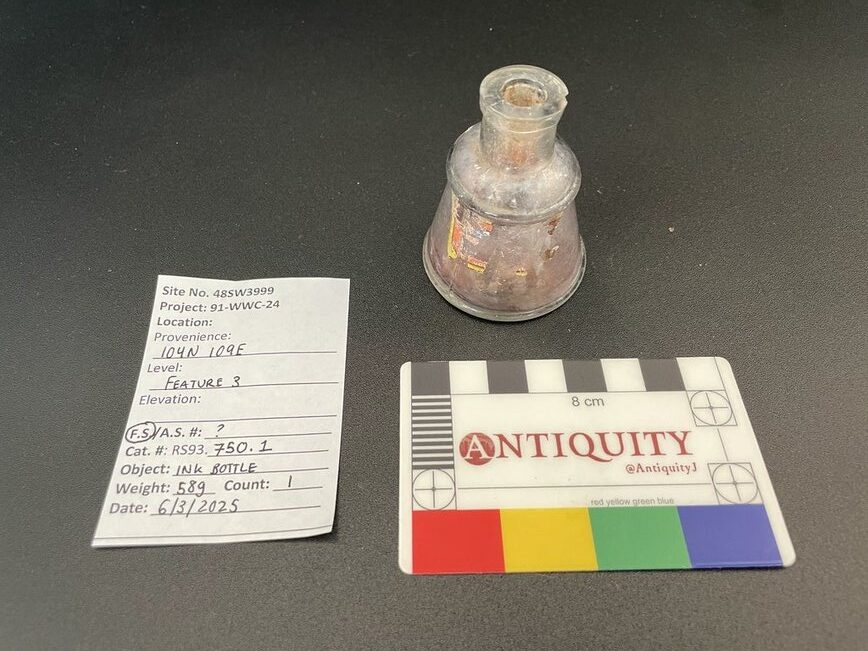
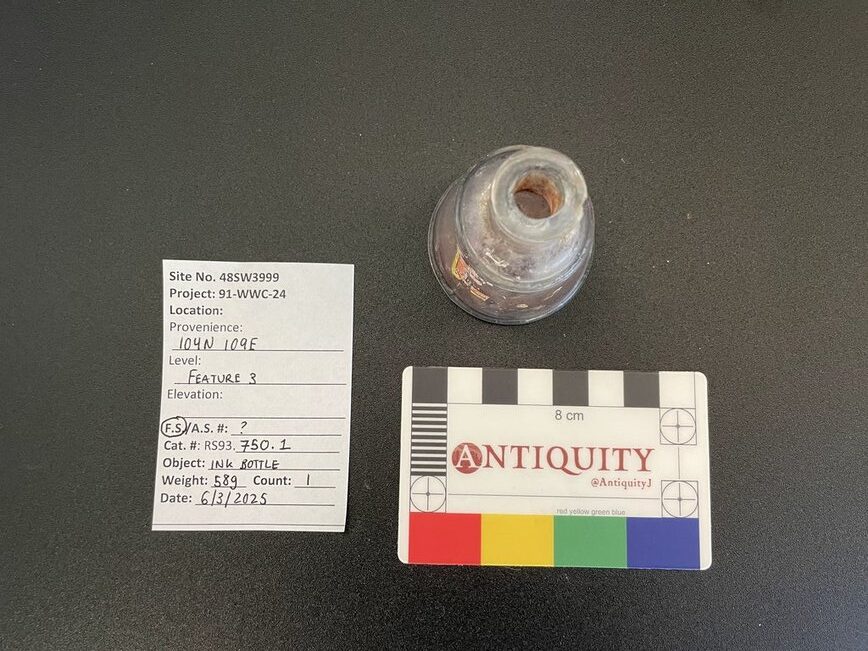
The ink bottle is small and composed of colorless glass. Its measurements are: 2cm diameter rim, 4.75cm diameter base, and 5.75cm tall. Inside, there seems to be the remains of a cork that was used to seal it, but has since dried up.
I determined that it was an ink bottle using the Society for Historical Archaeology Historic Bottle Website. The bottle matches diagnostic characteristics of different ink bottles: it has a patent-style finish, cone-shaped body, and ringed shoulder.
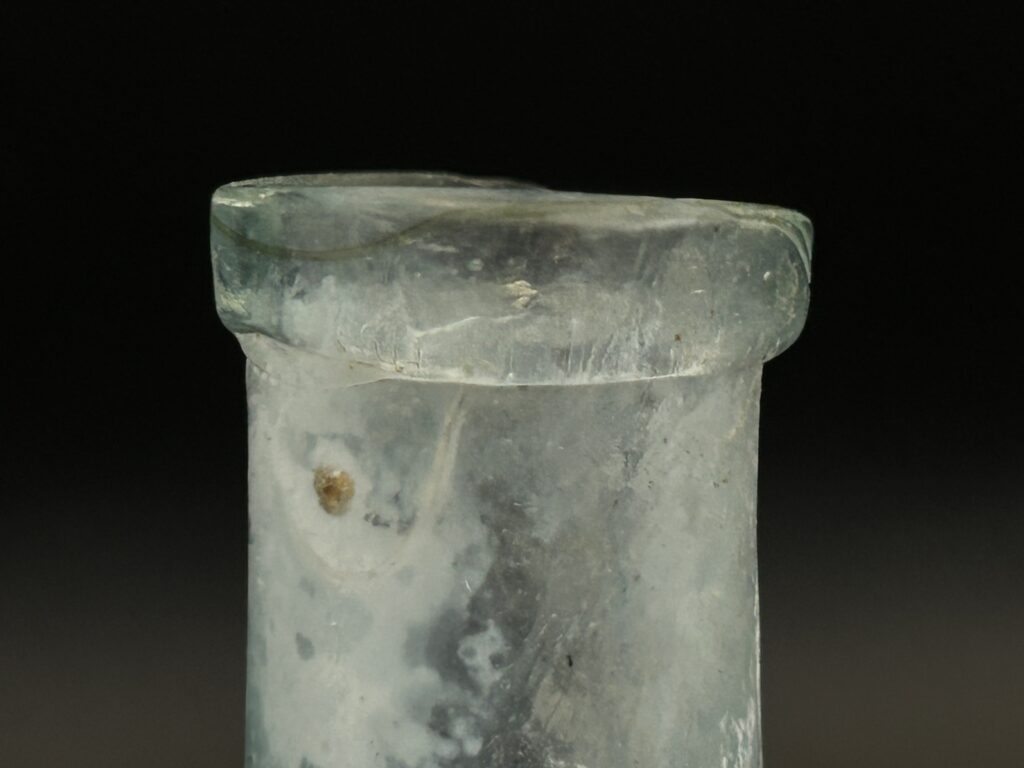
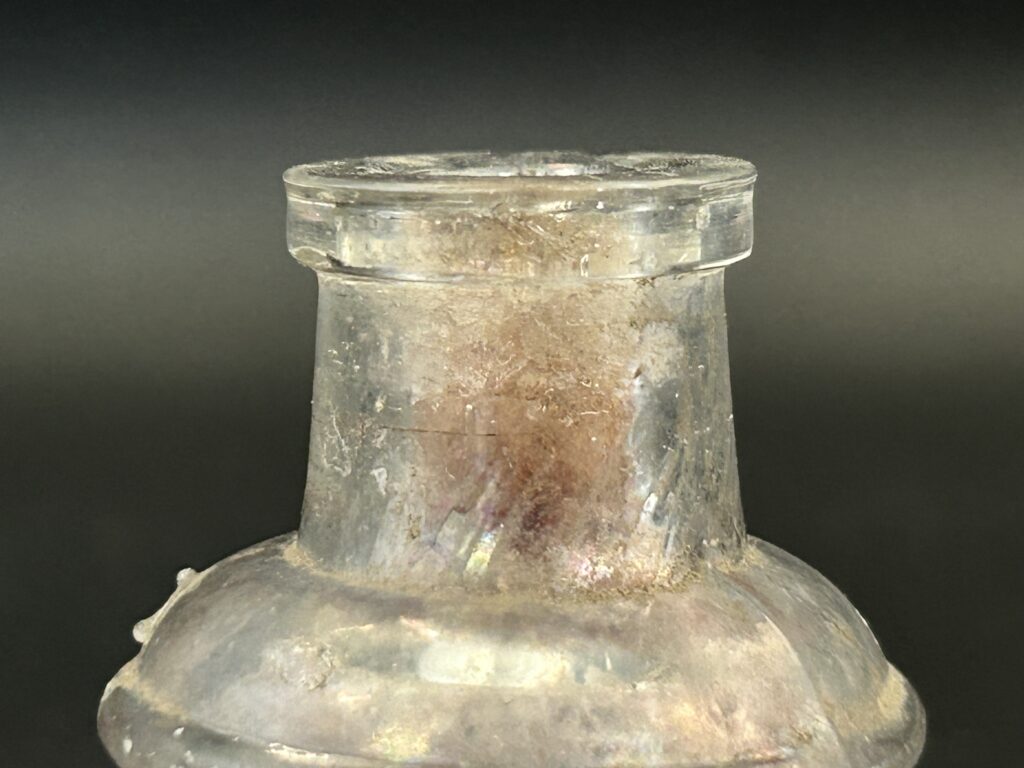
The lip of the bottle is squared off and slightly wider than the upper neck, known as a patent, extract, or flat-style finish. A comparison of the lip on our ink bottle can be made to another ink bottle in the Grinnell College reference collection, as shown in Figure 3 and Figure 4. This type of finish was most common from the mid-1800s to the end of the 19th century on extract/patent & proprietary medicine bottles. This style is used on hand-blown bottles and some of the earliest machine-produced ones. Although the patent-style finish is found on this particular ink bottle, it does not commonly appear on most.
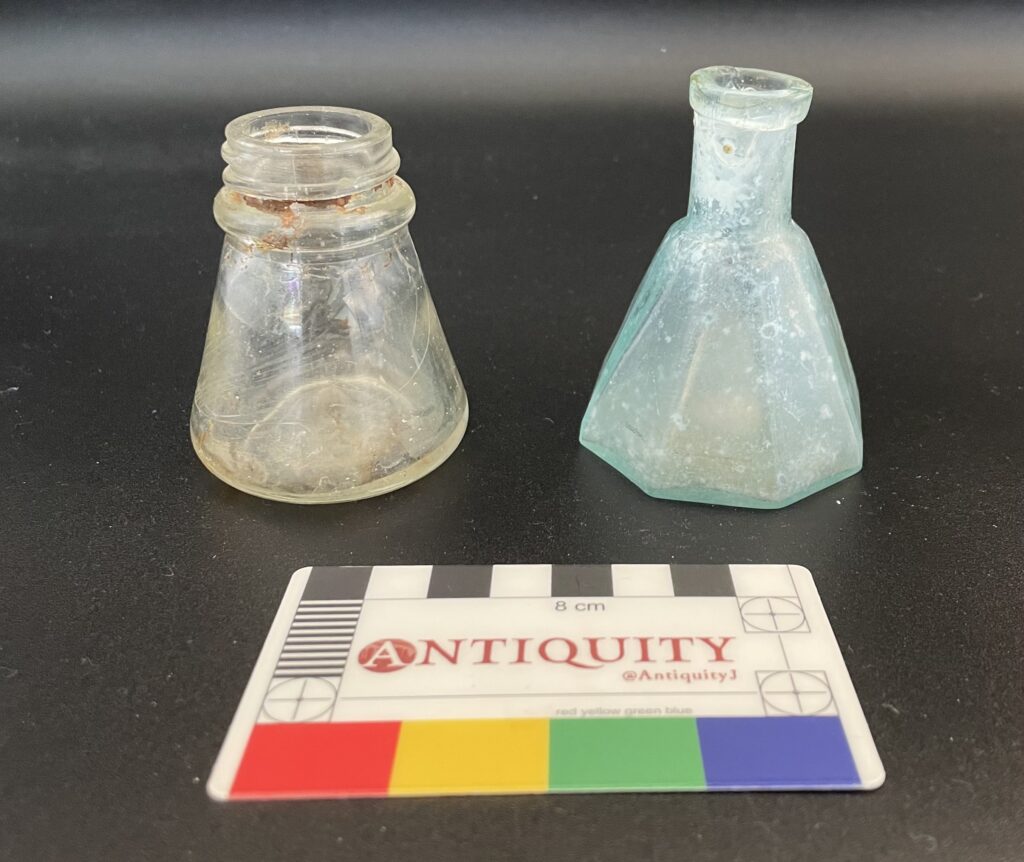
The ink bottle has a cylindrical, conical shape, meaning that it is round with a decreasing diameter from the base to the shoulder. However, a ring on the shoulder of the bottle body makes it one of the most common cylindrical ink bottle styles: ring shoulder cone inks. Also known as a ring cone or cone carmine (depending on the manufacturer), this style was used by both American and British companies, but it is believed to have originated in the US. The conical shape was used by many bottle-making companies from the mid to late 1870s until approximately the mid-1920s. Based on this, I would date the bottle to this window of time.
The ink bottle has no maker’s mark on its base, so we don’t know who manufactured the bottle. And while there are remnants of a yellow/gold and orange label with a few letters on the body, it is insufficient to identify the ink bottle brand. In the future, I hope to identify the bottle maker if I can access a more comprehensive guide that includes ink bottle companies and their labels.
The Chinese community in Rock Springs sprang up as the result of the completion of the first Transcontinental Railroad and some of the residents could have been former railroad workers. Gordon Chang notes that there are no surviving documents written by Chinese immigrants who worked on the Transcontinental Railroad, but this is not an indication of illiteracy among Chinese migrants, as there are records from the Pacific Mail Steamship Company that affirm that thousands of letters were exchanged between China and the US throughout the late 19th century (Chang 2019:8). The ink bottle found in Rock Springs Chinatown is significant because it provides further evidence of Chinese migrant literacy beyond written records.
Sources:
Chang, Gordon H. 2019. Ghosts of Gold Mountain: The Epic Story of the Chinese Who Built the Transcontinental Railroad. Mariner Books.
SHA (Society for Historical Archaeology). 2025. “Historic Bottle Website.” 2025. https://sha.org/bottle/.


Leave a Reply to George Matthes Cancel reply