

Hey everyone! It’s Avajane — it’s been a minute since I’ve posted on the Buried Chinatowns Blog. As the team has continued to catalog artifacts from last summer’s dig, we were able to identify and research an escutcheon we found above the burn layer, Stratum D, which post-dates the 1885 Chinese Massacre.
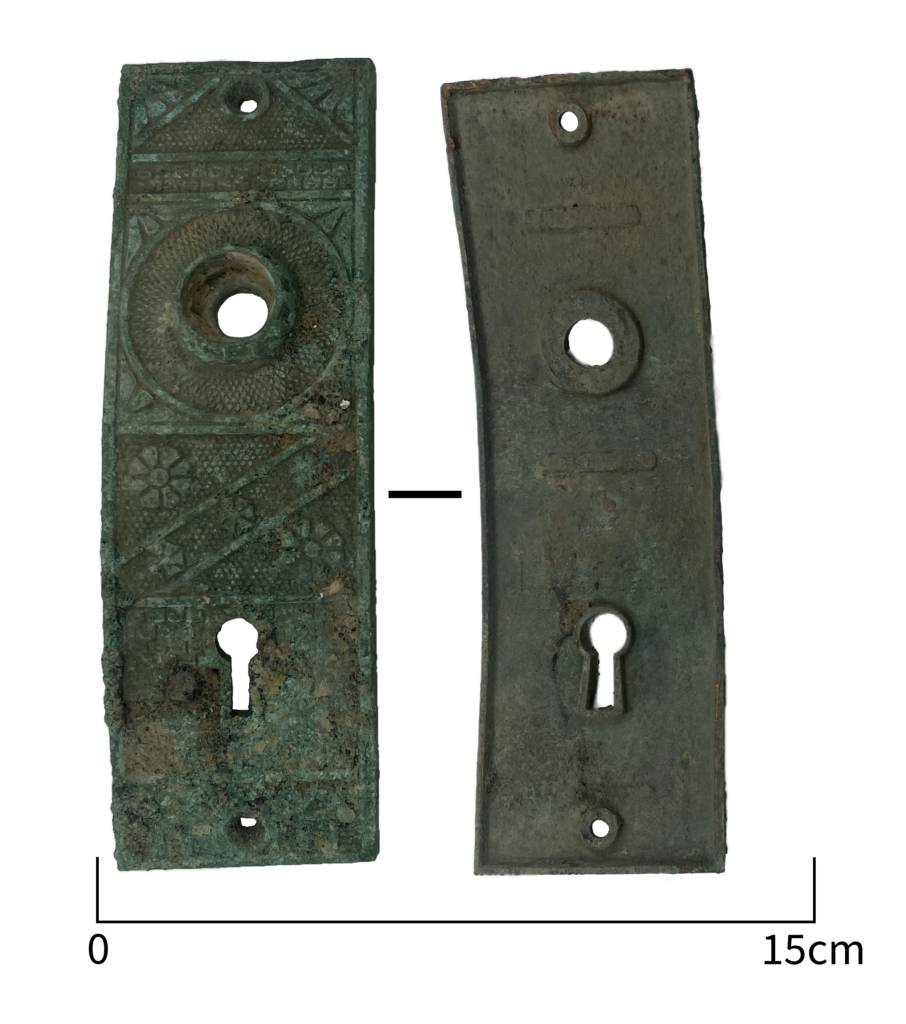
The escutcheon was manufactured by the F.C. Linde manufacturing company, which I identified based on the maker’s mark on the back and using reverse Google images. F.C. Linde was known for producing ornamental brass metal hardware, including the oxidized brass escutcheon discussed in this blog post.


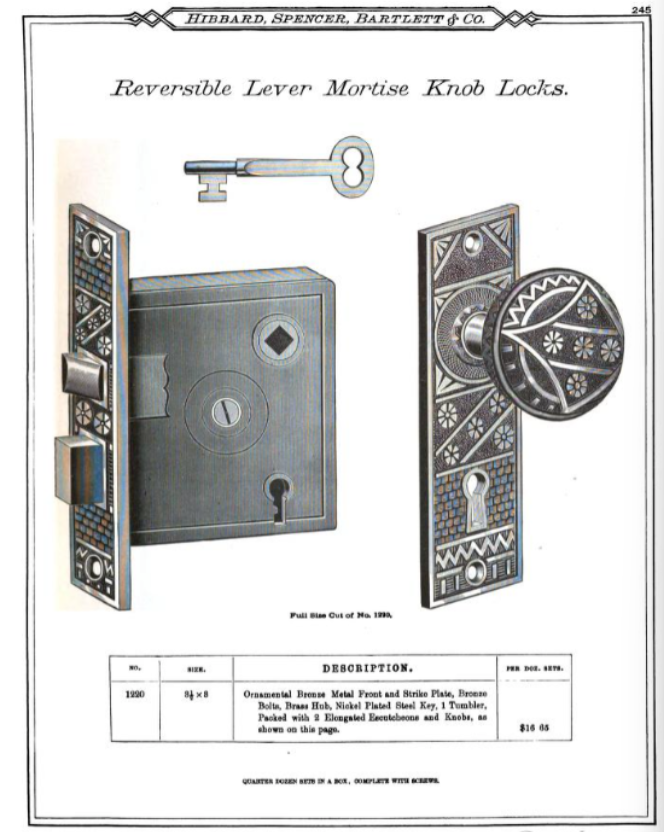
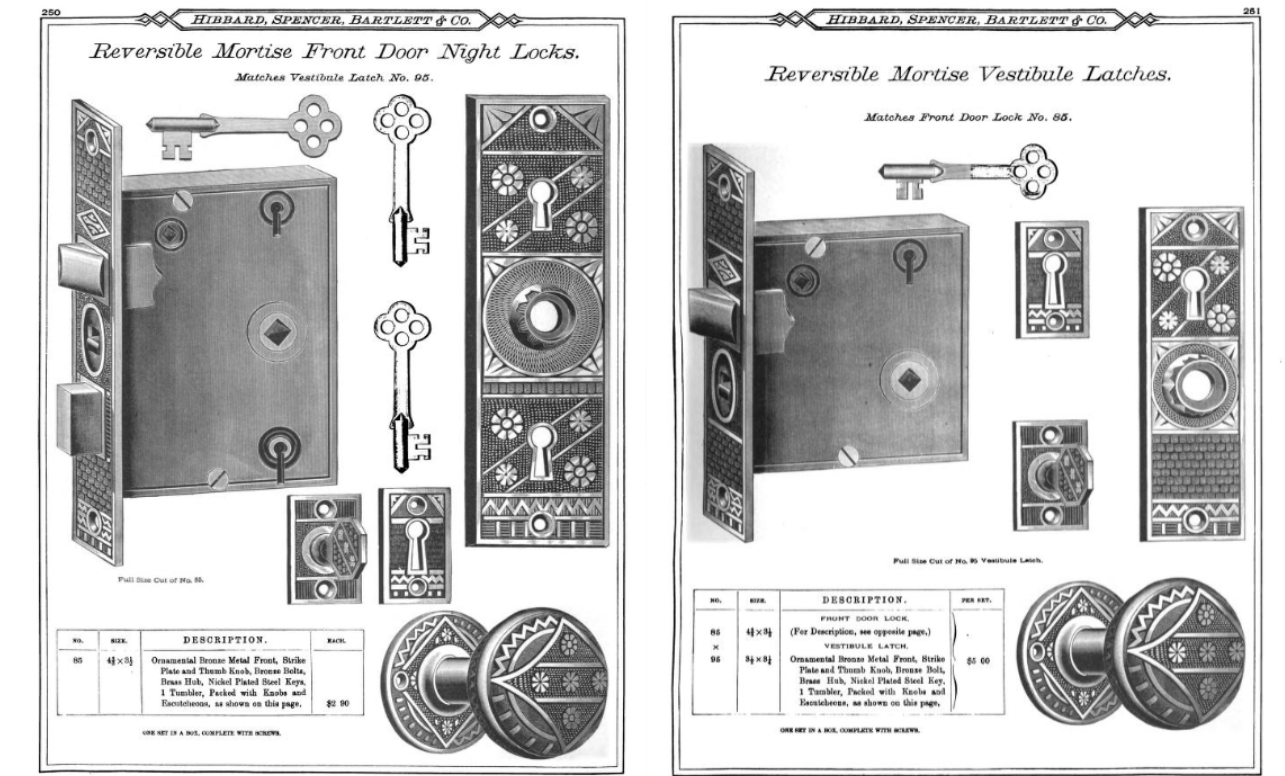
One of F.C. Linde’s distributors was the Hibbard, Spencer, Bartlett & Company, based in Chicago, IL. The decorative pattern on the escutcheon found in Rock Springs is similar to three products listed in the Hibbard, Spencer, Bartlett & Co. General Catalogue from 1891. However, it is most identical to the one included in the reversible lever mortise knob lock set (see below). For $16.65, a complete set would include two brass metal escutcheons: one with a keyhole and doorknob hole (aka the Rock Springs Chinatown escutcheon), and another to activate a lock mechanism from the inside (Hibbard et al. 1891).
According to an article in the American Machinist Magazine published in 1886, the F.C. Linde company moved from South Norwalk, CT, to Cresskill, NJ, in July of that year. It remained in Cresskill until it was bought by the Barrows manufacturing company in 1890 and relocated to Lockport, IL. Given that the maker’s mark on the escutcheon found in Rock Springs includes an inscription mentioning Cresskill, it was likely manufactured between 1886 and 1890, when the company produced this door hardware at that location.
These dates are consistent with the layer we found the escutcheon in, which post-dates the 1885 Rock Springs Chinese Massacre and pre-dates the construction of the Washington School in 1913. The escutcheon was likely used in a house built for the second Chinatown, imported via the railroad connecting Rock Springs to Chicago, where Hibbard, Spencer, Bartlett & Co. would have distributed it (Clayman 2024).
After the 1885 Rock Springs Chinese Massacre, the destroyed Chinatown was rebuilt in less than a week and occupied by the Chinese residents until it was torn down for the construction of the Washington School in 1913. This implies that Chinese immigrants who resided in Rock Springs continued to personalize and modify their homes for long-term occupation, even after the massacre.
Acknowledgments
Special thanks to members of the Facebook Group, Antique Doorknob Collectors of America discussion group (no sales), for posting metalworking magazine references to F.C. Linde & Co.’s different headquarters in the late 19th century, as well as the 1891 Hibbard, Spencer, Bartlett & Co. hardware catalog.
References
American Machinist (New York, NY). 1886. “Manufacturers.” May 1. http://archive.org/details/sim_american-machinist_1886-05-01_9_18
Clayman, Andrew. “Hibbard, Spencer, Bartlett & Co., Est. 1855.” Made-In-Chicago Museum, October 16, 2024. https://www.madeinchicagomuseum.com/single-post/hibbard-spencer-bartlett/
Hibbard, W.G., F.F. Spencer, and A.C. Barlett. 1891. Hibbard, Spencer, Bartlett & Co.: General Catalogue: 1891.http://archive.org/details/HibbardSpencerBartlett1891GeneralCatalogue.
The Iron Age (Boston, MA). 1890. “Hardware.” May 1. http://archive.org/details/sim_chiltons-iron-age_1890-05-01_45


Leave a Reply