

Hey everyone! George here, and this post will be a little less artifact-related, and more about history. Let’s begin with this: What did Chinese migrants do for a living in Evanston or the city’s Chinatown? If you answered coal miner, this assumption would only be partially correct. While coal mining was the most common profession among Evanston’s Chinese migrant men in the late 19th century, by the early 20th century, very few of Evanston Chinese residents were still coal miners. In fact, by 1900, none of them were (U.S. Census 1900). While Evanston Chinatown existed in the first two decades of the 20th century, the majority of young Chinese men would have been working in restaurants across the city (U.S. Census 1900; 1910; 1920). Aside from restaurants, Chinese residents of Evanston would have would have worked in stores selling Chinese goods (Figure 1), laundries, or agriculture.
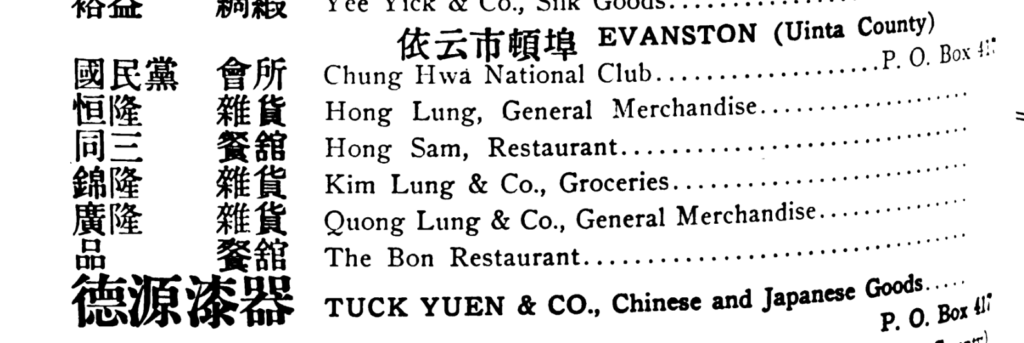
One notable Chinese resident of the Evanston who was known for his work in agriculture was a man named Lock Chong Choong. Lock was born in Gee Lung Village in the Taishan area of Guangdong Province, China, on February 2nd, 1862 (Uinta Chieftan 1939). Lock would have spent his childhood in an environment where transnational connections between the United States and Toisan (Taishan) County were already established and still growing, with at least a generation of men having traveled to and returned from the U.S. before his birth. It is still unknown who in his family had traveled to the U.S. before or whether they had been at all. In any of these scenarios, and whether or not they played a role in his emigration from China, it is reported in census data that Lock managed to find himself in the U.S. by 1881, when he was 19 years old (U.S. Census 1900). He arrived in the country at an age when most young men were coming to do some form of manual labor amongst many others in a labor-intensive industry. While this may possibly be what Lock did initially in the U.S. (this is not known), Lock would be reported as an independent farmer in Evanston by 1900 (U.S. Census 1900).
Lock also arrived in the U.S. during a consequential period in the history of U.S.-Chinese migration. Census records including Lock report him as having arrived in the U.S. in 1881, only a year before the first enactment of U.S. Chinese Exclusion policy. As anti-Chinese legislation would ramp up over the following decades, Lock would have had to acquire his own registration card under the Geary Act (1892) and undergo intensive review by immigration inspectors any time he wanted to leave and return to the U.S. (Lee 2007; Lew-Williams 2018). Over the course of Lock’s life, there is only one known instance in which he returned to China, which occurred in 1909 (Casper Star Tribune 1989). There is no documentary evidence of him having ever left the country at any other time. While it is impossible to judge whether draconian immigration policy affected the frequency with which Lock would move to and from the U.S., it should be noted that he would have had to experience the enforcement of those policies throughout almost his entire life in the country.

By the time Lock left the U.S. for the first –and last– time, he was 46 years old, owned land in Evanston, and was successful enough as a vegetable farmer to employ others to work with him (Figure 2) (Chinese Exclusion Act File) Given the extensive documentation required of Chinese individuals’ properties and activities to allow their movement in and out of the U.S. at the time, there is a wealth of available surviving information on Lock during the span of his travel between the U.S. and China from 1908-1910. He would leave and return to the U.S. from the port of Seattle, likely arriving in China in early 1909. While in China, Lock married a woman named Woo Chee (sic Shee), possibly also having his son Joe Lock with her. Joe is mentioned explicitly in sources very late in Lock’s life, while there is also a description of an unnamed stepson of Lock’s coming to the U.S. in 1919. It is unknown whether Joe is Lock’s biological son or his stepson; however, if he were to have been born while Lock was visiting China, he would almost certainly be a different individual from the stepson described as arriving in 1919. It is at least known that this Joe Lock –son or stepson– would be in Evanston, assisting Lock in his old age in the 1930s, as described in his obituary.

Going in line with the reviews mandated in the Chinese Exclusion Act, immigration officials interviewed Lock’s employee at the time, Charley Chin, while he was still abroad. In this interview, Chin was questioned regarding the assets that Lock possessed, in which he stated the amount of land and livestock that he possessed at the time, the former of which being information that Lock would also personally divulge in a different immigration interview. According to these immigration interviews, Lock owned about 2.36 acres of land valued at $1,000, along with 1 horse, 3 pigs, and 7 chickens in 1909. However, Chin stated that Lock used to own far more pigs and chickens, that their numbers were now low as many pigs had died, and that all of their chickens had been previously stolen at some undisclosed point. The culprit and motivation behind the chicken theft are unknown. Lock also possessed his own horse carriage for personal transport. The assets described in these interviews convey a certain level of prosperity that Lock had been able to achieve by his mid-forties, having worked and owned this property since his purchase of it in 1904.
According to the 1900 census, Lock already owned his own house in some location and supported himself prior to his purchase of the 1904 property. In his 1908 return application interview, Lock is asked the same questions regarding his assets and gives much larger amounts for his answers, with 2 horses, 18 pigs, and 140 chickens. With this in mind, these interviews suggest that the aforementioned pig deaths and chicken theft occurred while Lock was outside of the country. In his interview, Lock is also asked if he has any debts; he answers, “white men owe me.”

Aside from owning livestock, Lock’s use of his land was primarily agricultural. The vast majority of local newspaper articles discussing Lock reference his selling of vegetables to all kinds of townspeople. His obituary also states that he had worked in restaurants prior to 1909 and ran his own curio shop after that time (Uinta Chieftan 1939). The nature of the work Lock was doing in restaurants is unclear; it is possible that he was selling vegetables to them for their dishes or fully involved in working the restaurant service, but there is no clear indicator in either direction.
This summer, while doing fieldwork with Dr. Ng on excavating the Evanston Chinatown, I used some of my time off of excavation to compare historical maps in an attempt to find Lock’s original property. Through comparing section/township maps and an original property map of Lock’s land from 1911, I was able to find the exact location of the property today, which is located just west of the Bear River and north of China Mary Road, close to Avenue A and ending where the river bends east after running under Holland Drive. Once I had found the boundaries of the property, I created a map in ArcGIS to show his property boundaries today, superimposed over current satellite imagery (Figure 4).
References
Casper Star Tribune Evanston Chinatown had one of only three Joss house in United States. Casper Star Tribune, Casper, WY, May 21st, 1989.
Lee, Erika. At America’s gates: Chinese immigration during the Exclusion Era, 1882-1943. Chapel Hill, NC: Univ. of North Carolina Press, 2007.
Lew-Williams, Beth. The Chinese must go: Violence, exclusion, and the making of the alien in America. Cambridge, MA: Harvard University Press, 2018.
Lock Chong Choong. 1908-1910. File RS2653; Chinese Exclusion Act Case Files, 1892-1944; Seattle Office; Records of the U.S. Immigration and Naturalization Service, Record Group 85; National Archives and Records Administration-Pacific Region, Seattle, WA.
Newbrough, William Map of Choong Ditch. State of Wyoming, County of Uinta. 1911.
Uinta Chieftan “Mormon Charlie” Dies in Evanston, Wyoming. Uinta Chieftan, 11(3):1. Evanston, WY. October 20th, 1939.
U.S. Bureau of the Census Town of Evanston, Uinta County, Wyoming. U.S. Bureau of the Census, Washington, DC. 1900. Ancestry <https://www.ancestry.com>.
U.S. Bureau of the Census Town of Evanston, Uinta County, Wyoming. U.S. Bureau of the Census, Washington, DC. 1910. Ancestry <https://www.ancestry.com>.
U.S. Bureau of the Census Town of Evanston, Uinta County, Wyoming. U.S. Bureau of the Census, Washington, DC. 1920. Ancestry <https://www.ancestry.com>.
Wong, Kin. 1913. International Chinese Business Directory of the World. San Francisco, CA: International Chinese Business Directory. http://babel.hathitrust.org/cgi/pt?id=uc1.$b440600;view=1up;seq=1.

Leave a Reply