

Hey all,
Welcome back to the Buried Chinatowns Blog! George and I have been hard at work cataloging thousands of Evanston Chinatown artifacts, but I’ve decided to take a break today to discuss one of our more interesting sets of objects: ammunition!
Evanston may not have been the rough-and-tumble, gunslinging town that stories of the Old West may lead one to believe, but they were certainly familiar with firearms! Across the years of excavations, we have catalogued over twenty different gun-related artifacts. Most commonly, we have found fired shell casings and bullets, but we have also recorded a surprising number of intact, unfired cartridges! In this post, we will take a look at these artifacts and see what they can tell us about the types of firearms used by Evanston Chinatown residents.
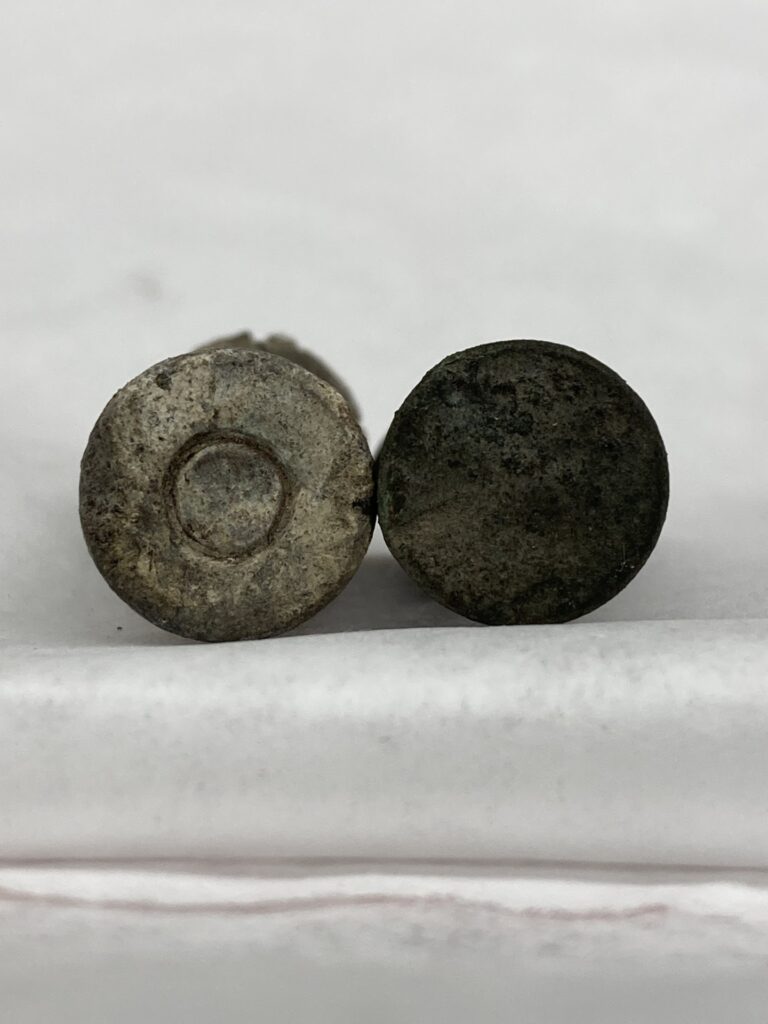
Among all types of ammunition recovered from Evanston Chinatown, rimfire cartridges were the most common by a large margin. Rimfire ammunition, as the name suggests, requires the rim of the case to be struck in order to ignite the propellant inside. This type was invented before centerfire ammunition and was eventually out-competed by the superior performance of a central primer. However, for several decades in the late 19th and early 20th centuries, the two types co-existed. In fact, rimfires are still commonly seen on the market today, albeit almost exclusively in .22 caliber.
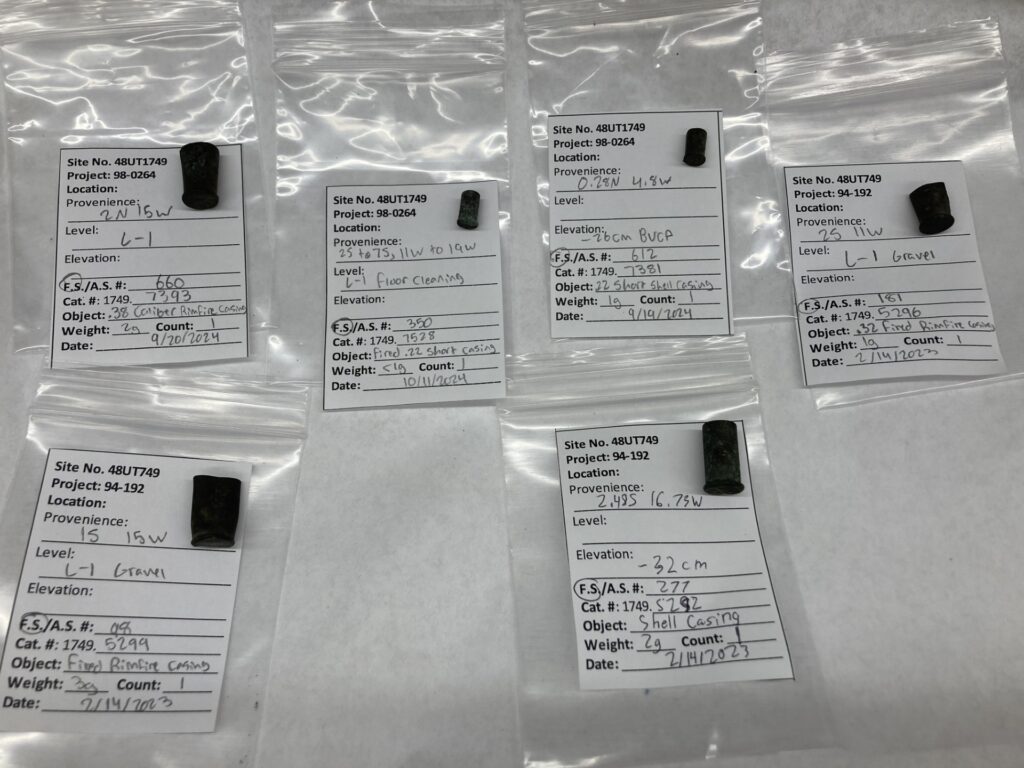
While a few .22 short casings have been recovered, most rimfire ammunition was found in .38 and .32 caliber. Revolvers chambered in these calibers were likely more common in this era, but rifles also used the same ammunition, making identification of the weapons used by Evanston Chinatown residents difficult. It is worth noting, however, that the abundance of rimfire ammunition may indicate that much of it was manufactured and used in the late 19th century, before center-fire cartridges became the more popular choice.
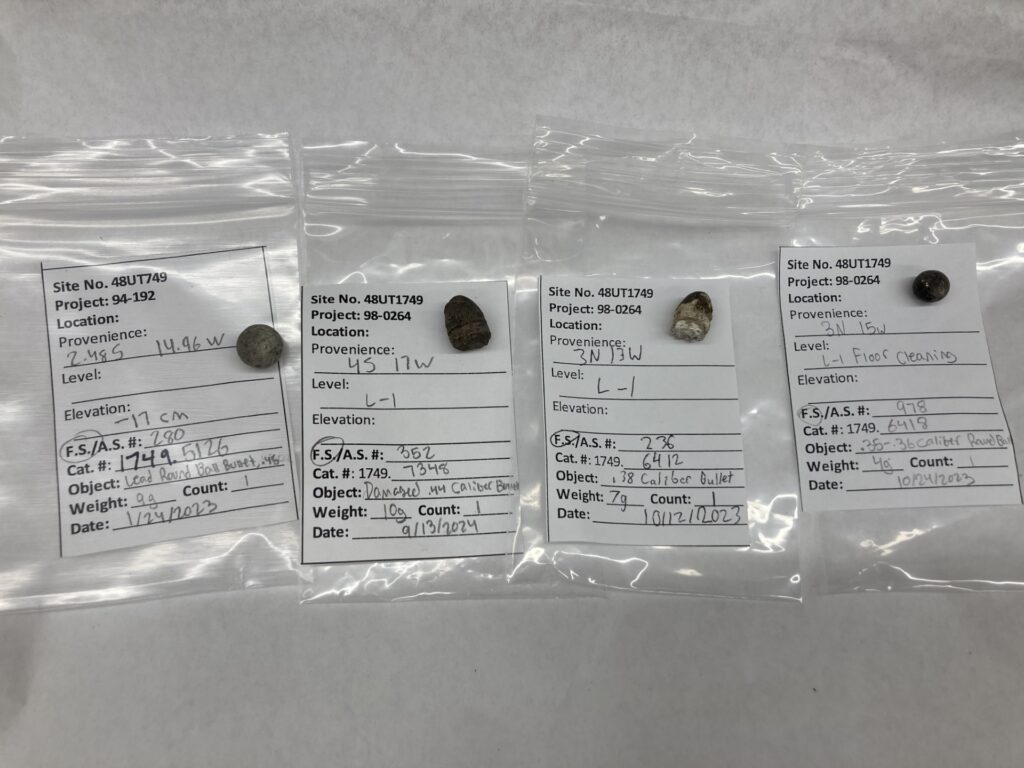
While fairly limited in number, we have documented a handful of fired or dropped bullets, not all of which are represented in the photo above. Limited by sample size, the equal number of muzzle-loaded and cartridge-based bullets is unusual. Prior to the invention and adoption of cartridge ammunition, firearms had to be hand-loaded with loose powder and a typically round projectile. When this system was greatly simplified by cartridge ammunition in the mid-19th century, the use of muzzle-loaded firearms dropped significantly. However, in the mid-20th century, hobbyists began using this style of ammunition again, and it has remained a popular alternative to modern firearm technology ever since. The two “round balls” recovered are of .45-.46 caliber and .35-.36 caliber. While the .35-.36 caliber ball may be modern, given the lack of oxidization of the lead and very general provenience, the .45-.46 was found in-situ and is likely from the 19th century.
Dating these projectiles is already difficult, and determining the intended firearm is even harder. Muzzle-loaded ammunition, in these calibers, were used in both pistols and rifles. As mentioned above, the historical accessibility of pistols may make it more likely that all four bullets were fired or intended to be fired from handguns, but it is nearly impossible to say definitively.
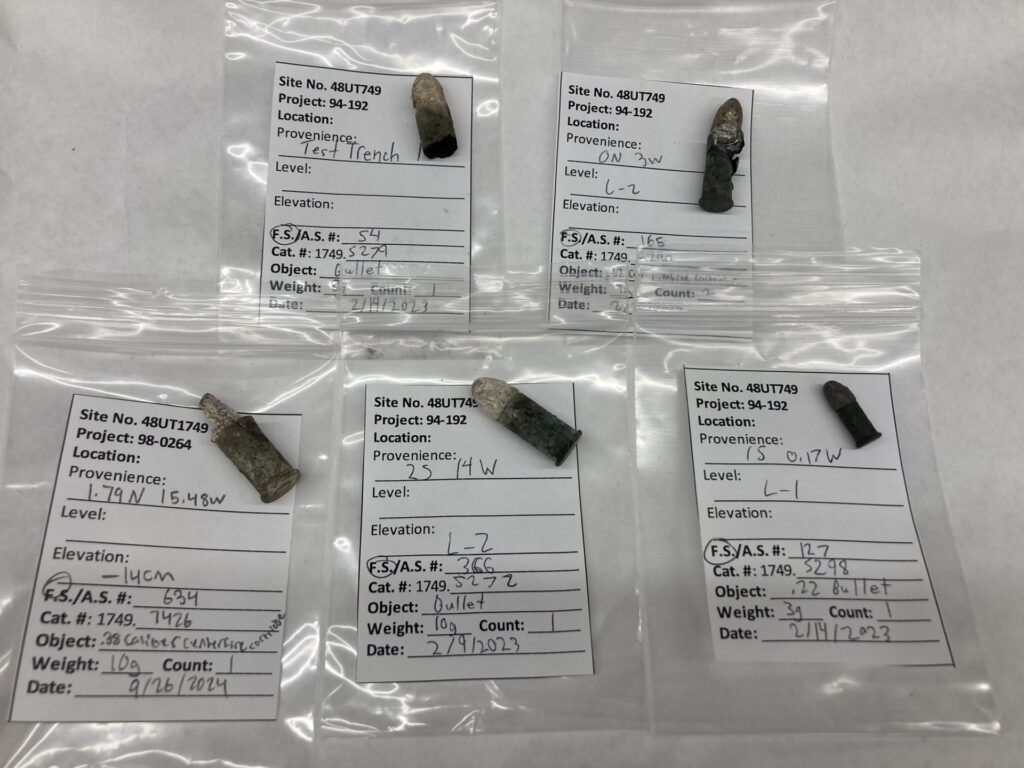
The number of unfired cartridges was also an unexpected feature of the assemblage. While we originally suspected that some may have been “duds” that were discarded after failing to fire, inspection of the bases revealed no indentations that would have been left by a firing pin. While it would not be surprising to find a cartridge or two that were accidentally dropped and lost, the presence of five is certainly unusual. There is no clear explanation of why so much seemingly usable ammunition would have been discarded or lost by Evanston residents, but perhaps invisible environmental damage or chance is to blame.
Finally, one unusual characteristic of our sampling of Evanston Chinatown ammunition is the lack of shotshell heads – the brass component of a shotgun shell case. In fact, of our 2,500+ catalog codes, we have found none. Based on anecdotal evidence between George, Professor Ng, and I, we would expect an abundance of this ammunition type in a site of Evanston Chinatown’s age. However, just because we haven’t found any doesn’t mean they weren’t recovered or used by Chinatown residents. The shotgun headstamps, by pure chance, may have already been catalogued and stored away prior to our involvement in the project. Additionally, we still have several thousand artifacts to catalog, meaning we might not have gotten to them yet. Given the utility of shotguns for hunting and self-defense, in addition to their ubiquitous presence across turn of the twentieth century, North American sites, we expect to find many as this project continues. We are confident that historical Evanston residents’ affinity for firearms will continue to show in the archaeological record!


Leave a Reply