

Hi all, it’s Evan again. Recently we found an unusual curved blue glass shard in our Evanston Chinatown collection that took some crowdsourcing and additional research to finally identify as a railroad semaphore lens! Mixed in with shards belonging to a variety of different bottle types, it was immediately apparent that this was no ordinary piece of glass. The most striking feature of this shard is its color – a dark teal. Additionally, the thickness and shape of the glass is highly unusual for a bottle. On closer examination, some very light embossing is also visible on the underside of the shard, although unreadable.
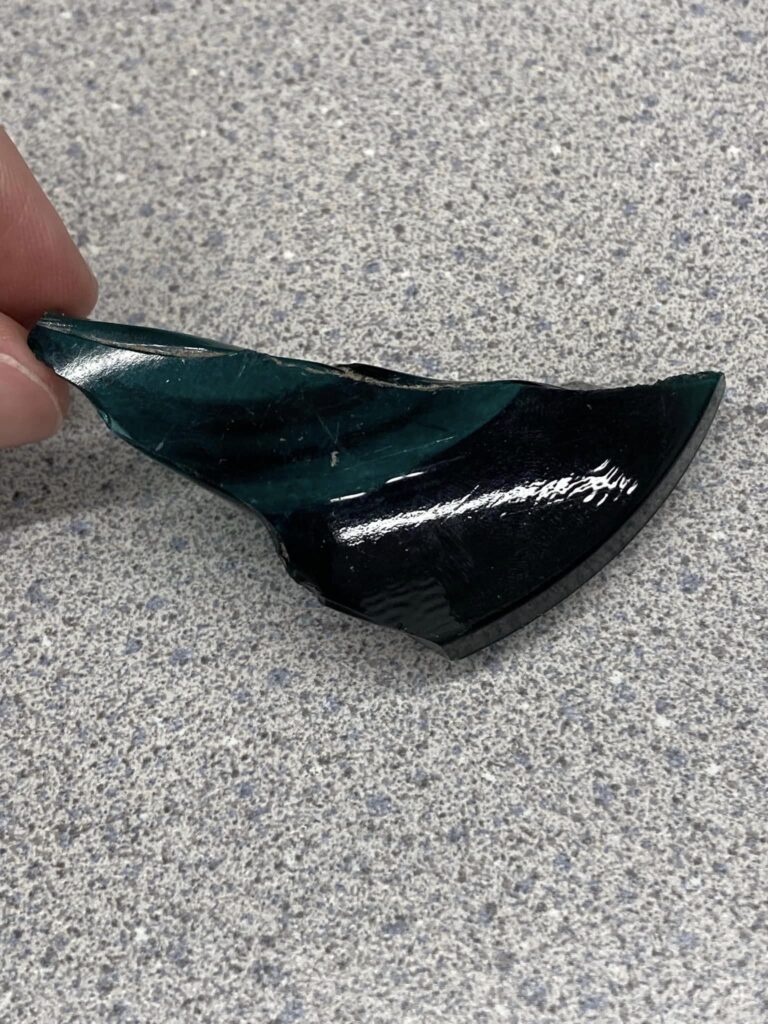
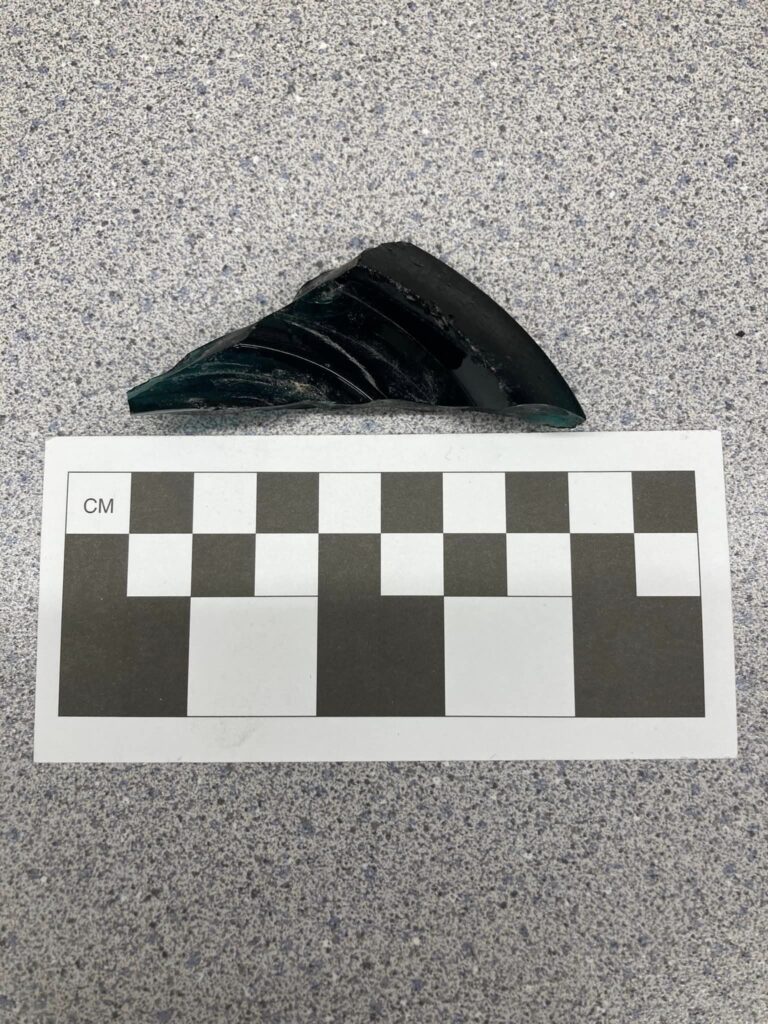
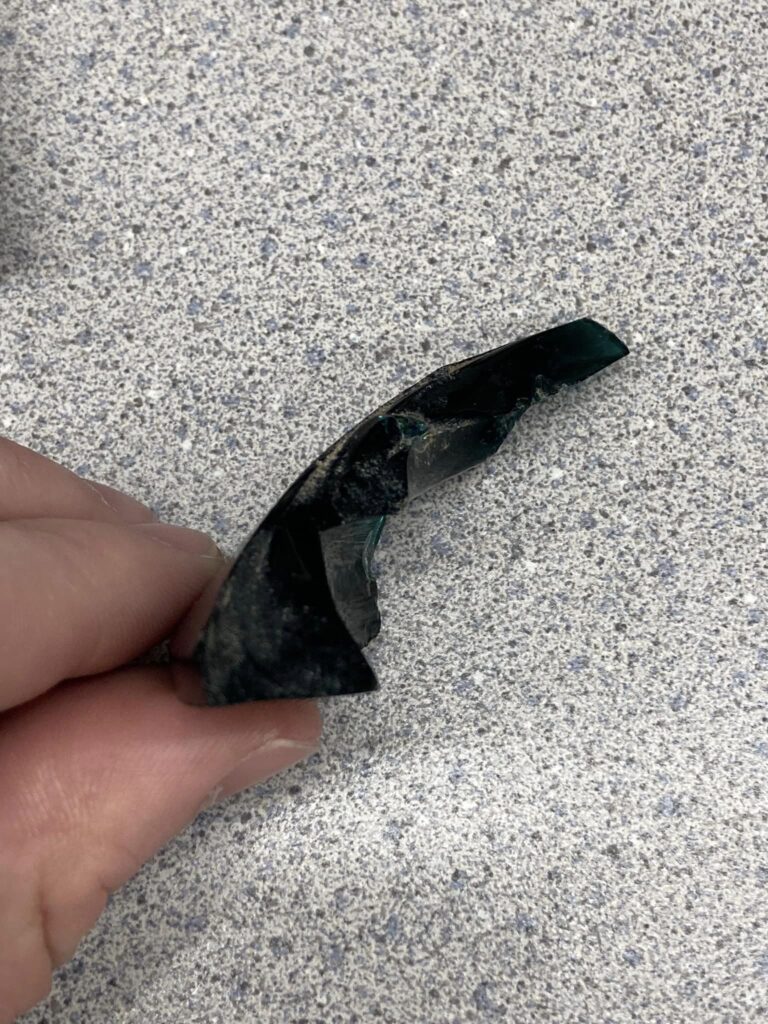
Our first guess was that it was from a glass insulator which were widespread starting in the 1850s and were often made of thick, colorful glass. Assuming that this was the correct identification, I posted photos of our glass fragment to a glass insulator Facebook group, asking if anyone could identify the exact CD number. Soon after posting, I began to receive multiple replies suggesting that this shard did not belong to an insulator, but rather a railroad lantern lens. Because these lanterns used different colors to indicate different track conditions to passing trains, each lantern would had several different colored lenses. Using this information and the faint embossing as clues, I did some additional research and eventually found a match for this shard on the auction archive website WorthPoint: https://www.worthpoint.com/worthopedia/vintage-semaphore-pat-1877-railroad-491252574.
According to the examples on WorthPoint, the full embossing of our shard would have read: “SEMAPHORE PAT. US FEB 20 CAN MAR 29 APL 13 ENG DEC 24 1877”. While these are often referred to as railroad lantern signals, it is likely that most of such semaphore lenses were used in later, electric semaphore signals that quickly eliminated the need for kerosene signal lamps in the railroad industry upon their introduction in the early 20th century. Whether this lens was used in a lantern or electric signal, it is undoubtedly an artifact that represents the intimate connection Evanston and its inhabitants had with the railroad industry.
Leave a Reply