

Hey everyone! This is Emily, a new member of the 2026 summer team for the Wyoming Rock Springs Chinatown Archaeology Project. Today I wanted to share an artifact that our team discovered while working through the 1991 excavation catalog: a fully intact ironstone China bowl.
While exploring past project research, I came across a blog post written by former team member Julia Ghorai about a reconstructed ironstone plate recovered from the site. Her post discussed the history of ironstone China and provided a great starting point for my own research.
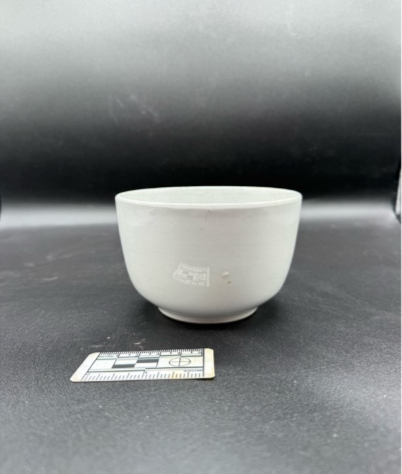
The original ironstone China was developed in England during the early nineteenth century as a durable and affordable alternative to porcelain. The bowl from the 1991 excavation, however, is not English-made. Instead, it is an American-produced version of European ironstone manufactured in East Liverpool, Ohio, by Dresden Pottery Works. This is known because of the Encyclopedia of Marks by Kowalsky and Kowalsky, which shows the exact mark that is on the bottom of the bowl, and we can identify the company that produced this bowl because of this mark. It also states that the company changed ownership several times throughout its history and ran under names including Brunt, Bloor, Martin & Co. from 1875-1882, to the Potters Co-Operative Company from 1882-1925, and then to the Dresden pottery works from 1925-1927. The maker’s mark stamped on the base of the bowl helped find its manufacturer and allowed us to date it to approximately 1891.
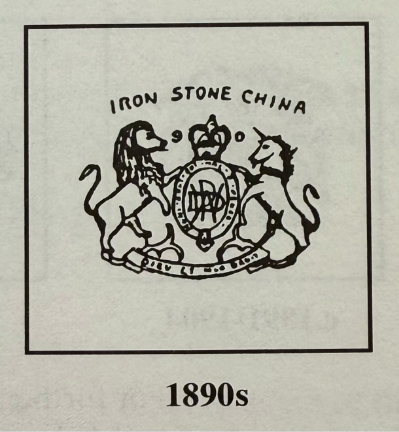
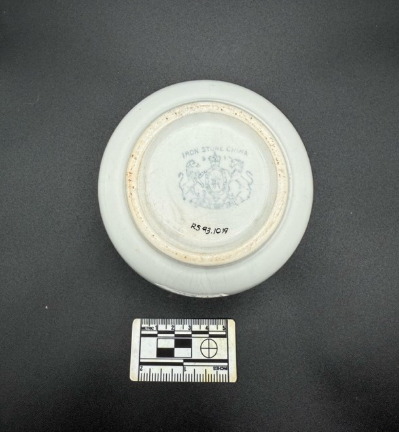
The history behind the company is just as interesting as the bowl itself. In 1875, English immigrant William Brunt bought the struggling Dresden Pottery Works and transformed it into a successful manufacturer of white granite and ironstone wares. By 1876, the company produced tableware, tea sets, hotelware, toys, and decorative ceramics. That same year, Dresden competed alongside other East Liverpool potteries at the Centennial Exposition in Philadelphia and received the “Highest Award and Diploma of Merit for white granite ware.”
One of the reasons ironstones became so popular was its durability. Unlike more delicate porcelain, ironstone was made with thick walls that allowed it to withstand everyday use. Because it was sturdy, inexpensive, and mass-produced, ironstone became especially common among middle-class households during the late nineteenth century.
The shape of our bowl also provides clues about its age and function. Ceramic historians have noted that ironstone styles have changed over time. From the Rare Bird Antiques website, it breaks down the times and styles of Ironstone China. Earlier examples from the 1830s and 1840s featured paneled or octagonal forms, while later decades saw increasingly decorative floral and harvest-themed patterns. By the 1880s and 1890s, however, styles shifted back toward simpler forms. The plain design and round shape of this bowl fit well within this later trend, supporting the date suggested by the maker’s mark.
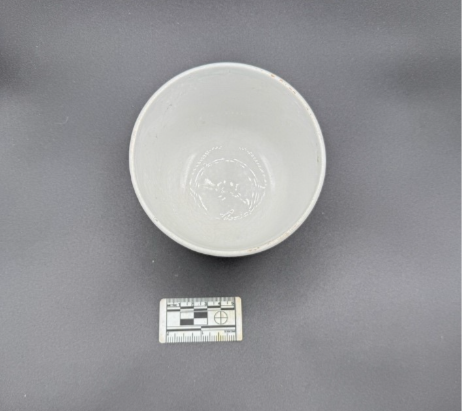
So, what was this bowl used for? The answer is that it may have served several purposes. Bowls of this shape were commonly used for serving fruit or nuts at the table. Another possibility is that it functioned as a slop bowl. During tea service, slop bowls were used to discard tea leaves or the remnants of an earlier cup of tea before pouring a fresh serving. The deep walls and straight-sided shape of our bowl closely resemble examples of slop bowls found in museum collections and antique catalogs. Similar pieces were also sold as part of larger China and dining sets through mail-order retailers such as Sears, whose 1892 catalog featured a wide selection of household ceramics and tableware.
What makes this artifact particularly significant is what it reveals about life in Rock Springs, Chinatown. This bowl was a very American-made object, manufactured hundreds of miles away in Ohio and distributed through national markets. Its presence at the site suggests that Chinese American residents were buying affordable local and regional tableware while also keeping cultural traditions using imported Chinese ceramics. Rather than choosing between Chinese and American material culture, many residents incorporated both into their daily lives. This small, undecorated bowl may not seem noteworthy, but it provides a glimpse into everyday household activities such as serving food and sharing meals.
References
Hanks, Lori. 2020. “History of Ironstone China.” Rare Bird Antiques. February 5, 2020. https://rarebirdantiques.com/ironstone-history/.
Kowalsky, Arnold A, and Dorothy E Kowalsky. 1999. Encyclopedia of Marks on American, English, and European Earthenware, Ironstone, and Stoneware (1780-1980). Atglen, Pa: Schiffer Publishing.
Museum of Ceramics. n.d. “William Bloor.” https://www.themuseumofceramics.com/famousfaces/william-bloor.
Reid, Jubilee P. 2024. “Ironstone: Dishware for the Ages.” Living Heritage Museum. January 11, 2024. https://www.livingheritagemuseum.org/2023/09/16/10711/ironstone-dishware-for-the-ages.
1897 Sears Roebuck & Co. Catalog., 1897
Snyder, Jeffrey B. 2001. “White Ironstone Ceramics.” Antiques & Collecting Magazine 106, no. 5 (July 1): 20.
Witt, Joan. n.d. “The Dresden Avenue Potteries.” East Liverpool Historical Society. http://www.eastliverpoolhistoricalsociety.org/dresavepots.htm.


Leave a Reply