

Hello, I am Alice, one of the new summer research assistants, and I will be discussing Chinese and Japanese porcelains found in the 1991 Rock Springs Chinatown excavation. When examining our current assemblage of Chinese porcelains, specifically from Stratum C, three artifacts in particular stood out: a part of a planter, a Chinese teapot spout, and the rim of a Japanese teapot. The artifacts all had blue-on-white glazes that distinguished them from the common Wintergreen, Bamboo, and Four Seasons sherds also found in Rock Springs Chinatown.
Planter
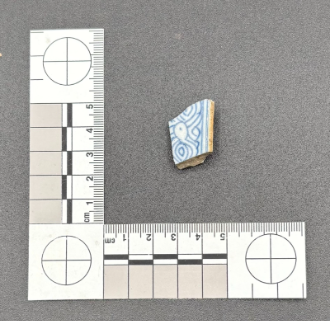
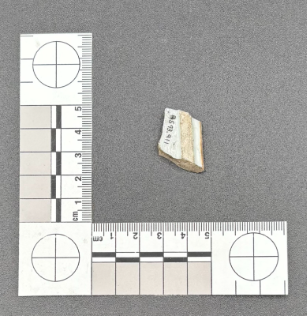
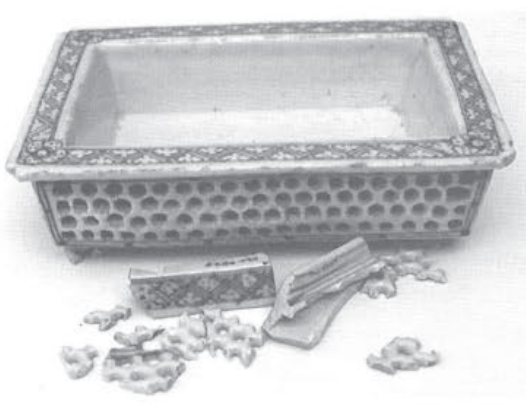
Initially, I compared two sherds with a Sweet Pea design to seal and paste boxes and ink pen/brush holder from the Southern Oregon Digital Archives Chinese Material Culture Collection, but realized they matched neither because the Rock Springs Chinatown sherd edge is straight and does not drop down. It is, however, visually similar to the rim sherds of a bulb planter from Down by the Station (1996), a book on the archaeology of Los Angeles Chinatown. The planters usually held narcissus bulbs and not only served as tasteful household decorations that breathed life into the simple wooden houses the Chinese lived in—they also had cultural significance. If the bulbs “flowered before the Chinese New Year, it was an omen that the family would prosper in the coming year” (Greenwood 1996:122).
Cylindrical Teapot Spout
Given that the surface of the teapot connecting to the spout is straight, it can be assumed that the structure of the teapot is similar to that of other straight-sided/cylindrical teapots with wire or wooden handles.
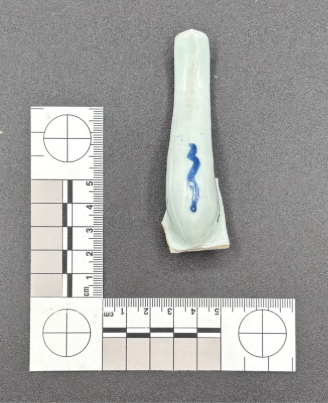
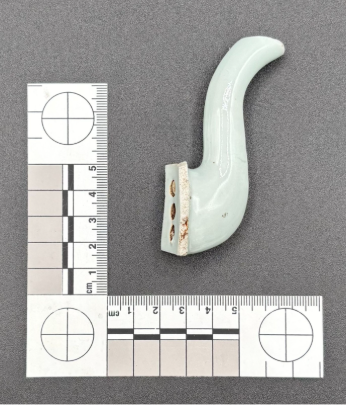
According to Dr. Renae Campbell, an Assistant Professor of Asian American Historical Archaeology at the University of Idaho, the fragments are a close match to hand-painted blue-on-white porcelain teapots found in the Asian American Comparative Collection (AACC). Although the “squiggle” design on the spout fragment is not the same, the shape, size, and design placement are similar to that of teapot AACC-2020-097 and one on exhibit at the Sweetwater County Historical Museum in Wyoming. While the teapot sherd from the 1991 dig has a blue design, it does not have any blue glaze on the tip of the spout.
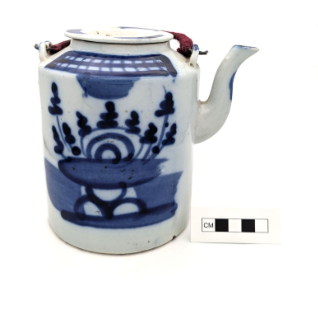
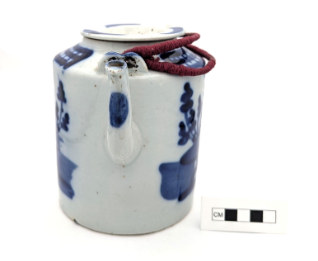
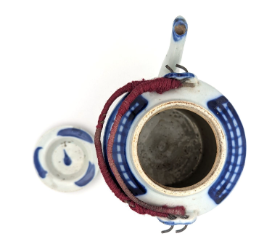
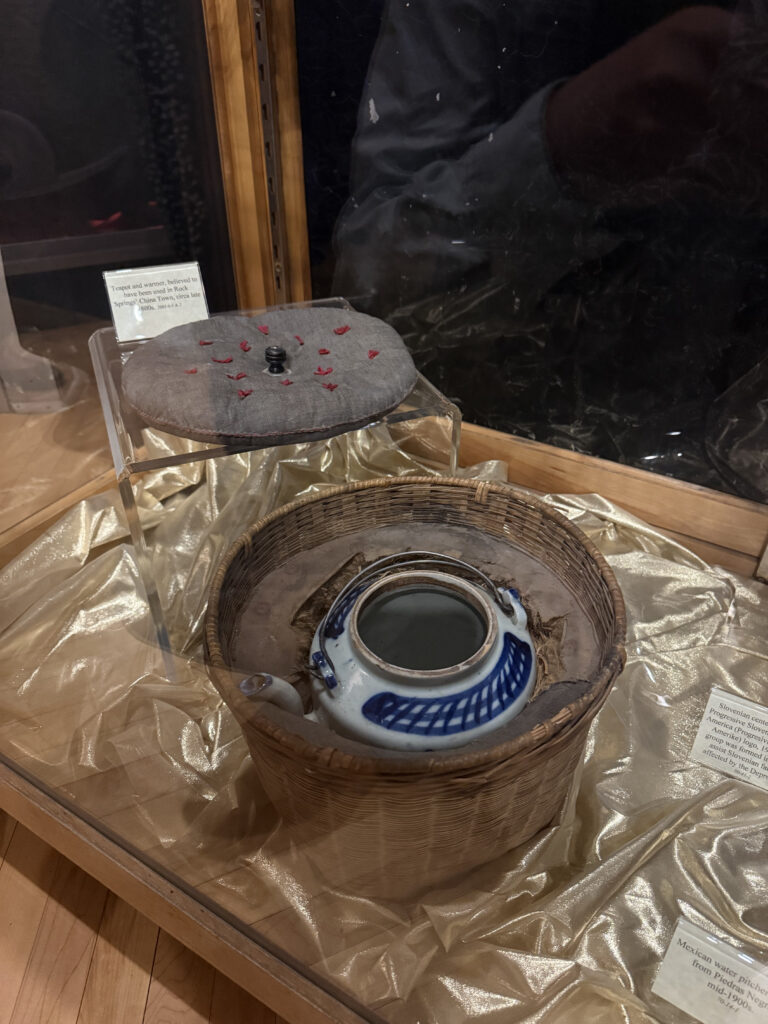
A similar cynlindrical Chinese teapot with a wire loop for a handle is displayed at the Sweetwater County Historical Museum in Wyoming. The exhibit label reads:
“Teapot and warmer, believed to have been used in Rock Springs’ China Town, circa late 1800s.” (Catalog #s 2003-6-1 & 2)
Photo by Laura Ng
Japanese Teapot
A third interesting blue-on-white vessel is comprised of two porcelain fragments, which were originally cataloged as “porcelain base fragments.” Upon closer inspection, the porcelain fragments looked more like the rim of a teapot because there was a thinner surface inside that seemed like it would support a teapot lid. It was glazed everywhere except the interior of the recessed rim where the teapot lid would sit. Originally, I was under the impression that it would be another Sweet Pea pattern, but something that separated it from other Sweet Pea porcelain pieces was the blue circle details near the rim. In addition, there was one part of the sherd (photo below) that was not glazed with the blue-on-white decoration. After consulting with Dr. Campbell on these sherds, I learned that this was actually part of the rim of a Japanese teapot. Specifically, it is a Aizu-Hongo export ware teapot (Bibb 2022).
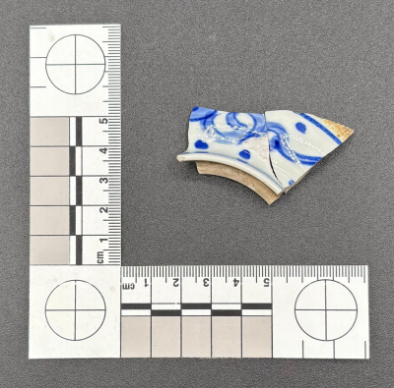
Our teapot is a combination of two Japanese styles: Sometsuke (hand-painted blue and white) on the top, and Samegawa (brown sharkskin glaze) towards the bottom beneath the most inferior blue line (Bibb 2022). The sharkskin part of the teapot has a stylized peony design.
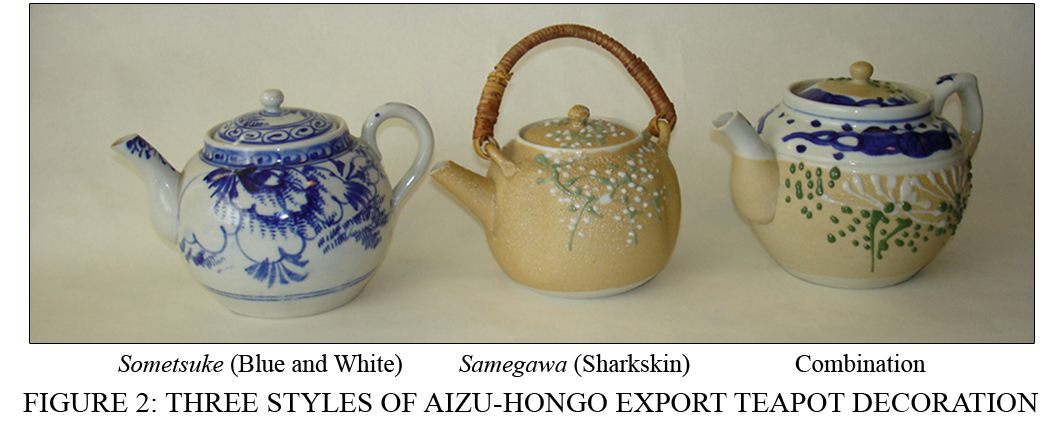
Three Aizu-Hongo teapot styles (Bibb 2022). Image used with permission by Leland Bibb.
The target customers were likely non-Asians as the teapots could have a “ceramic rod, or ‘pistol grip’ handle on the side at right angles to the spout (positioned for use by a right-handed person)” or a “Western style teapot with the ceramic loop handle opposite the spout,” serving as the perfect “gateway into Japan for Western culture” (Bibb 2022). To explain the bulbous shape as opposed to the Chinese cylindrical teapot mentioned before, “Japanese teapots made for export have a Western-style spout that is slightly more bulbous at the base” (Campbell personal communication). Further supporting the idea that these teapots were made for Westerners is the fact that during the 26-year-long production of Aizu-Hongo ware peony teapots (1886-1911), several million were sold in the United States (Bibb 2022).
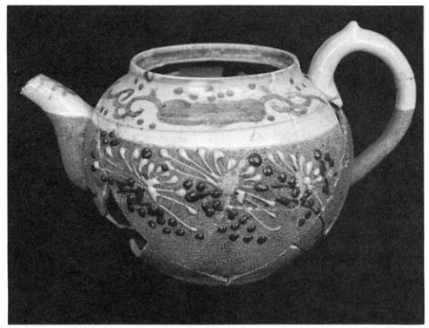
Dr. Campbell also informed me that Aizu-Hongo ware are sometimes found in “assemblages from Chinese American, Japanese American, and European American sites,” which makes sense as as they were “manufactured as exports.” These are sometimes misidentified as well. For example, Leland Bibb mentions a Aizu-Hongo teapot in a book on the Tucson Chinese archaeological assemblage that was labeled “Chinese” but has the the Aizu-Hongo combination teapot (Lister and Lister 1989:55). According to Bibb, the combination Aizu-Hongo wares also included cream pitchers and tea caddies. The combination wares likely began production in 1909 or 1910 and stopped in 1916 when most of the ceramic workshops in Hongo town burned down in a fire (Bibb 2022).
Professor Ng suggested I look at historic newspaper ads for stores that might have sold Japanese goods in Southwestern Wyoming. Based on my research, the Tuck Yuen Co. Store in Evanston Chinatown and dealer Chung Kee in Evanston, WY, sold various goods including Japanese goods and Chinaware. Given the language used like “Oriental Curiosities,” it is safe to assume the target customers were not just Chinese individuals.
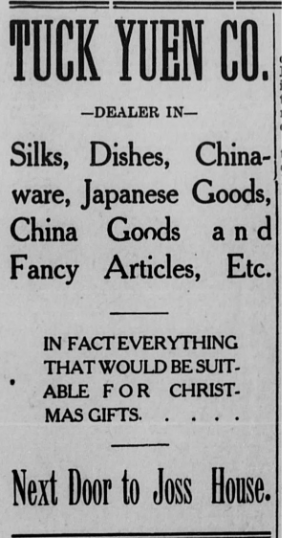

Interestingly, the Lun Sing Chong, a long-standing store in the Rock Springs Chinatown, did not seem to advertise their wares to Euroamericans at all. I tried to look for instances of advertisements of goods by the Lun Sing Chong store on the Wyoming Digital Newspaper Collection and did not find any.
As Leland Bibb points out, however, Aizu-Hongo wares were also sold to Euroamericans through mail-order catalogs such as the Butler Brothers. The Japanese teapot in Rock Springs Chinatown, therefore, could have been purchased in a variety of ways.
Bibliography
Bibb, Leland. 2022. “Aizu-Hongo Ware.” Asian American Comparative Collection Newsletter, June 2022.
Greenwood, Roberta S. 1996. Down by the Station: Los Angeles Chinatown, 1880-1933. Monumenta Archaeologica 18. Institute of Archaeology, University of California, Los Angeles.
Lister, Florence C., and Robert H. Lister. 1989. The Chinese of Early Tucson: Historic Archaeology from the Tucson Urban Renewal Project. Anthropological Papers of the University of Arizona, Number 52. The University of Arizona Press, Tucson.
Southern Oregon Digital Archives. “Chinese Material Culture Collection: CMCC Home.” https://libguides.sou.edu/soda/cmcc/home.


Leave a Reply